Control, Gateways & Networked Systems · Study deck

Systems Thinking: Decision Records and Communication

A block diagram shows parts, but it does not record why a choice was safe.

Gateway Gus is your guide for this deck.

processessystemscommunication
Gateway Gus, the module guide, in a scene from this chapter.
iotclass.org

After studying this chapter

Learning objectives

You will be able to:

  • Explain: Fallback: if remote connectivity is unavailable, the local controller should keep recording events and use the local alarm path if the condition remains unresolved.
  • Explain: A design is not closed-loop because it has a sensor, and it is not PID because it has a variable output.
  • Explain: They also help the next maintainer understand why a block diagram, interface, placement choice, or fallback rule was accepted.
  • Explain: The record should show the measurement, comparison, command, output limit, and fallback behavior before the control label is accepted.
iotclass.org

Major section

Start With the Decision · Decision Records
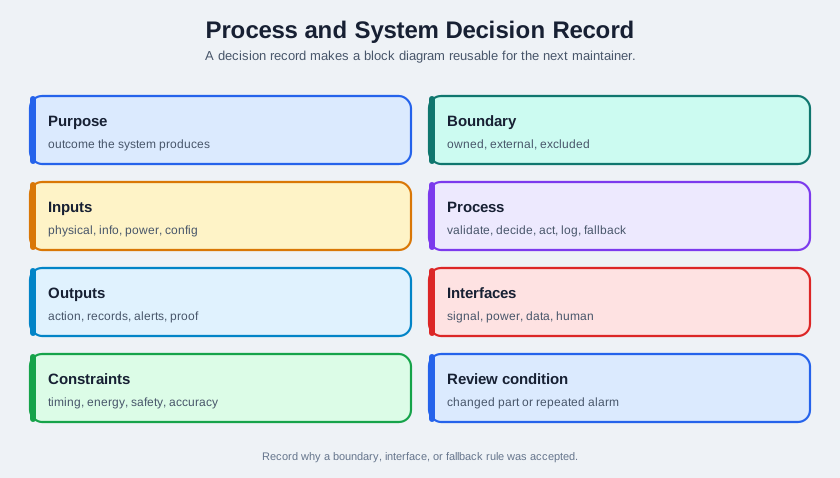
A block diagram shows parts, but it does not record why a choice was safe.

  • A decision record keeps the claim, evidence, and fallback together.
  • Process-and-system decision records make design choices reusable.
  • They also help the next maintainer understand why a block diagram, interface, placement choice, or fallback rule was accepted.
Process-and-system decision record
iotclass.org

Major section

Learning Route · Fundamentals Route Addendum

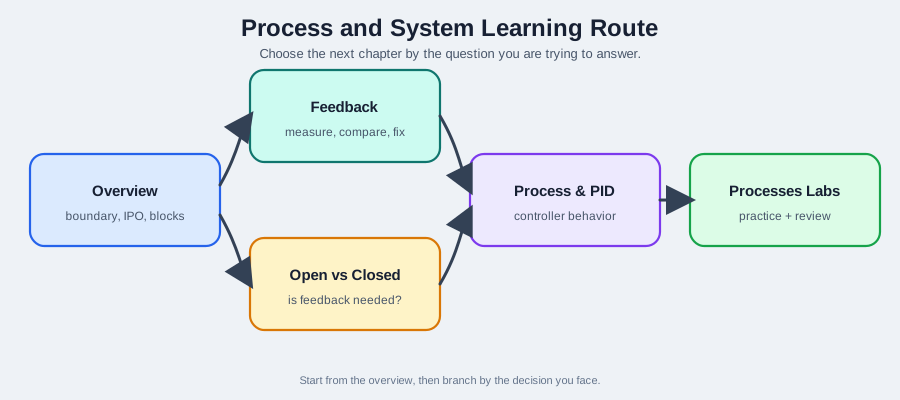
A design is not closed-loop because it has a sensor, and it is not PID because it has a variable output.

  • This route prevents premature labels.
  • The record should show the measurement, comparison, command, output limit, and fallback behavior before the control label is accepted.
Learning route through process and system chapters
iotclass.org

Major section

Cold-Room Door Monitoring · Match the Overview Concepts · Order a Process-and-System Decision
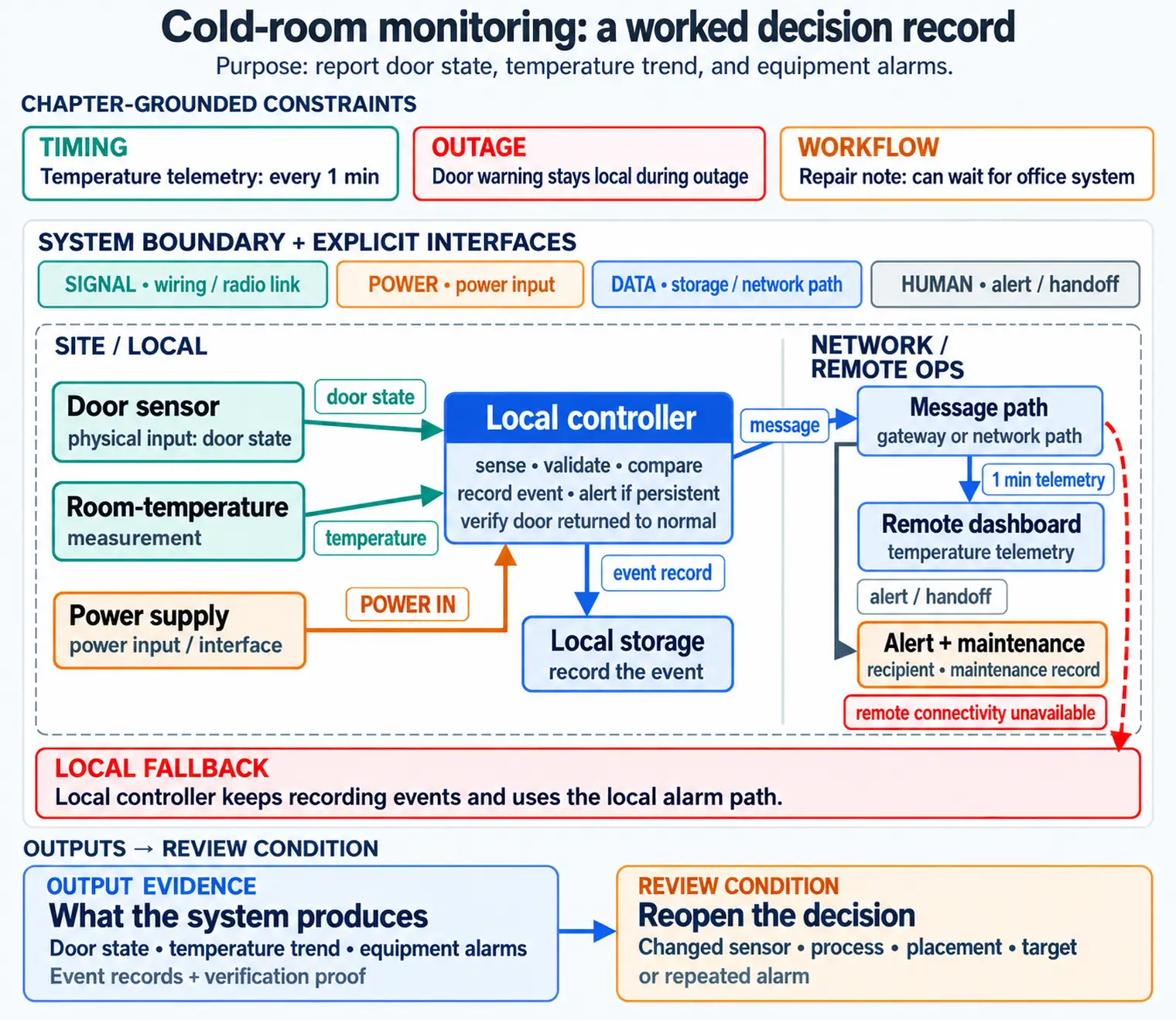
A cold-room monitoring system reports door state, temperature trend, and equipment alarms.

  • A process-and-system overview does not start by choosing a controller.
  • It starts by naming boundaries and flows.
  • Fallback: if remote connectivity is unavailable, the local controller should keep recording events and use the local alarm path if the condition remains unresolved.
  • The overview diagram keeps those later views grounded.
iotclass.org

Major section

Key Concepts · Common Pitfalls

Implementation becomes hard to check when nobody knows what the system owns or which process each block supports.

  • A block diagram should expose responsibilities and flows first.
  • An output is not trustworthy until the design says how it is checked, logged, or escalated.
  • Feedback is one process pattern.
  • The system also needs interfaces, ownership, constraints, and fallback behavior.
iotclass.org

Major section

Communication Models for IoT · Summary · Continue Your Route
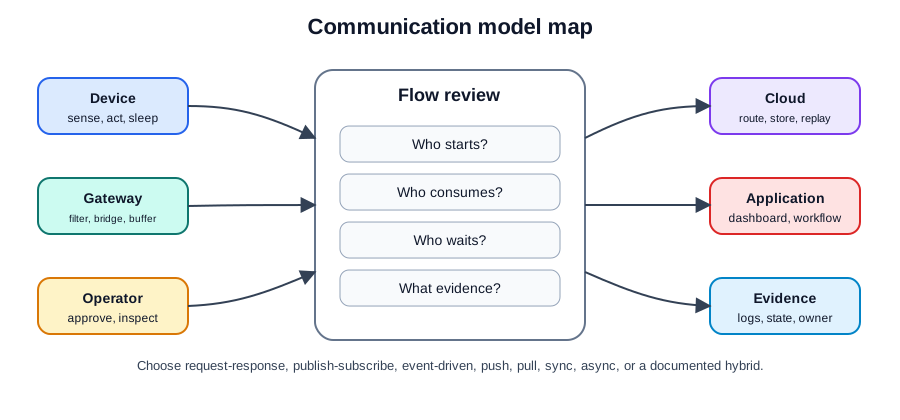
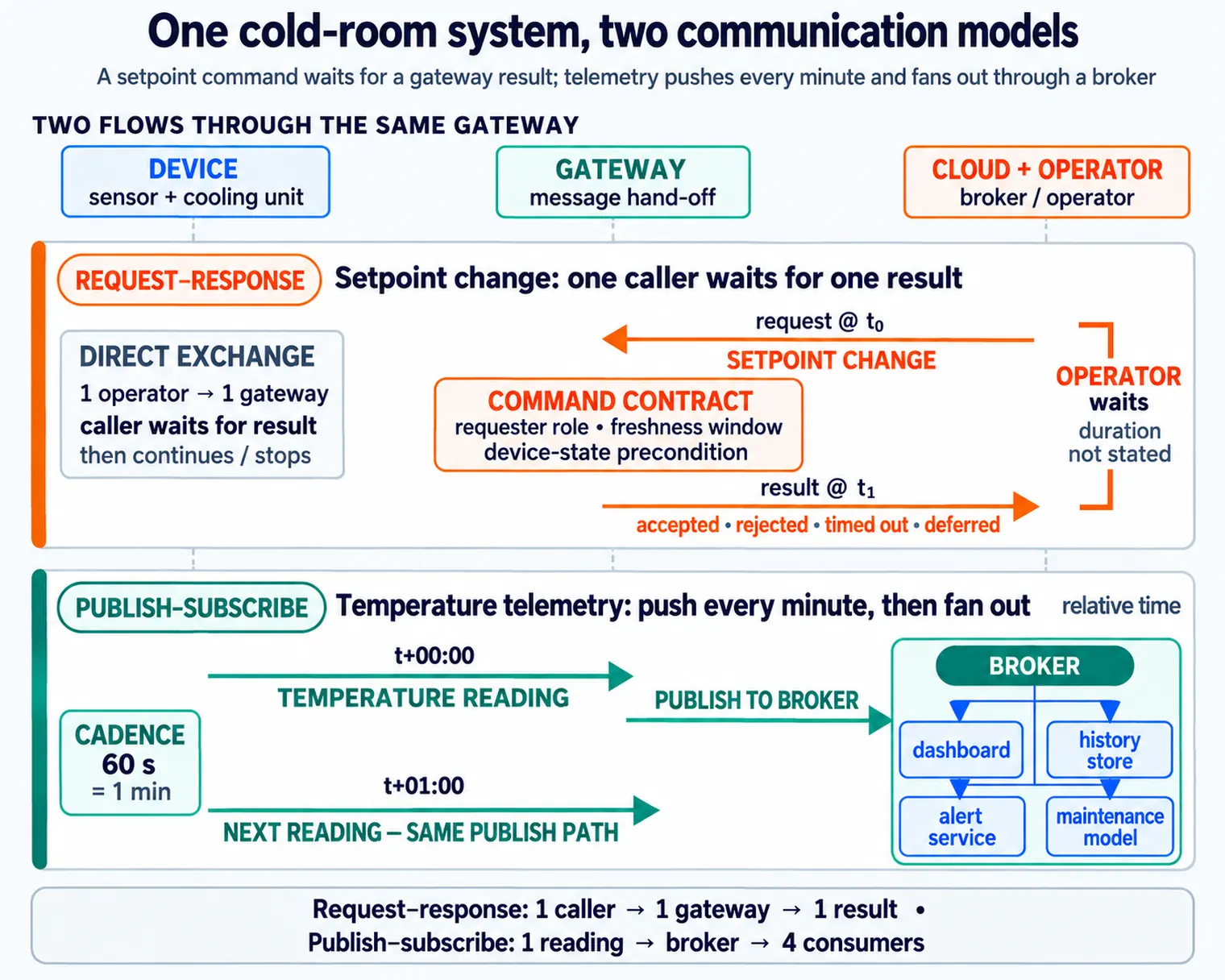
The sensor sends a temperature every minute.

  • A worker can also change the target.
  • An open door must trigger a local warning.
  • A repair note can wait until the office system is ready.
  • These messages do different jobs.

Why it matters

A maintenance report can be queued asynchronously because a technician can wait for a final work-order reference.

Communication models turn message movement into an architecture boundary
iotclass.org

Deck summary

Key takeaways

A block diagram shows parts, but it does not record why a choice was safe.

  • A design is not closed-loop because it has a sensor, and it is not PID because it has a variable output.
  • A cold-room monitoring system reports door state, temperature trend, and equipment alarms.
  • Implementation becomes hard to check when nobody knows what the system owns or which process each block supports.
  • The sensor sends a temperature every minute.
iotclass.org

Retrieval practice

Recall check 1 of 4

Gateway Gus says: answer from memory, then check your reasoning.

Q1A team draws one box labeled 'smart pump system' and immediately starts writing control code. During testing, the pump runs but no one can tell whether the level sensor, local controller, message path, or remote dashboard owns each decision. What should the team ask for first?

AConnector-level wiring for every pump cable before assigning system responsibility.
BA process-and-system block diagram naming boundaries, inputs, outputs, interfaces, fallback, and owners.
CA controller gain table before naming sensor trust, interfaces, or fallback behavior.
DA remote-only design that moves ownership away from the device by default.
Show answer

Answer: B A process-and-system overview should first clarify boundaries, flows, interfaces, and responsibility.

iotclass.org

Retrieval practice

Recall check 2 of 4

Gateway Gus says: answer from memory, then check your reasoning.

Q2In a cold-storage facility, telemetry feeds dashboards, local alarms must survive cloud outage, and operators change compressor setpoints. What should the design split before protocol choice?

APick one familiar protocol and force telemetry, alarms, and commands through it.
BDelay model choices until failures reveal which messages mattered.
CSplit telemetry, alarms, and commands, then document timing, outage, owners, and replay evidence.
DUse publish-subscribe for all messages because it supports many consumers.
Show answer

Answer: C Cold-storage communication design should split telemetry, alarms, and commands because they have different fan-out, waiting, outage, replay, and ownership needs.

iotclass.org

Retrieval practice

Recall check 3 of 4

Gateway Gus says: answer from memory, then check your reasoning.

Q3A cold-storage gateway publishes temperature readings to several consumers, must alarm locally during cloud outage, and accepts operator setpoint changes. Which model split is strongest?

APoll every flow from the cloud so local devices never decide.
BUse request-response for all telemetry and alarms.
CStore only event logs and remove command acknowledgements.
DPublish telemetry, run local alarm events, and request-response setpoints.
Show answer

Answer: D Mixed IoT systems should split telemetry, alarms, commands, and workflows by timing, fan-out, outage behavior, and evidence.

iotclass.org

Retrieval practice

Recall check 4 of 4

Gateway Gus says: answer from memory, then check your reasoning.

Q4Why should the communication review record separate the model from the current protocol?

ABecause protocol details make reliability identical after the model is selected for a flow.
BBecause protocol changes must preserve initiator, consumer, waiting, failure, replay, and owner evidence.
CBecause publish-subscribe should replace direct responses and event handling in production.
DBecause records are diagrams only, not tests, runbooks, or operations evidence.
Show answer

Answer: B Separating model from protocol preserves the behavioral contract when implementation details change.

iotclass.org

Print reference

Answers

Answer key.

  1. B · A process-and-system overview should first clarify boundaries, flows, interfaces, and responsibility.
  2. C · Cold-storage communication design should split telemetry, alarms, and commands because they have different fan-out, waiting, outage, replay, and ownership needs.
  3. D · Mixed IoT systems should split telemetry, alarms, commands, and workflows by timing, fan-out, outage behavior, and evidence.
  4. B · Separating model from protocol preserves the behavioral contract when implementation details change.
iotclass.org