Prototyping · Study deck
Fleet Device Management
Picture fifty water meters fitted in basements.
Voltage Vera is your guide for this deck.
After studying this chapter
Learning objectives
You will be able to:
- Define the device management evidence an IoT prototype should capture before fleet growth.
- Review enrollment, identity, configuration, health, diagnostics, update, and retirement evidence.
- Separate device-management responsibility from cloud, edge, application, firmware, and support work.
- Plan staged rollout evidence with canary groups, pause gates, rollback evidence, and recovery records.
Major section
In 60 Seconds · Start With the Story
A settings change works on the bench unit, yet nobody can tell which field units received it or how to recover one that stopped halfway.
- A fleet begins with one device whose full change path is visible.
- Firmware is the code stored on a device.
- One successful unit does not prove a whole fleet.
Major section
Device Management Proves Fleet
Device management is the difference between a prototype that works while the developer is present and a fleet that another team can enroll, configure, update, diagnose, suspend, replace, and retire.
- The review should prove managed states, not just a successful firmware flash or a list of connected devices.
- The final decision can repeat, extend, or pilot the trial.
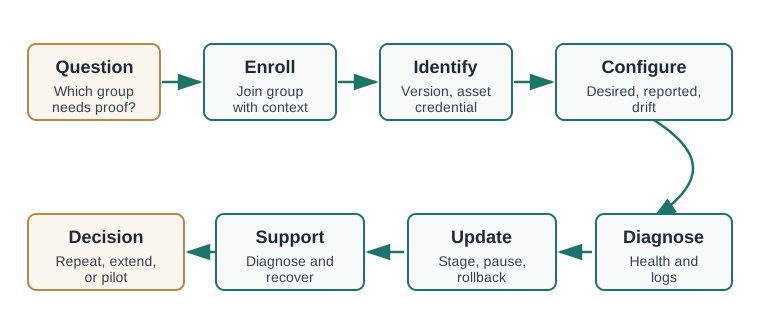
- the A device-management prototype is useful when the fleet question, enrollment proof, identity record, configuration state, diagnostic trail, update result, support action, and next decision stay connected diagram follows one device group from enrollment to support evidence.
- The route in the A device-management prototype is useful when the fleet question, enrollment proof, identity record, configuration state, diagnostic trail, update result, support action, and next decision stay connected diagram asks which fleet group needs proof before a device is enrolled.
Major section
Device Management Proves Fleet (continued)
Joining records the unit and context; identity links version, asset, credential, and owner.
- Configuration then compares desired with reported state so drift is visible.
- Diagnostics add health and logs before a staged update can be paused or rolled back.
- The evidence should connect physical reality to managed state.
Major section
Match Platform to Managed State
If the only support path is a developer shell session, the team has not yet proven operations ownership.
- AWS IoT Device Management Jobs, AWS IoT Fleet Provisioning, and AWS IoT Device Defender can prove cloud-side enrollment, job rollout, and security posture.
- Azure IoT Hub Device Provisioning Service and Device Update for IoT Hub can prove provisioning and staged updates.
- The aim is to prove the shape of fleet control before the organization pays for field growth.
Major section
Match Platform to Managed State (continued)
Mender, Eclipse hawkBit, balenaCloud, Memfault, Golioth, Particle Device Cloud, ThingsBoard, AVSystem Coiote, and LwM2M stacks such as Eclipse Leshan can prove OTA, diagnostics, grouping, device shadow, or constrained-device management patterns.
- If the uncertainty is enrollment, the trial should prove manufacturing id, installer action, credential issue, group assignment, first contact, and ownership transfer.
- If the uncertainty is configuration drift, the trial should prove desired state, reported state, rejection, retry, local fallback, and who can approve the change.
- Enroll one normal device, one device with a credential problem, and one device that goes offline during a change.
Major section
Firmware Supports Managed State
The most important hidden contract is the device state machine.
- A management platform cannot rescue firmware that has no identity boundary, no safe update path, no local health record, or no recovery mode.
- The device, gateway, cloud service, and support workflow all need compatible state machines.
- Diagnostics and support also need privacy and access boundaries.
Major section
Firmware Supports Managed State (continued)
Identity boundary: separate manufacturing id, user-visible asset id, certificate subject, MQTT topic namespace, device-shadow record, and support ticket reference.
- Lifecycle boundary: preserve replacement mapping, credential revocation, data-retention action, final configuration state, and proof that the retired unit can no longer reconnect.
- If the firmware reports only a generic "online" state, the management platform cannot reliably decide whether to continue a rollout, pause it, or ask for field support.
- The prototype should say which of these are real, which are mocked, and which are out of scope for the next pilot.
Major section
Flash Scripts Are Not Management · Evidence Roles in the Managed Fleet Path
Manual flashing can be enough for the bench.
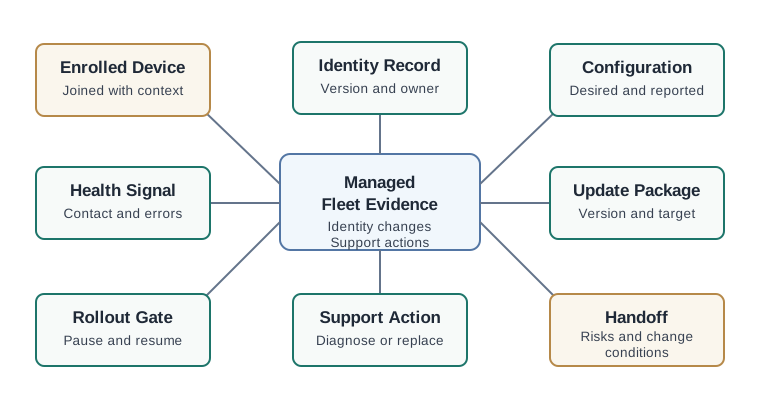
- The evidence must show identity, grouping, version, configuration, health, update state, and support action.
- An enrolled device needs an identity record with version and owner.
- Configuration keeps desired and reported settings together, while health signals show contact and errors.
Major section
Identity Is the Base Layer · Enrollment and Identity Evidence
If the team cannot identify a device, it cannot safely configure, update, support, suspend, replace, or retire that device.
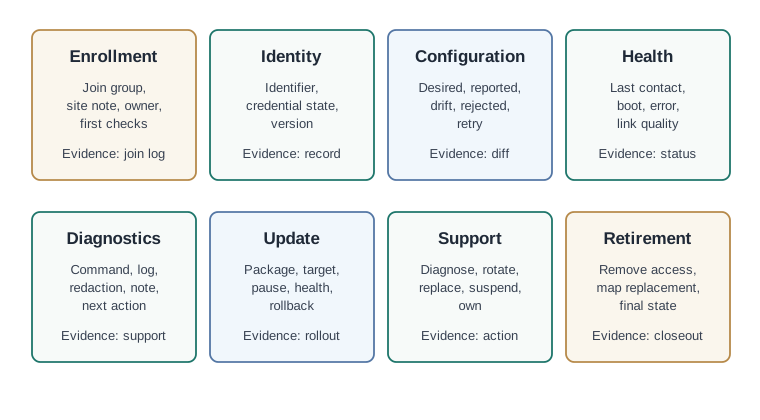
- The first device management review should prove that devices can enter the managed set with enough context to support later decisions.
- Identity and configuration evidence are the foundation for update rollout and support.
- Identity keeps the identifier, credential state, and version; configuration compares desired and reported values and records rejection or retry.
- Health needs last contact, boot, and error signals so stale devices are visible.
Major section
Test Drift Deliberately · Diagnostics and Rollout Limits
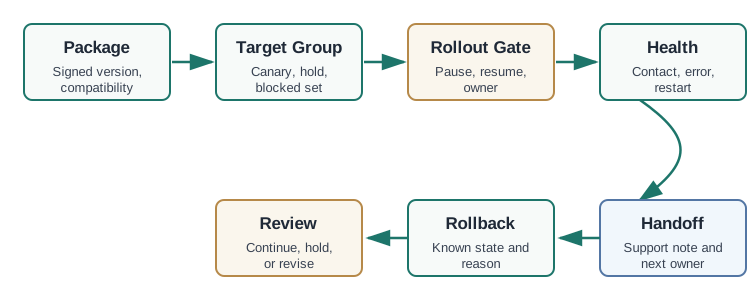
The prototype should prove more than "the update installed." It should show targeting, compatibility, staged rollout, health checks, pause conditions, rollback evidence, and support diagnosis.
- The worked chain starts with three sensors and a staged package.
- Compatibility, credential state, and hardware or storage conditions need a preflight result before the canary is selected.
- the Device management rollout boundary for IoT prototypes diagram tests the cold-room rollout before fleet expansion.
- The canary group then receives the package and reports health; a failed check pauses wider rollout.
Major section
A Rollout Is a Decision Chain · Cold-Room Managed Fleet Trial
A rollout should leave evidence for package readiness, target group, first install, health check, pause or continue decision, rollback case, and final handoff.
- A team has reviewed cold-room devices, cloud ingestion, edge buffering, and operator workflow.
- The next uncertainty is whether a small managed fleet can be enrolled, configured, diagnosed, updated, and supported before a pilot.
- The team does not yet accept the path for a larger pilot because replacement mapping and field retirement still need a repeatable support workflow.
Major section
Fleet Handoff Summary
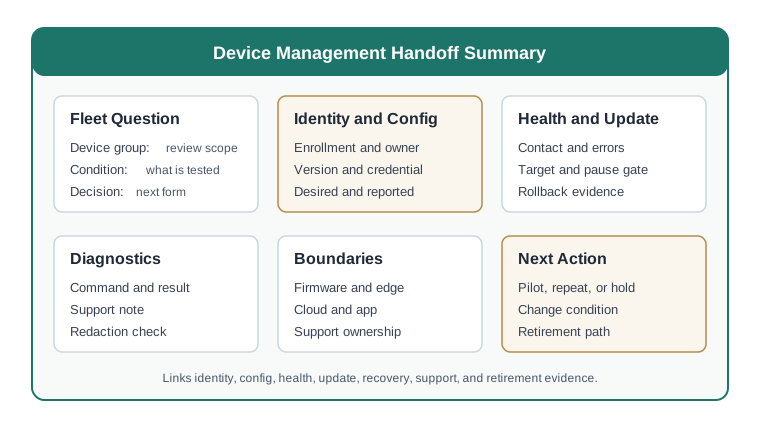
A device management handoff summary should make fleet readiness repeatable.
- It should capture what the managed path proved, what it only mocked, and what would require another run before pilot growth.
- The fleet question identifies which group and tested condition the review covers.
- Identity and configuration fields keep enrollment owner, version, credential state, and desired versus reported values.
Major section
Fleet Handoff Summary (continued)
Diagnostics keep a support command with its observed result, so an operator can tell whether recovery worked.
- The decision should say whether to repeat, extend, or pilot the group and name the next form.
- A rollout pass without those support facts would leave the fleet hard to maintain after the prototype team leaves.
- Weak: The update mechanism works.
Deck summary
Key takeaways
A settings change works on the bench unit, yet nobody can tell which field units received it or how to recover one that stopped halfway.
- Device management is the difference between a prototype that works while the developer is present and a fleet that another team can enroll, configure, update, diagnose, suspend, replace, and retire.
- Joining records the unit and context; identity links version, asset, credential, and owner.
- If the only support path is a developer shell session, the team has not yet proven operations ownership.
- The most important hidden contract is the device state machine.
Retrieval practice
Recall check 1 of 4

Voltage Vera says: answer from memory, then check your reasoning.
Q1Per this chapter's 'Device Management Proves Fleet' section, why is a firmware version alone not enough evidence for fleet readiness?
Show answer
Answer: B see answers page
Retrieval practice
Recall check 2 of 4
Voltage Vera says: answer from memory, then check your reasoning.
Q2Per this chapter's per-category evidence guidance, what should a 'diagnostics' record specifically include?
Show answer
Answer: D see answers page
Retrieval practice
Recall check 3 of 4
Voltage Vera says: answer from memory, then check your reasoning.
Q3Per this chapter's 'Firmware Supports Managed State' section, why can't a management platform reliably decide whether to continue, pause, or escalate a rollout if firmware only reports a generic 'online' state?
Show answer
Answer: D see answers page
Retrieval practice
Recall check 4 of 4
Voltage Vera says: answer from memory, then check your reasoning.
Q4A prototype has several cold-room sensor devices. The next risk is whether the team can enroll them, identify each one, change configuration, detect drift, stage an update, and recover a failed update. What should the first device management evidence loop test?
Show answer
Answer: B Device management evidence should prove enrollment, identity, configuration, diagnostics, staged update, pause gates, rollback, support action, and retirement boundaries under representative conditions.
Print reference
Answers 1 of 3
Answer key.
- B · The chapter gives three parallel examples of single facts that are not enough evidence on their own: a serial number needs a support-dashboard mapping to the installed asset, a firmware version needs package/signing-key/target-group/install-result/rollback-state context, and a configuration value needs desired-state/reported-state/rejected-value/last-writer context.
Print reference
Answers 2 of 3
Answer key.
- D · The chapter gives each evidence category its own record fields: provisioning needs serial number and certificate identity, configuration needs desired/reported state, diagnostics needs reset reason/boot count/crash signature/RSSI/battery voltage, and rollout needs package id/signing key/canary result/rollback version.
Print reference
Answers 3 of 3
Answer key.
- D · The chapter calls the device state machine the 'most important hidden contract': firmware must report boot slot, package version, configuration version, monotonic install attempt, last successful check-in, power condition, storage headroom, network class, reset reason, watchdog state, and rollback possibility -- a generic 'online' state collapses all of this into one fact the platform cannot act on safely.
- B · Device management evidence should prove enrollment, identity, configuration, diagnostics, staged update, pause gates, rollback, support action, and retirement boundaries under representative conditions.