Prototyping · Study deck

Cloud IoT Platforms

Picture a workshop prototype that sends room readings to a hosted service.

Voltage Vera is your guide for this deck.

platformscloud
iotclass.org

After studying this chapter

Learning objectives

You will be able to:

  • Define the evidence a cloud platform should expose for an IoT prototype.
  • Review device identity, authentication, ingestion, routing, and state visibility without committing to a full production architecture.
  • Separate cloud convenience from data ownership, operations, edge behavior, and support workflow.
  • Build a cloud evidence trial that includes normal operation, invalid messages, disconnects, stale state, and recovery.
iotclass.org

Major section

In 60 Seconds · Start With the Story

A chart moves and an alert arrives, so the demo looks complete.

  • The support lead still needs to know who trusted the device, where each record went, how old state is shown, and how the team recovers from failure.
  • The hosted service may store history, route work, and notify people, but it must not silently become the only safety control.
  • This opening does not choose a permanent vendor or final scale.

Why it matters

A cloud platform can make a prototype look operational because messages arrive, charts update, and rules fire.

iotclass.org

Major section

Cloud Platforms Prove Boundaries · Test Operator-Owned Path
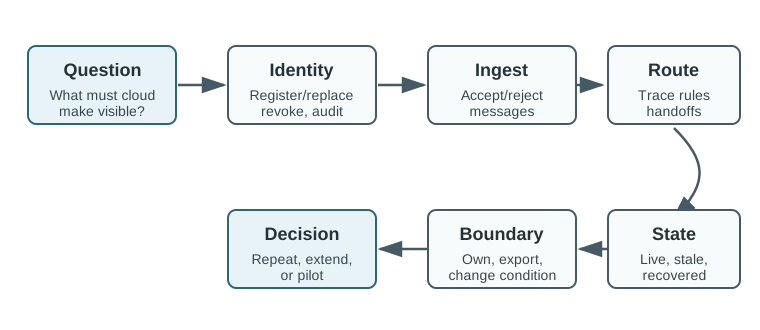
A prototype that only proves "the device reached the cloud" has not yet answered the useful question.

  • A representative device should authenticate with the intended credential form, publish a versioned payload, hit the intended topic or endpoint, route into a reviewable destination, and leave a visible state record.
  • A cloud IoT platform should make a boundary visible: where device identity is trusted, where messages enter, where rules route data, where state becomes stale, where data leaves the managed service, and where operators can see recovery evidence.
  • The prototype is not choosing a permanent cloud architecture yet.
A cloud platform prototype is useful when the question, identity proof, ingestion path, routing trace, state review, ownership boundary, and next decision stay connected.
iotclass.org

Major section

Managed Services Hide Ownership

Managed platforms absorb certificate handling, endpoint scaling, retry queues, state stores, metrics, dashboards, alerting, and integrations.

  • That speed is useful, but it can hide who owns schema drift, quota limits, retention, replay, alert fatigue, access changes, and support handoff.
  • The prototype should expose those ownership boundaries before the team confuses a quick managed path with an architecture decision.
  • The key technical boundary is the contract between device evidence and cloud state.
iotclass.org

Major section

Managed Services Hide Ownership (continued)

Device identity may be represented by an X.509 certificate, symmetric key, token, SIM identity, or gateway-assigned identity.

  • Payloads may be JSON, CBOR, SenML, Protobuf, or another contract with units, timestamps, version fields, status flags, and error fields.
  • Routing rules may forward data into streams, queues, object storage, time-series storage, dashboards, webhooks, alerts, or analytics jobs.
  • A strong cloud prototype names what stays portable and what becomes platform-specific.
iotclass.org

Major section

Ingestion Is Not the Review · Evidence Roles in the Cloud Path
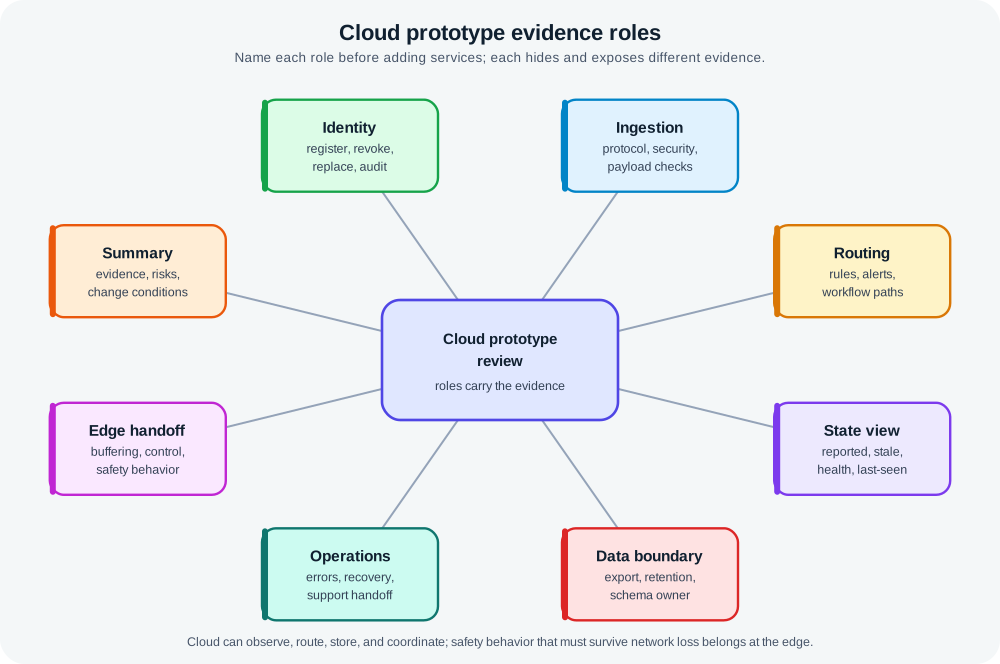
The review also needs invalid payloads, lost connections, duplicate messages, stale state, permission failure, and recovery notes.

  • Identity records must show registration, replacement, revocation, and audit events for representative devices.
  • Ingestion needs accepted and rejected payloads with protocol and security checks.
  • the Cloud IoT evidence roles for prototype review diagram separates cloud identity, ingestion, routing, and state evidence.
  • Routing needs rule intent and alert handoffs, while the state view must distinguish live, stale, and recovered devices.
Cloud IoT evidence roles for prototype review
iotclass.org

Major section

Cloud Is Not the Same as Remote Control · Ingestion and Identity Evidence

Cloud services can observe, route, store, and coordinate.

  • They should not hide safety behavior that must continue locally during network loss or service delay.
  • The first serious cloud review is identity plus ingestion.
  • Known device: Registered device connects, publishes the expected payload, and updates last-seen state.
iotclass.org

Major section

Routing, State, and Data Boundaries · Keep Payload Contracts Visible
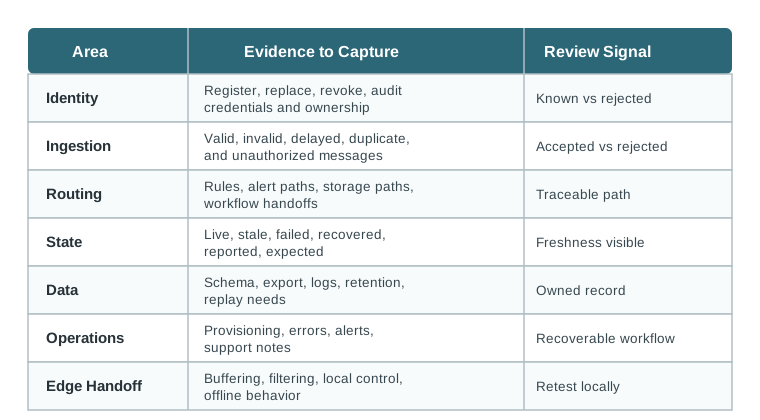
A cloud service can make these paths easy to assemble, but the prototype still needs to show where the data goes and who can explain it later.

  • Cloud routing should not bury the payload contract inside a rule editor or private notebook.
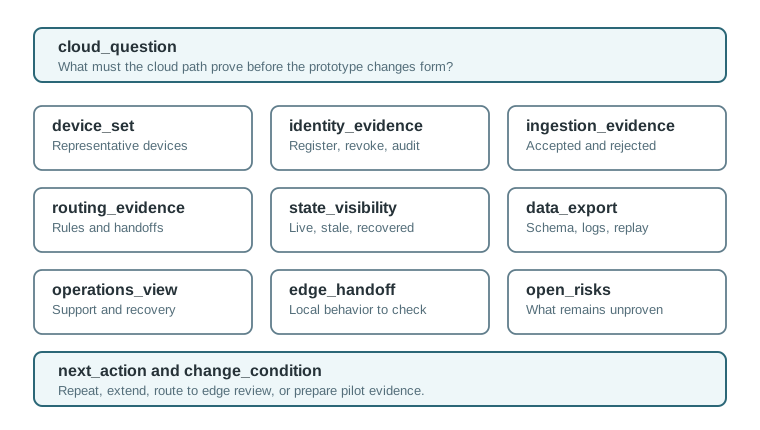
  • In the Evidence matrix for cloud IoT platform review diagram, After ingestion works, the review moves to routing and state.
Evidence matrix for cloud IoT platform review
iotclass.org

Major section

Operations and Exit Boundaries

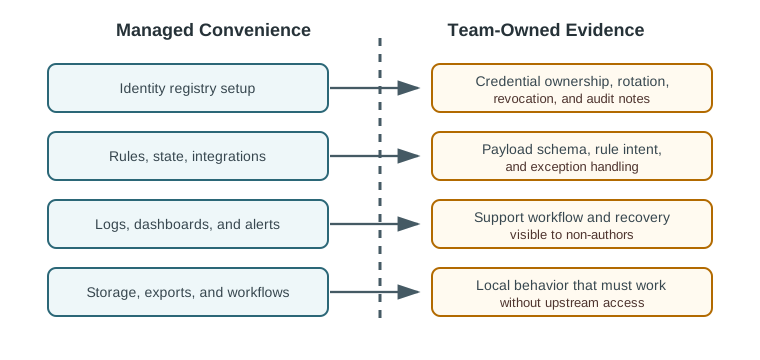
The more a platform does for the team, the more important it is to record what remains under team control.

  • Managed identity, rules, dashboards, storage, and exports can speed a trial.
  • The team must still decide who rotates credentials, approves payload fields and exceptions, reviews rule changes, and supports recovery.
  • the Cloud platform boundary review for IoT prototypes diagram separates managed service convenience from evidence the team must own.
  • The boundary in the Cloud platform boundary review for IoT prototypes diagram separates services the platform provides from records the team still owns.
Cloud platform boundary review for IoT prototypes
iotclass.org

Major section

Portability Needs Evidence · Worked Scenario: Cold-Room Cloud Trial

Using a common protocol helps, but portability also depends on identity, routing rules, schema, logs, data export, dashboards, operations workflow, and local fallback.

  • A team has already proven a battery-powered cold-room sensor node.
  • The next uncertainty is whether a managed cloud path can make device state, stale readings, and alert acknowledgement visible before a small pilot.
  • The team runs three representative devices through normal operation, wrong credentials, malformed payloads, gateway outage, delayed messages, duplicate messages, and recovery.
iotclass.org

Major section

Cloud Handoff Summary

A cloud platform handoff summary should make the decision repeatable.

  • It should capture what the cloud path proved, what it hid, and what remains open.
  • Identity evidence records registration, revocation, and audit; ingestion evidence includes accepted and rejected payloads.
  • Routing shows which rules fired and where a notice went.
  • Operations notes identify who handles exceptions and support.
Handoff summary template for cloud IoT platform evaluation
iotclass.org

Major section

Cloud Handoff Summary (continued)

The state view must make live, stale, and recovered conditions visible, and an export must preserve schema and logs for replay.

  • Good: Revoked device was rejected, the failed connection was logged, and the support view showed the affected device identity.
  • Weak: The platform supports secure device authentication.
  • Weak: The platform has dashboards and routing rules.
iotclass.org

Deck summary

Key takeaways

A chart moves and an alert arrives, so the demo looks complete.

  • A prototype that only proves "the device reached the cloud" has not yet answered the useful question.
  • Managed platforms absorb certificate handling, endpoint scaling, retry queues, state stores, metrics, dashboards, alerting, and integrations.
  • Device identity may be represented by an X.509 certificate, symmetric key, token, SIM identity, or gateway-assigned identity.
  • The review also needs invalid payloads, lost connections, duplicate messages, stale state, permission failure, and recovery notes.
iotclass.org

Retrieval practice

Recall check 1 of 4

Voltage Vera says: answer from memory, then check your reasoning.

Q1Per this chapter's 'Cloud Platforms Prove Boundaries' section, which example does the chapter give for showing that downstream data is inspectable outside the dashboard?

AA queue, object-store export, or time-series table
BMQTT over TLS with an authenticated device identity
CX.509 certificates in a managed identity service
DJSON Schema or Protobuf as the export artifact
Show answer

Answer: A see answers page

iotclass.org

Retrieval practice

Recall check 2 of 4

Voltage Vera says: answer from memory, then check your reasoning.

Q2Per this chapter's guidance for testing the operator-owned path, why should network-specific metadata for Sigfox, LoRaWAN, or NB-IoT be recorded separately from the cloud platform evidence?

ATo let a cloud upload alone prove the operator path after radio diagnostics.
BTo show that a cloud platform cannot ingest low-power network messages.
CTo make radio delivery sufficient acceptance while cloud results stay optional.
DTo separate radio-network delay or rejection from cloud-platform effects.
Show answer

Answer: D see answers page

iotclass.org

Retrieval practice

Recall check 3 of 4

Voltage Vera says: answer from memory, then check your reasoning.

Q3Per this chapter's 'Managed Services Hide Ownership' section, which of the following does the chapter list as easier to carry forward (more portable) rather than platform-specific?

APrivate rule editors, unversioned dashboard queries, hidden device-shadow logic, and manual console steps
BManaged device twins and serverless functions, since these are always vendor-neutral by design
CMQTT topics, schemas, CloudEvents fields, OpenTelemetry traces, CSV/Parquet exports and API contracts.
DRetry queues and state stores, since the chapter treats these as the most portable artifact of all
Show answer

Answer: C see answers page

iotclass.org

Retrieval practice

Recall check 4 of 4

Voltage Vera says: answer from memory, then check your reasoning.

Q4A prototype can publish one valid sensor reading to a cloud endpoint. The next risk is whether operators can see stale state and whether engineers can review rejected identities and malformed payloads. What should the next cloud evidence loop test?

AAdd stale-state widgets and alert cards, then leave identity rejection tests for launch
BTest accepted and rejected identity, invalid payload, delay, route trace and recovery.
CTreat one successful publish as proof, and document malformed payload handling later
DMove local safety behavior into cloud rules, then skip upstream-loss recovery checks
Show answer

Answer: B Cloud platform evidence should cover accepted and rejected identities, valid and invalid payloads, route traces, stale state, disconnects, delayed messages, and recovery records.

iotclass.org

Print reference

Answers 1 of 4

Answer key.

  1. A · The chapter pairs each evidence claim with a specific example: MQTT over TLS proves secure publish, X.509 certificates prove identity handling, JSON Schema or Protobuf make payloads reviewable, and a queue, object-store export, or time-series table proves downstream data is inspectable outside the dashboard.
iotclass.org

Print reference

Answers 2 of 4

Answer key.

  1. D · The chapter gives protocol-specific recording guidance for MQTT, HTTP callback/webhook, and low-power networks, and specifically calls out separating LPWAN network metadata from cloud platform evidence so a delay or rejection can be attributed to the correct layer rather than blamed on the cloud service by default.
iotclass.org

Print reference

Answers 3 of 4

Answer key.

  1. C · The chapter draws a specific line between portable and platform-specific artifacts: MQTT topics, payload schemas, CloudEvents-style fields, OpenTelemetry-style traces, exported CSV/Parquet files, and documented API contracts carry forward more easily than private rule editors, unversioned dashboard queries, hidden device-shadow logic, or manual console steps -- and the handoff record should name exactly which platform-specific behaviors must be rebuilt, exported, or accepted as lock-in.
iotclass.org

Print reference

Answers 4 of 4

Answer key.

  1. B · Cloud platform evidence should cover accepted and rejected identities, valid and invalid payloads, route traces, stale state, disconnects, delayed messages, and recovery records.
iotclass.org