Design Patterns · Study deck
Device State Machines: Transition Contracts
Every transition should be readable enough that firmware, cloud, QA, and operations teams can review it together.
Blueprint Bina is your guide for this deck.

After studying this chapter
Learning objectives
You will be able to:
- Explain: This distinction carries the running transition contract into the cloud: version the request, apply it idempotently on the device, and acknowledge the resulting reported state before declaring reconciliation complete.
- Explain: A connection state machine protects the device from chaotic reconnect behavior and gives the cloud a clear view of whether the device is online, degraded, or intentionally disabled.
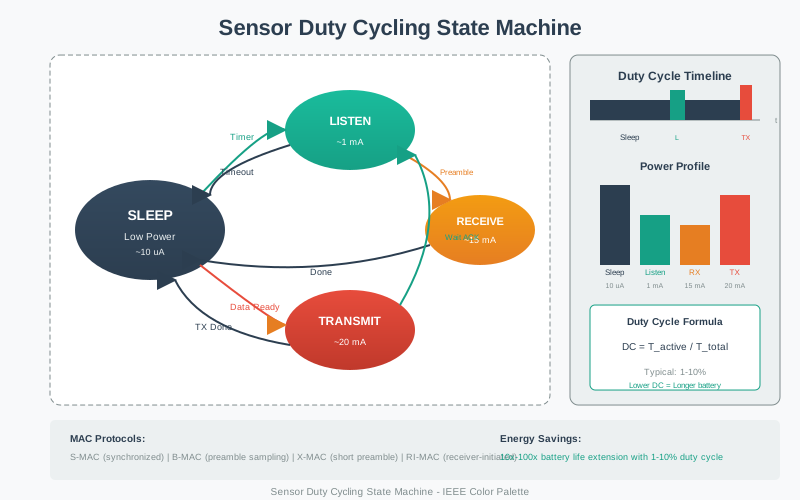
- Explain: A received packet moves into: Receive, whereas local data takes the: Transmit path and waits at: Wait ACK before the cycle can close.
- Explain: The pattern therefore connects transition timing and acknowledgement policy to the battery-life claim.
Major section
Transition Contract
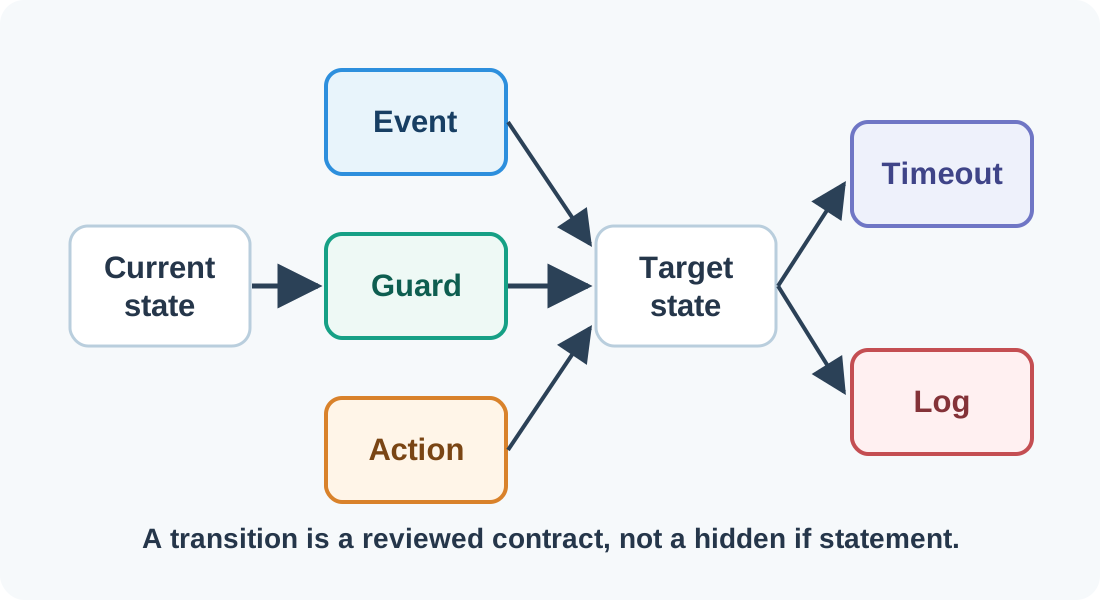
Every transition should be readable enough that firmware, cloud, QA, and operations teams can review it together.
- Current state: The only mode where this transition is valid.
- For safety paths, this should often be SAFE_OFF, ERROR, or LOCKOUT.
Major section
Pattern 1: Connection Lifecycle
A connection state machine protects the device from chaotic reconnect behavior and gives the cloud a clear view of whether the device is online, degraded, or intentionally disabled.
- Offline: Radio or client is inactive.
- Credentials may be missing, provisioning may be incomplete, or a retry delay may be running.
- Online: The session is established.
Major section
Pattern 1: Connection Lifecycle (continued)
Connecting: The device activates the network, starts a bounded connection attempt, and waits for success or timeout.
- Heartbeats, subscriptions, telemetry, and command channels are active.
- Degraded: The device cannot reach the cloud but can still sample, buffer, or run local safety rules.
- Connection retries need backoff, jitter, and a maximum local buffer policy.
Major section
Pattern 2: Sampling and Power
Sampling state machines keep energy, latency, and data quality decisions visible.
- Energy claims need a time sequence, not just a list of modes.
- A received packet moves into: Receive, whereas local data takes the: Transmit path and waits at: Wait ACK before the cycle can close.
Major section
Pattern 2: Sampling and Power (continued)
The pattern therefore connects transition timing and acknowledgement policy to the battery-life claim.
- The next event may be a timer, interrupt, command, or safety alarm.
- The device filters, compresses, aggregates, or classifies data while the active budget remains available.
- The device sends data if the network is available and a deadline remains.
Major section
Pattern 3: Actuator Safety
Actuator state machines need stricter recovery rules than telemetry workflows.
- The safe state should be easy to enter, and dangerous states should be hard to re-enter accidentally.
- Armed: Preconditions are satisfied, but motion or output has not started.
- Guards are checked again before activation.
- Active: The actuator is moving or energized.
Major section
Pattern 4: Cloud Shadow Reconciliation
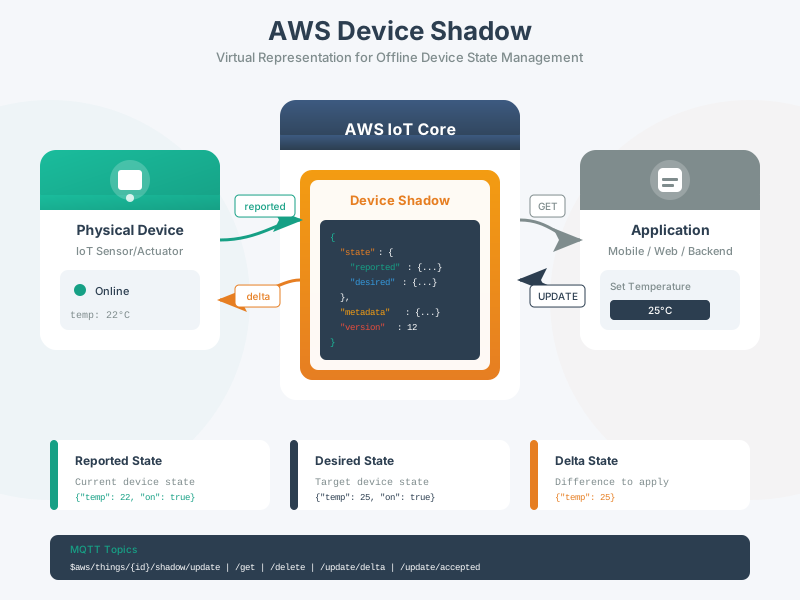
Cloud shadows, device twins, and desired-reported property models are state reconciliation patterns.
- They work best when the device treats cloud instructions as events and reports its actual state honestly.
- Cloud reconciliation becomes unsafe when desired and observed state are treated as one value.
- The cloud records an intended configuration or command.
Major section
Pattern 4: Cloud Shadow Reconciliation (continued)
The delta exists only while those values differ; it is not proof that the actuator already changed.
- This distinction carries the running transition contract into the cloud: version the request, apply it idempotently on the device, and acknowledge the resulting reported state before declaring reconciliation complete.
- The device has accepted a desired change and is attempting local work.
- The device rejects an invalid, stale, unsafe, or unsupported desired state and reports why.
Major section
Hierarchical and Parallel State Machines
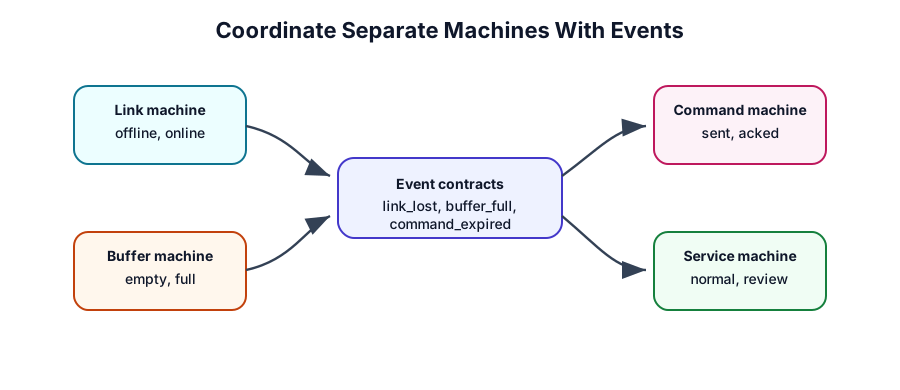
Simple FSMs are enough for many devices.
- When the state count grows, use hierarchy or parallel regions rather than multiplying every combination into a new flat state.
- One flat machine would multiply every link, buffer, command, and service mode into an unmanageable cross-product.
- Hierarchical States.
Major section
Hierarchical and Parallel State Machines (continued)
When the link changes from offline to online, it can emit an event that lets the buffer flush without rewriting command logic.
- The event contracts preserve coordination while keeping each machine testable, which is the reason to introduce parallel state machines here.
- For example, CONNECTED can contain IDLE, SAMPLING, and TRANSMITTING, while connection-loss handling remains defined once at the parent level.
- A device may have one state machine for connectivity and another for actuator safety.
Major section
Architecture Review Checklist
Waiting states: Every waiting state has timeout and cancellation behavior.
- Event inventory: External events, internal timers, watchdog warnings, cloud commands, operator actions, and sensor faults are all named.
- Transition contract: Each transition defines source, event, guard, target, action, timeout, and log behavior.
- Persistence: The design identifies which state is persisted across reboot and which state must be recomputed.
Major section
Common Pitfalls
Many flags can create impossible combinations.
- Waiting forever for a packet, sensor, or acknowledgement is a field failure waiting to happen.
- Some faults should require inspection, manual reset, or a service workflow before reactivation.
Deck summary
Key takeaways
Every transition should be readable enough that firmware, cloud, QA, and operations teams can review it together.
- A connection state machine protects the device from chaotic reconnect behavior and gives the cloud a clear view of whether the device is online, degraded, or intentionally disabled.
- Connecting: The device activates the network, starts a bounded connection attempt, and waits for success or timeout.
- Sampling state machines keep energy, latency, and data quality decisions visible.
- The pattern therefore connects transition timing and acknowledgement policy to the battery-life claim.
Retrieval practice
Recall check 1 of 5

Blueprint Bina says: answer from memory, then check your reasoning.
Q1A state machine has a WAIT_FOR_ACK state after sending an actuator command. The diagram only shows the transition when the acknowledgement arrives. What is the most important missing transition?
Show answer
Answer: D Every state that waits for an external event needs a timeout path.
Retrieval practice
Recall check 2 of 5

Blueprint Bina says: answer from memory, then check your reasoning.
Q2A pump controller enters EMERGENCY_STOP after a pressure sensor fault. Which recovery rule is safest for a serious repeated fault?
Show answer
Answer: A Serious or repeated actuator faults should move toward safe off or lockout.
Retrieval practice
Recall check 3 of 5

Blueprint Bina says: answer from memory, then check your reasoning.
Q3A device model has connection states, power states, and actuator states. The team starts creating combined states such as CONNECTED_SLEEP_ARMED and RECONNECTING_SAMPLE_ACTIVE. What is the likely design problem?
Show answer
Answer: C State explosion happens when one flat machine combines independent dimensions.
Retrieval practice
Recall check 4 of 5

Blueprint Bina says: answer from memory, then check your reasoning.
Q4Place each control where it lives so you can review whether every device transition has an allowed trigger, effect, and recovery path.
Show answer
Answer: A These regions connect the decision from evidence to action so you can review whether every device transition has an allowed trigger, effect, and recovery path.
Q5Complete the table-driven state machine dispatch method:
Show answer
Answer: A A table-driven FSM keeps the current state, looks up transitions by (state, event), logs rejected events, runs the transition action, and then records the target state.
Retrieval practice
Recall check 5 of 5

Blueprint Bina says: answer from memory, then check your reasoning.
Q6Why should state transitions be logged with previous state, event, target state, and timestamp?
Show answer
Answer: C Transition logs make state-machine behavior observable.
Print reference
Answers 1 of 2
Answer key.
- D · Every state that waits for an external event needs a timeout path.
- A · Serious or repeated actuator faults should move toward safe off or lockout.
- C · State explosion happens when one flat machine combines independent dimensions.
- A · These regions connect the decision from evidence to action so you can review whether every device transition has an allowed trigger, effect, and recovery path.
Print reference
Answers 2 of 2
Answer key.
- A · A table-driven FSM keeps the current state, looks up transitions by (state, event), logs rejected events, runs the transition action, and then records the target state.
- C · Transition logs make state-machine behavior observable.