Design Methodology · Study deck

Sensor Selection: Requirements and Candidate Screening

A sensor shortlist starts with limits for range, error, heat, and power.

Blueprint Bina is your guide for this deck.

specsheetsensor
Blueprint Bina, the module guide, in a scene from this chapter.
iotclass.org

After studying this chapter

Learning objectives

You will be able to:

  • Explain: A BME280 can be a viable candidate if the product also needs barometric pressure; a Sensirion SHT31-DIS-style humidity sensor may be a better-focused candidate when pressure is irrelevant.
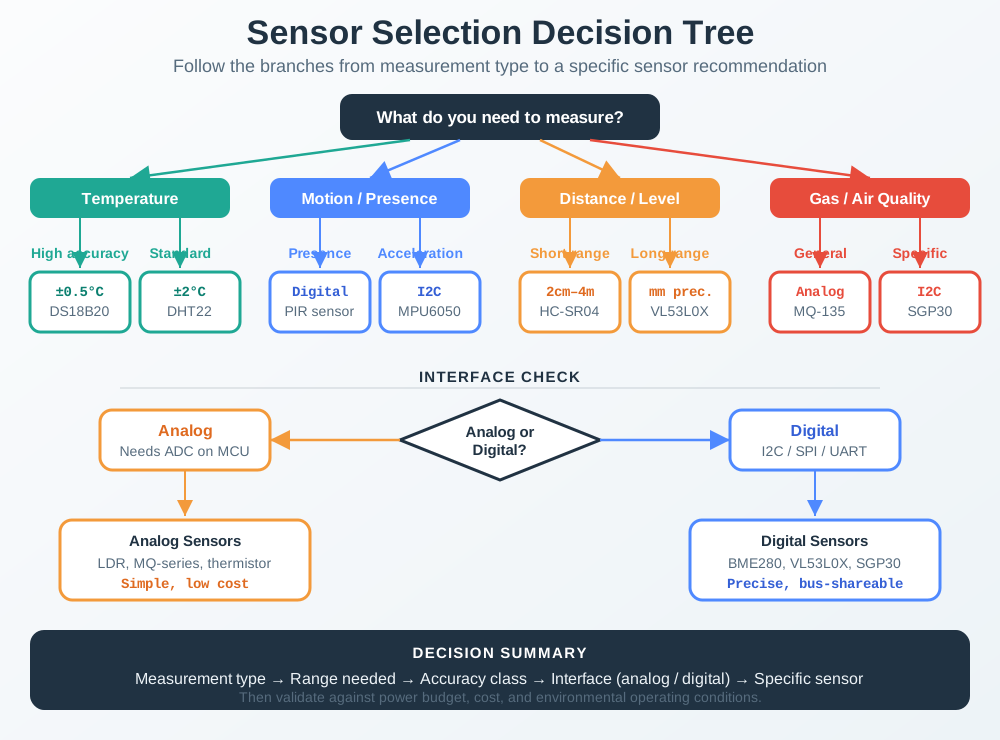
  • Explain: Reading: PIR sensor against: Short range clarifies the practical meaning of A sensor shortlist should start from the measured quantity and interface constraints before comparing individual part numbers.
  • Explain: Environmental node Pressure, humidity, temperature Gate on operating range, accuracy over temperature, recovery from condensation, enclosure airflow, supply, current, and calibration needs.
  • Explain: Current by mode, conversion time, startup time, duty-cycle assumptions, and regulator limits.
iotclass.org

Major section

Requirements Before Parts
The brief can be short, but it must be specific enough to reject a candidate.

  • Reading: PIR sensor against: Short range clarifies the practical meaning of A sensor shortlist should start from the measured quantity and interface constraints before comparing individual part numbers.
  • Current by mode, conversion time, startup time, duty-cycle assumptions, and regulator limits.
A sensor shortlist should start from the measured quantity and interface constraints before comparing individual part numbers.
iotclass.org

Major section

Mandatory Gates First

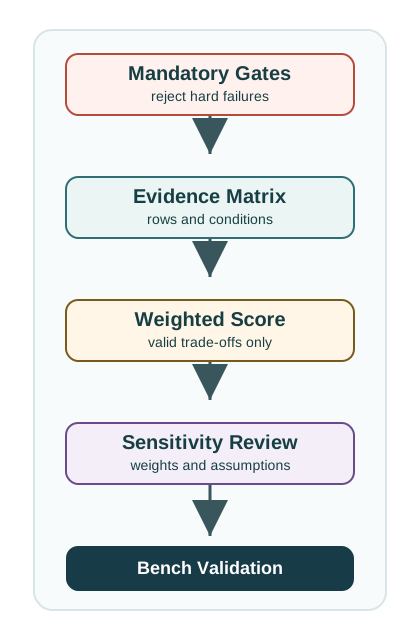
A gate has a pass, fail, or investigate result.

  • Host logic exceeds sensor I/O limit.
  • Sensor saturates before the required event is captured.
  • Worst-case error is within the required limit under relevant conditions.
  • Average and peak current fit regulator, battery, thermal, and firmware assumptions.

Key terms

Sensor opening
Sensor opening is blocked by coating or enclosure.
iotclass.org

Major section

Incremental Examples

A classroom comfort sensor needs temperature and humidity updates every few minutes, not pressure or high-rate motion.

  • A BME280 can be a viable candidate if the product also needs barometric pressure; a Sensirion SHT31-DIS-style humidity sensor may be a better-focused candidate when pressure is irrelevant.
  • The first gate is not brand preference.
  • A wearable fall-detection prototype might compare LIS3DH and ADXL345-style accelerometers.
iotclass.org

Major section

Power Review Without False Precision

For battery systems, record every state that the firmware can enter.

  • Average current is only meaningful when the duty cycle is realistic.
  • Short bursts can exceed regulator or battery pulse limits.
  • Measured current after final board leakage and pullups are included.
  • Board leakage can dominate the sensor datasheet value.
iotclass.org

Major section

Interface and Firmware Checks

The selected sensor must match both hardware and firmware, not just the block diagram.

  • Schematic review and absolute maximum pin limits.
  • Bus speed, setup, hold, conversion, and interrupt timing.
  • Driver reads before data is valid.
  • Firmware assumes a default mode that the part does not use.
iotclass.org

Major section

Application Snapshots

The best sensor depends on the project requirements and final evidence.

  • Wearable motion Accelerometer or IMU Gate on range, output data rate, current states, package, interface, interrupt behavior, and mounting orientation.
  • Environmental node Pressure, humidity, temperature Gate on operating range, accuracy over temperature, recovery from condensation, enclosure airflow, supply, current, and calibration needs.
  • A scorecard cannot replace safety analysis.
iotclass.org

Deck summary

Key takeaways

The brief can be short, but it must be specific enough to reject a candidate.

  • A gate has a pass, fail, or investigate result.
  • A classroom comfort sensor needs temperature and humidity updates every few minutes, not pressure or high-rate motion.
  • For battery systems, record every state that the firmware can enter.
  • The selected sensor must match both hardware and firmware, not just the block diagram.
iotclass.org

Retrieval practice

Recall check 1 of 3

Blueprint Bina says: answer from memory, then check your reasoning.

Q1Place each selection artifact where it lives so you can choose a sensor that survives the environment and supports a claim you can verify on the bench.

ASensing Claim
BMandatory Gates
CDatasheet Evidence
DTrade-off Scoring
EBench Checks
FSelection Summary
Show answer

Answer: A Place each selection artifact where it lives so you can choose a sensor that survives the environment and supports a claim you can verify on the bench.

iotclass.org

Retrieval practice

Recall check 2 of 3

Blueprint Bina says: answer from memory, then check your reasoning.

Q2A candidate sensor has the highest weighted score, but its recommended operating temperature range does not cover the deployment environment. What should the review do?

AReject it unless the requirement or deployment environment is formally changed and verified.
BKeep it because a high weighted score can outweigh one formal operating-temperature requirement miss.
CAverage the temperature score with power and cost to hide the issue.
DUse the absolute maximum temperature rating as the normal operating range.
Show answer

Answer: A Mandatory requirements must pass before scoring begins.

iotclass.org

Retrieval practice

Recall check 3 of 3

Blueprint Bina says: answer from memory, then check your reasoning.

Q3A low-power sensor datasheet lists active current, sleep current, and startup time. What should the power review include before accepting a battery-life claim?

ADuty-cycle estimate plus final-board current for startup, interface, sleep, active, leakage, and derating.
BUse sleep current plus nominal battery capacity and assume startup, interface current, leakage, and derating are negligible.
COnly the active-current number, because it is the largest current.
DNo review is needed if the part has a low-power mode.
Show answer

Answer: A A defensible power claim combines datasheet rows, firmware state timing, measured board current, and battery assumptions.

iotclass.org

Print reference

Answers

Answer key.

  1. A · Place each selection artifact where it lives so you can choose a sensor that survives the environment and supports a claim you can verify on the bench.
  2. A · Mandatory requirements must pass before scoring begins.
  3. A · A defensible power claim combines datasheet rows, firmware state timing, measured board current, and battery assumptions.
iotclass.org