Design Methodology · Study deck
Sensor Selection: Evidence Before Preference
A sensor wins only if its data sheet supports the product claim.
Blueprint Bina is your guide for this deck.
After studying this chapter
Learning objectives
You will be able to:
- Explain: Replacing a sensor later can alter noise, timing, compensation, interrupt polarity, default register states, and package wetting behavior even when the new part uses the same bus and broad measurement category.
- Explain: If an SHT31-DIS-style humidity sensor has better package exposure for the enclosure, that belongs in the package and environmental evidence rows rather than a vague "better fit" note.
- Explain: The board rail, pullups, bus capacitance, enclosure vent path, conformal coating, mechanical stress, thermal mass, sampling firmware, compensation math, timestamp source, and calibration fixture can change what the system reports.
Major section
Start With the Requirement That Cannot Move
A high score is useless if one fixed need has already been missed.
- The buyer, circuit designer, software owner, and service worker should be able to point to the same boundary before anyone assigns weights.
- This first pass does not replace detailed error work or a long field trial.
Major section
Select for Claims, Not Favorites
Sensor selection starts with the job the product needs the data to do.
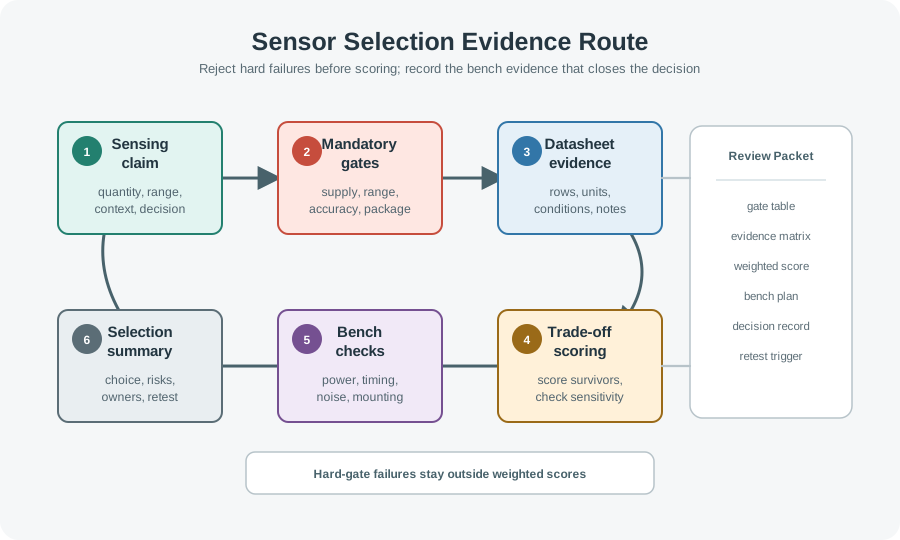
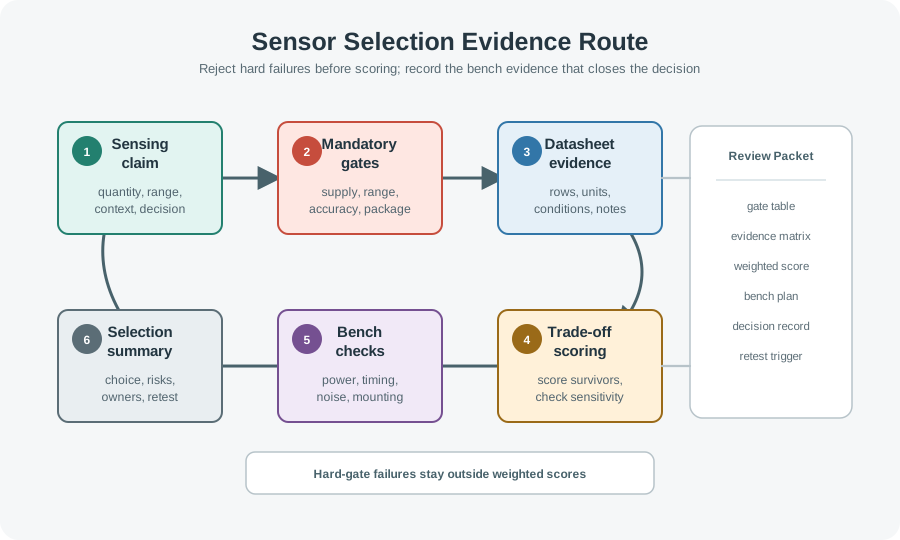
- Mandatory gates reject hard failures before datasheet evidence supports scoring the remaining candidates.
- Bench checks then feed a selection summary that records the choice, risks, owners, and retest needs.
- The first pass should reject candidates that fail mandatory gates before any scoring table appears.
Major section
Select for Claims, Not Favorites (continued)
If the host is 1.8 V and the sensor I/O cannot tolerate it, the part fails.
- If a humidity sensor cannot recover from condensation in the enclosure, the part fails.
- The route above keeps that discipline visible.
- Mandatory gates then remove parts that cannot support the claim under recommended operating conditions.
Major section
Select for Claims, Not Favorites (continued)
Another may pass integration but fail release evidence because the final enclosure traps humidity or the firmware cannot enter the advertised sleep state.
- The sensing claim names the measured quantity, the deployment context, and the decision that will be made from the data.
- Measurement claim: The sensor range, resolution, accuracy, noise, drift, and response time fit the physical event.
- Selection is therefore a controlled evidence route, not a shopping exercise.
Major section
Compare Real Part Rows
A motion shortlist might compare LIS3DH and ADXL345 rows for +/-2 g to +/-16 g range choices, output data rate, FIFO behavior, interrupt support, I2C/SPI access, package size, operating temperature, and supply/I/O requirements.
- Range, normal operating conditions, I/O tolerance, address conflict, package exposure, required accuracy, and production lifecycle are usually gates.
Major section
Compare Real Part Rows (continued)
A gate answers "can this part support the claim at all?" A preference answers "which viable part gives more margin or lower integration risk?" Do not mix them.
- Lower active current, easier calibration, stronger driver ecosystem, FIFO depth, interrupt flexibility, and lead-time margin are usually preferences after the gates pass.
- A practical evidence matrix should include the candidate part number, datasheet revision or date, row name, value, unit, test condition, and reviewer note.
- Copying only the headline number is not enough.
- A humidity accuracy row may apply at a particular supply voltage, temperature, and humidity band.
Major section
Compare Real Part Rows (continued)
A current row may describe one-shot forced mode rather than the firmware's actual oversampling, warm-up, interface, and sleep pattern.
- If the BME280 pressure capability is not needed, it should not win points unless the product actually uses pressure.
- If an SHT31-DIS-style humidity sensor has better package exposure for the enclosure, that belongs in the package and environmental evidence rows rather than a vague "better fit" note.
- That summary is what manufacturing, firmware, purchasing, and later maintainers will read when a supplier change, enclosure change, or field failure forces the decision to be revisited.
Major section
Datasheet Is Not Measurement
The selected sensor does not measure alone.
- The board rail, pullups, bus capacitance, enclosure vent path, conformal coating, mechanical stress, thermal mass, sampling firmware, compensation math, timestamp source, and calibration fixture can change what the system reports.
- Timing claims fail in similar ways.
- Mechanical and environmental coupling matter as much as electrical fit.
Major section
Datasheet Is Not Measurement (continued)
A humidity sensor behind a poor vent path can lag the room condition.
- A motion node has the same pattern around output data rate, FIFO watermark, interrupt threshold, host wake time, and false-wake rate.
- A pressure sensor under enclosure stress can report offset shifts.
- The hidden engineering boundary is ownership.
Major section
Datasheet Is Not Measurement (continued)
A vibration-monitoring design using an ADXL355-class low-noise accelerometer needs fixture resonance checks and real sampling traces, not only a low noise-density row.
- A motion sensor mounted on a flexible board edge can measure board resonance instead of machine vibration.
- A production program should record lifecycle status, package options, approved alternates, firmware register differences, calibration changes, and supplier notification requirements.
- A good selection summary keeps those ownership boundaries visible.
Major section
Datasheet Is Not Measurement (continued)
Replacing a sensor later can alter noise, timing, compensation, interrupt polarity, default register states, and package wetting behavior even when the new part uses the same bus and broad measurement category.
- That boundary is why the final artifact should connect datasheet evidence to validation tasks.
- Without that link, the selected part is only plausible.
- With it, the team has an auditable chain from requirement to component to measured system behavior.
Major section
In 60 Seconds
Sensor selection is not a popularity contest.
- A weighted score can support the choice, but it cannot rescue a sensor that fails a must-have requirement.
Major section
What This Chapter Adds
Datasheet reading asks "what does this part say?" Sensor selection asks "which candidate best supports this system claim?" That shift adds gates, trade-offs, and evidence discipline.
- Gate Reject hard failures early Supply, range, interface, package, temperature, and lifecycle can disqualify a part before scoring.
Major section
Do Not Average Away a Must-Have Failure
A sensor that cannot survive the temperature range, fit the package, talk to the host, or meet a required safety limit should be rejected.
- A high weighted score in other categories does not make that acceptable.
Deck summary
Key takeaways
A high score is useless if one fixed need has already been missed.
- Sensor selection starts with the job the product needs the data to do.
- If the host is 1.8 V and the sensor I/O cannot tolerate it, the part fails.
- Another may pass integration but fail release evidence because the final enclosure traps humidity or the firmware cannot enter the advertised sleep state.
- A motion shortlist might compare LIS3DH and ADXL345 rows for +/-2 g to +/-16 g range choices, output data rate, FIFO behavior, interrupt support, I2C/SPI access, package size, operating temperature, and supply/I/O requirements.
Retrieval practice
Recall check 1 of 4

Blueprint Bina says: answer from memory, then check your reasoning.
Q1A sensor passes mandatory gates but has an untested condensation risk. What should its selection summary say?
Show answer
Answer: A The summary connects the selected part to residual validation work.
Retrieval practice
Recall check 2 of 4
Blueprint Bina says: answer from memory, then check your reasoning.
Q2A popular sensor fails a mandatory operating-range requirement. How should the shortlist handle it?
Show answer
Answer: B Mandatory gates remove candidates that cannot support the sensing claim.
Retrieval practice
Recall check 3 of 4
Blueprint Bina says: answer from memory, then check your reasoning.
Q3A sensor’s low-current headline comes from a different measurement mode. What should the comparison preserve?
Show answer
Answer: C Datasheet conditions may differ from the firmware’s actual sampling and sleep pattern.
Retrieval practice
Recall check 4 of 4
Blueprint Bina says: answer from memory, then check your reasoning.
Q4Two sensors pass mandatory limits. What should the final selection summary preserve?
Show answer
Answer: C The record supports later substitution and validation.
Print reference
Answers
Answer key.
- A · The summary connects the selected part to residual validation work.
- B · Mandatory gates remove candidates that cannot support the sensing claim.
- C · Datasheet conditions may differ from the firmware’s actual sampling and sleep pattern.
- C · The record supports later substitution and validation.