Design Methodology · Study deck
Reading a Datasheet
Imagine a sensor that looks perfect on the feature list but fails the supply rail, temperature range, timing, pinout, package, or interface requirement.
Blueprint Bina is your guide for this deck.
After studying this chapter
Learning objectives
You will be able to:
- Find the rows that matter first: absolute maximum ratings, recommended operating conditions, electrical characteristics, timing, pinout, package, and interface.
- Distinguish typical values from guaranteed minimum and maximum values.
- Read test conditions and footnotes before copying a number into a design.
- Create a short datasheet evidence record that supports a component decision.
Major section
Worked Example: The Row That Can Disqualify the Part
Reading a datasheet starts with the rows that can make the part unusable.
- The useful evidence is not the marketing summary; it is the condition, limit, tolerance, and test you can attach to a design decision.
- The first panel represents the easy but weak selection method: choosing by headline capability.
- The third requires each limit and tolerance to be read with its test condition rather than copied as an isolated number.
- The final panel rejects an unusable candidate before its features shape the board and firmware.
Major section
In 60 Seconds · Phoebe's Field Notes: What the ADXL345's "13-Bit" Row Actually Promises
A datasheet is not a catalog page.
- The mathematical gist: A ±16 g, 13-bit accelerometer rounds its span into 213 codes, so one step is 3.91 mg/LSB and the ideal quantisation SNR ceiling is 80.0 dB.
- At a 200 Hz output rate, Nyquist is 100 Hz; a real 240 Hz gear-mesh component therefore folds to 40.0 Hz.
Major section
Overview: Read for the Decision
A datasheet is useful only when it answers a design question.
- A beginner mistake is opening the PDF at the feature summary and choosing the part from the most attractive headline.
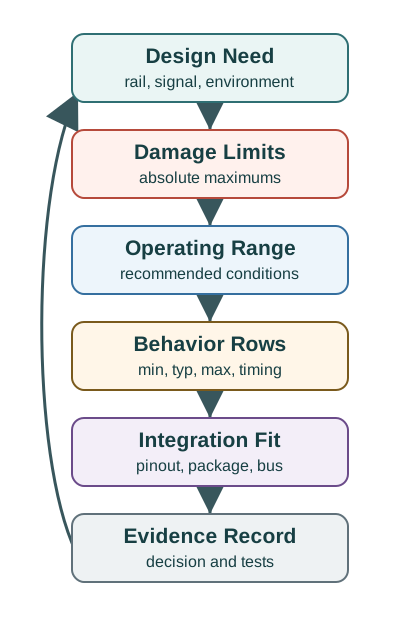
- The route in Figure: A first-pass datasheet review moves from design need starts with need and part limits; keep the proof before part choice.
- A better first pass asks whether the part can survive the circuit, operate inside the board envelope, communicate with the host, fit the PCB, and leave a testable evidence trail.
- The evidence record ties the part choice to decisions and tests.
Major section
Build Datasheet Evidence Records
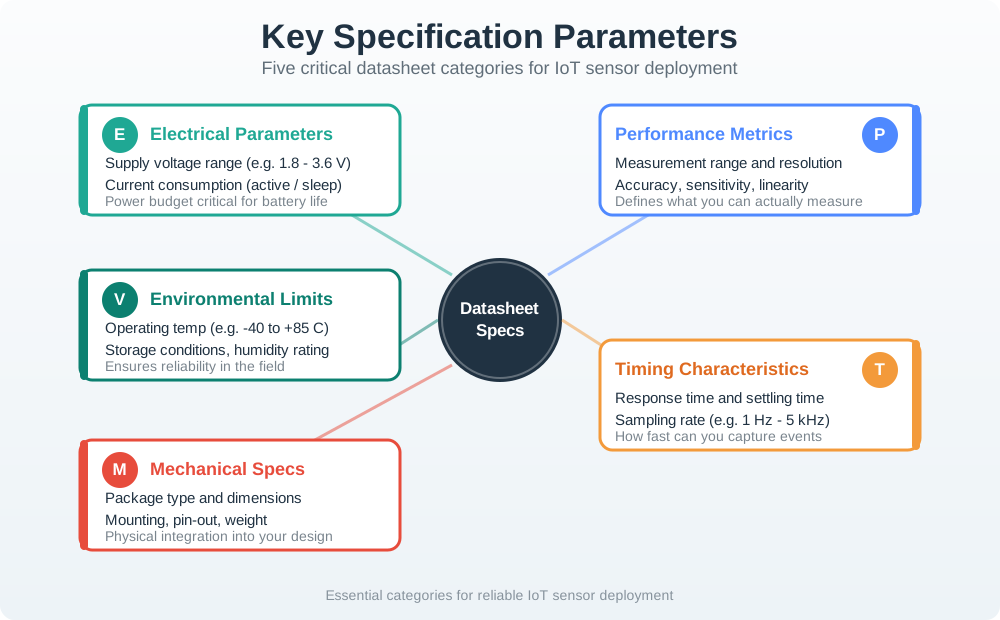
Include the use case, required range, selected part, manufacturer datasheet revision, orderable part number, package option, critical rows, test conditions, unresolved assumptions, bench checks, and the owner for repeating checks if the design changes.
- A maximum active current supports regulator and battery budgeting.
- An input-high threshold supports GPIO voltage compatibility.
- The record should be small enough to review, but precise enough that another engineer can repeat the decision without reopening every page of the PDF.
- A timing diagram supports firmware delay and bus-speed choices.
Major section
Build Datasheet Evidence Records (continued)
A package drawing supports footprint, orientation, and assembly review.
- A revision-history note or product-status page supports lifecycle risk.
- If the board rail, firmware sampling rate, package option, enclosure, supplier part number, or operating temperature changes, the affected datasheet rows must be rechecked.
- That retest trigger keeps the record useful after the first prototype instead of freezing an early assumption into production.
Major section
Why Typical Numbers Mislead · What This Chapter Adds
Datasheet tables are conditional.
- A current, timing, accuracy, or noise value may depend on supply voltage, temperature, load, clock rate, sample rate, gain, calibration state, package, or communication mode.
- Footnotes and diagrams carry design obligations that are easy to miss.
- A timing table may assume a specific bus capacitance or load.
Major section
The Datasheet Vocabulary You Need First
Assuming every pin can tolerate the same voltage as the supply.
- Ignoring separate analog, digital, or power grounds when the part has them.
- Supply current, often separated into active, standby, sleep, or quiescent states.
- Treating typical values as guaranteed limits.
- Designing normal operation near a stress limit.
Major section
Specification Value Types · Copy the Conditions With the Number
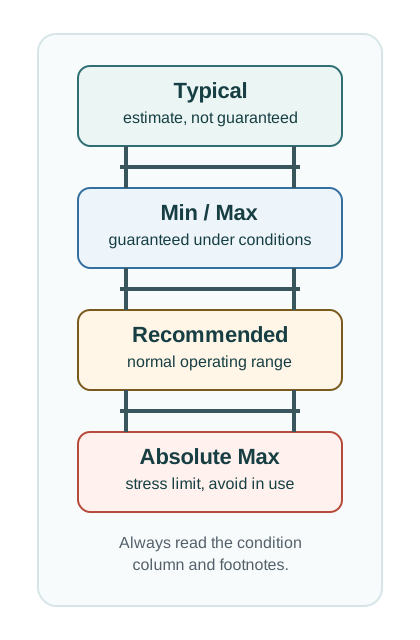
Their relationship frames Datasheet values have different meanings; a typical value is not the same kind of evidence as a guaranteed limit or a stress rating.
- Recommended values define the normal operating range; absolute max values mark stress limits to avoid in use.
- A release claim that every unit will meet the number.
- A design margin if the condition column does not match your design.
- Normal range where the part is expected to meet the rest of the datasheet specifications.
Major section
A Beginner's First Evidence Table
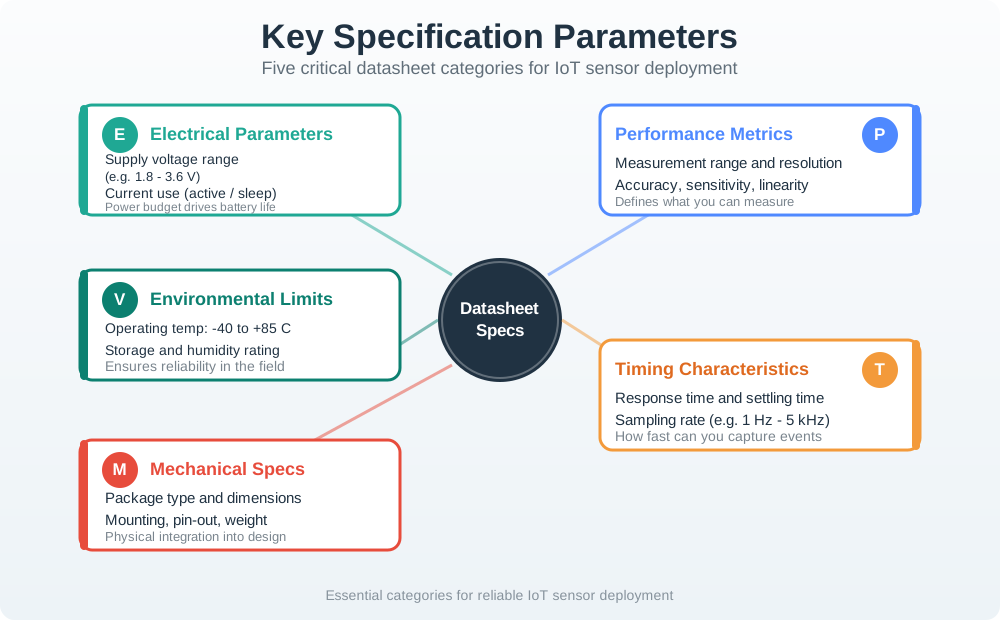
Response and settle time show if the part can catch the event at the planned sample rate.
- A supply range of 1.8–3.6 V proves only that the part can share the rail.
- Active and sleep current are also needed for the cell plan.
- Size and pins test board and case fit.
Major section
A Beginner's First Evidence Table (continued)
Response and settle time show if the part can catch the event at the planned sample rate.
- Heat, moisture, and exposure limits test the site.
- Absolute maximum ratings, ESD ratings, storage temperature, pin voltage limits.
- Stress limits, transient assumptions, protection needs, and assembly handling notes.
- Part number, variant, revision, supplier evidence, assumptions, and open tests.
Major section
Candidate Environmental Sensor
This example uses simplified values so the reading method is clear.
- Project requirement: a 3.3 V microcontroller must read temperature and humidity every few minutes from a battery-powered outdoor node.
- The board may see cold mornings, warm enclosures, sleep states, and I2C bus sharing.
- Recommended supply includes the board rail after tolerance.
Major section
Candidate Environmental Sensor (continued)
Compatible if the regulator tolerance, startup ramp, and sleep states stay inside range.
- Sleep, measurement, and interface currents are listed by mode.
- Temperature and humidity error are listed with ranges and conditions.
- I2C timing, address option, pullup guidance, and startup behavior are documented.
- Compatible if bus speed, pullups, address conflicts, and reset timing are handled.
Major section
Datasheet Row Is Not Design · Incremental Examples
If the datasheet says a sensor can measure humidity, the final product still needs enclosure airflow, contamination control, calibration decisions, firmware error handling, and field validation.
- The datasheet review must separate sensor supply range, I/O voltage compatibility, address options, I2C timing, forced-mode current, standby current, measurement time, and humidity exposure notes.
- A battery estimate that uses only standby current is incomplete.
- The evidence table should include range setting, output data rate, bandwidth, interrupt behavior, FIFO depth, noise, current by mode, SPI/I2C timing, package orientation, board-axis mapping, and the bench traces that prove the configured firmware matches the datasheet mode.
Major section
4. Confusing Survival With Operation · 5. Forgetting the Physical Part
Absolute maximum ratings tell you what can damage the part.
- They do not guarantee correct function.
- Electrical compatibility is not enough.
- Package, footprint, orientation, soldering, layout, thermal path, cleaning, and enclosure assumptions can still block a part.
Major section
Summary · Key Takeaway
Datasheet reading is a design-evidence process.
- This approach keeps beginner datasheet reading practical without turning typical values or feature lists into unsupported release claims.
- Spec-sheet fundamentals are design inputs, not marketing copy.
Deck summary
Key takeaways
Reading a datasheet starts with the rows that can make the part unusable.
- A datasheet is not a catalog page.
- A datasheet is useful only when it answers a design question.
- Include the use case, required range, selected part, manufacturer datasheet revision, orderable part number, package option, critical rows, test conditions, unresolved assumptions, bench checks, and the owner for repeating checks if the design changes.
- A package drawing supports footprint, orientation, and assembly review.
Retrieval practice
Recall check 1 of 3

Blueprint Bina says: answer from memory, then check your reasoning.
Q1What marks a component's survival boundary rather than a normal operating target?
Show answer
Answer: B Absolute maximum ratings mark survival boundaries and must not be used as normal operating targets.
Retrieval practice
Recall check 2 of 3
Blueprint Bina says: answer from memory, then check your reasoning.
Q2A sensor table lists sleep current as 20 uA typical and 80 uA maximum. Which value should carry a battery-life release claim?
Show answer
Answer: B Use guaranteed worst-case values and project-specific margins for release claims.
Retrieval practice
Recall check 3 of 3
Blueprint Bina says: answer from memory, then check your reasoning.
Q3A datasheet lists absolute maximum supply voltage as 6 V and recommended operating supply as 3.0 V to 5.5 V. What does a 5.8 V supply mean?
Show answer
Answer: A Recommended operating conditions define normal operation.
Print reference
Answers
Answer key.
- B · Absolute maximum ratings mark survival boundaries and must not be used as normal operating targets.
- B · Use guaranteed worst-case values and project-specific margins for release claims.
- A · Recommended operating conditions define normal operation.