Design Methodology · Study deck

Simulation and Validation: Test Matrices and Release Gates

A release review needs more than a list of tests.

Blueprint Bina is your guide for this deck.

simulatingtestingvalidation
Blueprint Bina, the module guide, in a scene from this chapter.
iotclass.org

After studying this chapter

Learning objectives

You will be able to:

  • Explain: Unit tests with PlatformIO or pytest check that a temperature parser rejects malformed values, clamps out-of-range readings, and moves the alarm state machine through normal, warning, alarm, and clear states.
  • Explain: That progression connects The release gate combines model evidence, physical evidence, and residual-risk review before a deployment decision to the next: Release Evidence Gate check.
  • Explain: A pass or hold is bounded by what the rig can inject and observe; the gap note and retest trigger keep unrepresented field conditions visible.
  • Explain: A sensor gateway sometimes stops forwarding readings after a broker outage.
iotclass.org

Major section

Build the Validation Matrix

It prevents the test suite from becoming a collection of disconnected scripts.

  • A validation matrix connects requirements, risks, test levels, and evidence.
  • The behavior, interface, limit, recovery action, or release statement being checked.
  • IoT failures often occur outside the happy path.
  • "Works with normal input.".
iotclass.org

Major section

Simulation, HIL, and Bench Roles

Simulation-driven validation works best when each method has a clear job.

  • SIL Fast behavior checks Use software-in-the-loop or emulation to check logic, protocol handling, and regression behavior before hardware is available.
  • Virtual Interface rehearsal Use virtual boards and peripherals to rehearse pin maps, display states, command sequences, and common fault inputs.
  • HIL Controlled physical check Use real firmware and real hardware while test equipment controls sensor values, power events, network conditions, or outputs.

Try it: Simulation, HIL, and Bench Roles in the chapter

iotclass.org

Major section

HIL Is Not Always Bigger

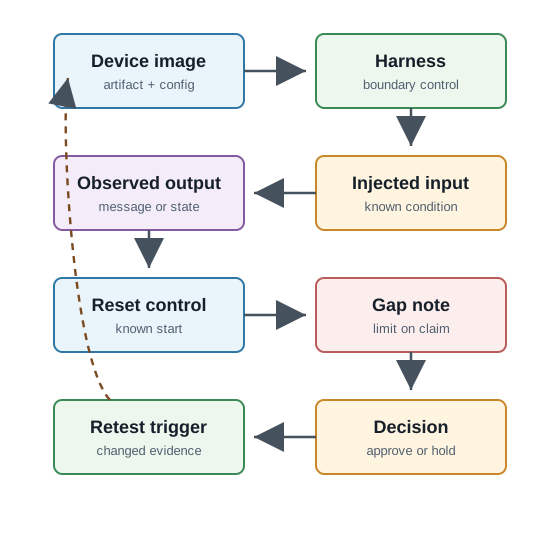
The real candidate image sits inside an explicit harness boundary that owns stimulus, observation, and reset.

  • Preserve the image hash, harness version, stimulus, response, and reset result in the run record.
  • A pass or hold is bounded by what the rig can inject and observe; the gap note and retest trigger keep unrepresented field conditions visible.
A compact HIL setup turns a device image, harness, injected input, observed output, and gap note into a repeatable release decision.
iotclass.org

Major section

Fault Injection and Negative Testing

Production IoT systems fail in ways that happy-path tests never see.

  • Disconnect real bus, use calibrated input, and inspect logic analyzer trace.
  • Backoff, local buffer limit, telemetry gap marker, reconnect evidence, and no watchdog loop.
  • No uncontrolled reset, clear error handling, bounded memory use, and data loss policy.

Key terms

Simulation and HIL
Simulation and HIL are useful because they make faults repeatable.
iotclass.org

Major section

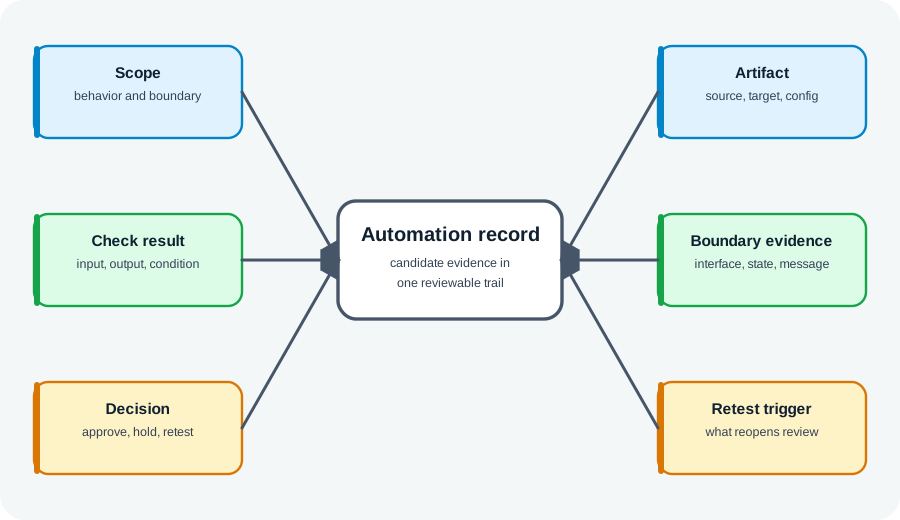
Automation and CI Evidence

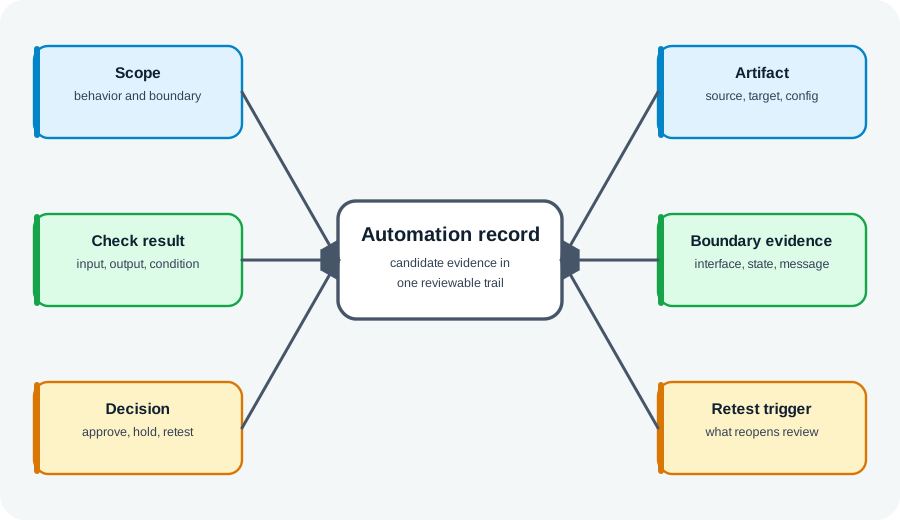
Automated validation should produce evidence, not just a green badge.

  • The release reviewer needs enough context to understand what ran and what was outside the run.
  • Pass, fail, investigate, waive, or accept-with-mitigation status.
  • Together they explain why Automated validation should produce reviewable artifacts, not only a pass/fail badge matters to: Automation and CI Evidence.
Automated validation should produce reviewable artifacts, not only a pass/fail badge.
iotclass.org

Major section

Release Evidence Gate

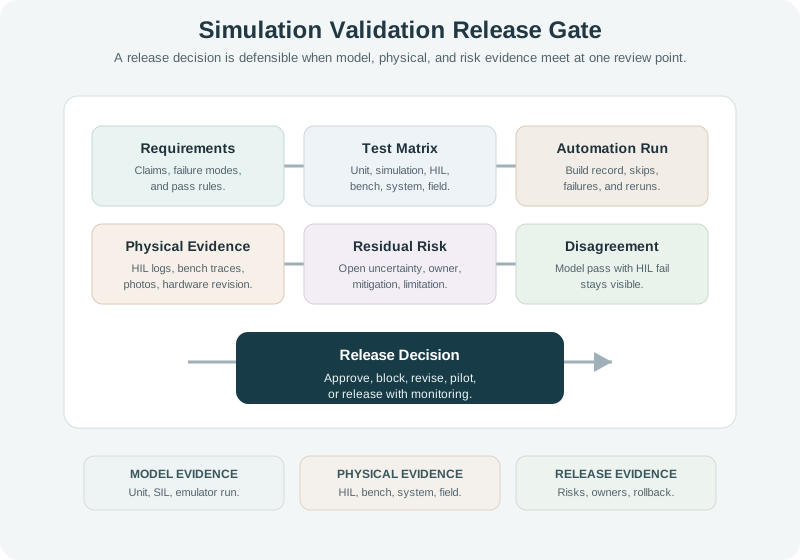
That progression connects The release gate combines model evidence, physical evidence, and residual-risk review before a deployment decision to the next: Release Evidence Gate check.

  • The release gate should make disagreement visible.
  • If simulation passes but HIL fails, the disagreement is useful evidence.
The release gate combines model evidence, physical evidence, and residual-risk review before a deployment decision.
iotclass.org

Major section

Incremental Examples

A multi-site release needs evidence from CI, virtual integration, HIL, bench measurements, and field logs.

  • A beginner validation pass can start with firmware logic before any fixture exists.
  • Sensor accuracy, power use, display visibility, and gateway delivery remain outside the unit-test evidence.
  • A gateway team can combine QEMU or Renode runs with a small HIL bench.
iotclass.org

Major section

Incremental Examples (continued)

Unit tests with PlatformIO or pytest check that a temperature parser rejects malformed values, clamps out-of-range readings, and moves the alarm state machine through normal, warning, alarm, and clear states.

  • If the model passes but the HIL run shows watchdog resets or flash-write pressure, the release gate should block or revise that claim.
  • GitHub Actions or another CI runner can preserve build records, Robot Framework or pytest reports, firmware images, skipped cases, and model versions.
  • The release decision should state which sites, firmware versions, monitoring alerts, rollback triggers, and owners are covered.
iotclass.org

Major section

Gateway Reconnect Validation

A sensor gateway sometimes stops forwarding readings after a broker outage.

  • The team has a simulator, a gateway development board, a test broker, and a packet capture point.
  • The gateway must recover after broker unavailability without losing bounded buffered readings or entering a reset loop.
  • Firmware logic handles expected states and malformed data.
iotclass.org

Deck summary

Key takeaways

It prevents the test suite from becoming a collection of disconnected scripts.

  • Simulation-driven validation works best when each method has a clear job.
  • The real candidate image sits inside an explicit harness boundary that owns stimulus, observation, and reset.
  • Production IoT systems fail in ways that happy-path tests never see.
  • Automated validation should produce evidence, not just a green badge.
iotclass.org

Retrieval practice

Recall check 1 of 3

Blueprint Bina says: answer from memory, then check your reasoning.

Q1Place each validation level where it lives so you can tell what the model proves, what needs real hardware, and what belongs in the release record.

ARequirement and Model Scope
BUnit and SIL Evidence
CHIL Bench Evidence
DRelease Record
Show answer

Answer: A Validation grows evidence deliberately: bound the requirement and model, connect virtual and hardware results, then retain field scope and the release decision.

iotclass.org

Retrieval practice

Recall check 2 of 3

Blueprint Bina says: answer from memory, then check your reasoning.

Q2A simulator run proves that firmware retries broker connection and buffers messages during a modeled outage. What should the validation record say?

AModel retry and buffering passed; network, flash, power, and field behavior still need HIL evidence.
BTreat model evidence as enough and mark network, power, flash wear, outage recovery, and field behavior validated.
CThe HIL and field tests should be deleted because they are slower.
DThe result should be ignored because only field tests matter.
Show answer

Answer: A Validation records should state the exact claim supported by the evidence and the remaining claims that need another evidence level.

iotclass.org

Retrieval practice

Recall check 3 of 3

Blueprint Bina says: answer from memory, then check your reasoning.

Q3A release gate shows passing unit tests and virtual integration tests, but the HIL bench run fails during a low-supply reset scenario. What is the strongest decision?

ABlock release until the reset failure is understood, fixed, mitigated, or accepted by the release owner.
BIgnore the HIL failure because the simulator passed.
CDelete the low-supply test so the release dashboard is green.
DShip with the failing HIL result and mark low-supply reset behavior as covered by unit and virtual tests.
Show answer

Answer: A Release gates should make failed evidence visible and connect it to a decision, mitigation, or owner.

iotclass.org

Print reference

Answers

Answer key.

  1. A · Validation grows evidence deliberately: bound the requirement and model, connect virtual and hardware results, then retain field scope and the release decision.
  2. A · Validation records should state the exact claim supported by the evidence and the remaining claims that need another evidence level.
  3. A · Release gates should make failed evidence visible and connect it to a decision, mitigation, or owner.
iotclass.org