Design Methodology · Study deck
Simulation and Validation: Evidence Strategy
A simulator can prove an algorithm and still miss a broken cable or clock.
Blueprint Bina is your guide for this deck.
After studying this chapter
Learning objectives
You will be able to:
- Build a simulation-driven validation plan that connects requirements to unit, simulation, emulation, hardware-in-the-loop, system, and field evidence.
- Choose the right validation level for firmware logic, protocol behavior, physical timing, power, environmental, and release claims.
- Define model boundaries so simulation results do not overclaim what was proven.
- Package automated test results, hardware runs, logs, traces, and residual risks into a release evidence record.
Major section
Start With the Evidence Ladder
A clean model can hide a weak antenna, worn storage, bad wiring, or a hard repair job.
- Firmware is the software stored on a device.
- A protocol is a shared set of message rules.
- A small code test can prove a calculation.
- A model can replay a lost message.
Major section
Start With the Evidence Ladder (continued)
A bench can show real timing and power.
- A field trial can show walls, weather, people, and service gaps.
- A field pass can also miss rare faults unless the team adds them on purpose.
- This freezer ladder cannot choose every test or prove every release.
- A higher rung adds evidence.
Major section
Validation as Evidence Chain
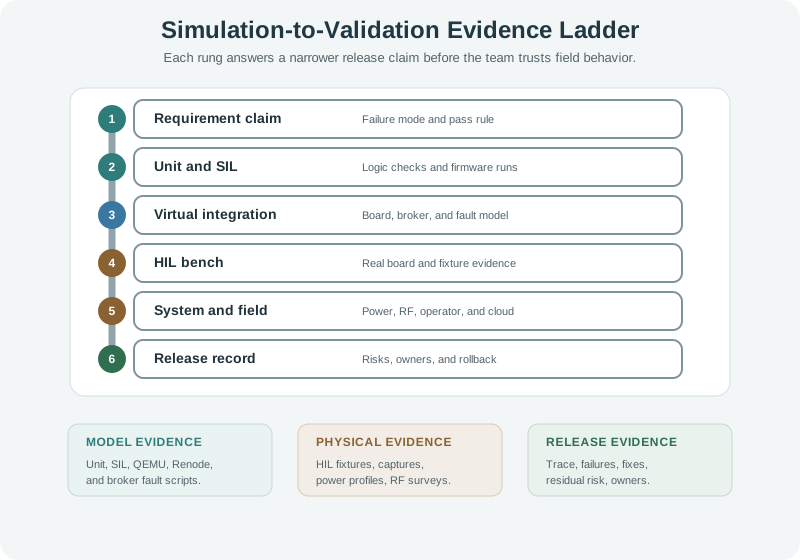
Simulation-driven validation works when each evidence level answers a different part of the release claim.
- Unit tests can prove parser, state-machine, and calculation behavior.
- Software-in-the-loop and emulators can replay deterministic firmware scenarios.
- Virtual integration can exercise boards, sensors, displays, protocol partners, and fault inputs.
- Field behavior and operator response remain open.
Major section
Validation as Evidence Chain (continued)
Physical evidence: HIL fixtures, serial logs, packet captures, logic-analyzer traces, current profiles, RF surveys, and environmental tests.
- Hardware-in-the-loop, bench tests, and field pilots prove the physical and deployment behavior that models cannot.
- A gateway-reconnect simulator can support retry and buffering logic.
- A passing model is one rung in the validation chain.
Major section
Validation as Evidence Chain (continued)
The validation plan should say which claim is being checked, which evidence level can support that claim, and which claims remain open.
- In Figure: Simulation-driven validation is defensible when model evidence, the worked claim is that buffered readings survive a 20-minute broker outage.
- Model checks cover queue limits, timestamp order, and retry logic with scripted inputs.
- The release record ties those results to the requirement, failures, residual risks, owners, and rollback conditions.
Major section
Validation as Evidence Chain (continued)
The HIL bench then puts production firmware on a real board with a test broker and controlled power, so logs, packets, current, and timing can be observed.
- If a bench reset conflicts with a model pass, keep both results visible and investigate the gap.
- That order ties Simulation-driven validation is defensible when model evidence, physical checks, and the final release record stay connected on one evidence ladder back to: Validation as Evidence Chain.
- Model evidence: Unit tests, SIL, QEMU, Renode, virtual circuits, simulated brokers, and scripted fault inputs.
Major section
Matrix Claims and Failure Modes
PlatformIO, pytest, Robot Framework, GitHub Actions, Renode tests, QEMU scripts, MQTT brokers, packet captures, and HIL controller scripts should all preserve versioned inputs and outputs.
- Each run needs firmware commit, board target, dependency versions, model or fixture version, input scenario, expected result, observed result, skipped cases, and who owns any failure.
- If the claim is "buffered readings survive a 20-minute MQTT broker outage," the fast checks cover queue limits, timestamp ordering, retry backoff, and serialization.
- The virtual run can drive CONNACK delay, DNS failure, credential rejection, and broker recovery.
Major section
Matrix Claims and Failure Modes (continued)
The HIL bench then runs the real board with the production firmware, a test broker, serial capture, packet capture, and controlled power input.
- A useful evidence packet includes the requirement ID, test case name, firmware image hash, board revision, model version, fixture calibration note, input script, observed log, failed assertion, skipped test reason, and residual-risk owner.
- If a simulated broker failure passes but the HIL run resets during reconnect, the matrix should preserve both results.
- The next action may be firmware backoff, flash-write reduction, power-rail measurement, watchdog tuning, or a narrower release claim.
Major section
Why Evidence Levels Fail
A failed field pilot may point to installation, backhaul, cloud latency, user workflow, support process, or environmental variation.
- A failed emulator run may point to boot flow, configuration, scheduling, or protocol handling.
- A failed virtual integration run may point to pin mapping, peripheral assumptions, command sequence, or model setup.
- Root-cause evidence also has different clocks.
Major section
Why Evidence Levels Fail (continued)
CI results are usually tied to a commit and can rerun in minutes.
- A failed HIL run may point to physical timing, voltage, sensor behavior, watchdog behavior, fixture calibration, or real firmware build differences.
- A low-supply reset failure may belong to firmware, hardware design, power supply, battery sizing, or test-fixture calibration.
- HIL results are tied to fixture wiring, calibration state, firmware image, device serial number, board revision, and instrument setup.
Major section
Why Evidence Levels Fail (continued)
A reconnect failure may belong to MQTT session handling, TLS certificate state, DNS, gateway queue policy, cellular backoff, cloud broker limits, or application stale-data rules.
- Field evidence is tied to installation date, firmware rollout cohort, radio environment, SIM profile, cloud region, broker limits, user action, and support process.
- A defensible release record keeps those clocks separate, so a later regression can identify whether the changed variable was code, model, fixture, hardware, site condition, or operations policy.
- Operational evidence: Field logs, incident timeline, support action, monitoring alert, rollback trigger, and residual-risk owner.
Major section
What This Chapter Adds
Untied tests become noise.
- Layer Use the right evidence level Fast software tests, simulated peripherals, HIL rigs, bench measurements, and field pilots answer different questions.
- Scope Document model limits A simulated pass may prove logic while leaving timing, power, RF, analog, or environmental claims open.
- Gate Release from evidence A release gate should show passing tests, failed tests, mitigations, residual risk, and owners for unresolved work.
Major section
Build Claim-to-Release Evidence
Simulation-driven validation starts with a claim that could fail.
- The team chooses the fastest evidence level that can check that claim, records the model boundary, adds physical or field evidence where the model stops, and only then makes a release decision.
- A project may move up and down as risks are discovered.
- The key is to state what each layer proves.
Deck summary
Key takeaways
A clean model can hide a weak antenna, worn storage, bad wiring, or a hard repair job.
- A bench can show real timing and power.
- Simulation-driven validation works when each evidence level answers a different part of the release claim.
- Physical evidence: HIL fixtures, serial logs, packet captures, logic-analyzer traces, current profiles, RF surveys, and environmental tests.
- The validation plan should say which claim is being checked, which evidence level can support that claim, and which claims remain open.
Retrieval practice
Recall checks 1–2 of 3

Blueprint Bina says: answer from memory, then check your reasoning.
Q1A gateway simulator passes retry and buffering tests. Which claim still needs physical evidence?
Show answer
Answer: B A reconnect simulation does not prove physical energy behavior.
Q2A firmware update fixes a reconnect bug. What test plan guards against the bug returning?
Show answer
Answer: A A saved fault case makes future changes prove recovery again.
Retrieval practice
Recall check 3 of 3
Blueprint Bina says: answer from memory, then check your reasoning.
Q3A release claim says buffered readings survive a broker outage. What should its evidence matrix include?
Show answer
Answer: C The example layers queue and retry tests with real hardware and deployed-path checks.
Print reference
Answers
Answer key.
- B · A reconnect simulation does not prove physical energy behavior.
- A · A saved fault case makes future changes prove recovery again.
- C · The example layers queue and retry tests with real hardware and deployed-path checks.