Design Methodology · Study deck
Network Simulation: Tool Landscape
Run several cases, not one perfect case.
Blueprint Bina is your guide for this deck.
After studying this chapter
Learning objectives
You will be able to:
- Choose a network simulation or measurement tool based on the design question it must answer.
- Distinguish packet-level simulation, firmware-aware emulation, modular simulation frameworks, packet capture, RF survey, and field telemetry.
- Explain why tool output must be tied to assumptions, scenarios, metrics, and validation evidence.
- Identify when a classroom visual tool is useful for learning but insufficient for production design evidence.
Major section
Start With the Evidence You Need
Building the whole site first would cost too much.
- A computer model can help, but only if it answers the same question the team must decide.
- The design lead should write one claim and a pass rule.
- For example: a warning must reach the local desk within two seconds when one radio path is blocked.
Major section
Start With the Evidence You Need (continued)
Leave out detail that cannot change the decision.
- They should be able to state which parts are real, which are estimated, and which are left out.
- End with a field check that can reject the model.
- A model that cannot be challenged is only an illustration.
- A designer may need the main trade-off.
Major section
Start With the Evidence You Need (continued)
Under the Hood examines event timing, radio models, repeated runs, and limits on the result.
- A reviewer needs the assumptions and spread.
- A field worker needs the check to repeat on site.
- If no decision changes, stop adding detail and spend the effort on real evidence.
- Link the raw results.
Major section
Start With the Evidence You Need (continued)
If the claim depends on packets, code, radio conditions, installed gateways, or operations telemetry, the tool has to match that claim rather than decorate the design.
- The card makes comparison fair.
- Two tools can answer the same question.
- One may model radio paths well.
- Another may run real device code.
Major section
Choose Tools by Question
A network tool is only useful when it observes or models the behavior behind a real design decision.
- A simulator can compare alternatives before deployment.
- An emulator can exercise firmware paths.
- A packet capture can show what actually crossed an interface.
- An RF survey can reveal site conditions.
Major section
Choose Tools by Question (continued)
Operations telemetry can show whether a deployed network stays healthy over time.
- The mistake to avoid is treating all of those outputs as equivalent.
- A packet-level model, a Contiki-NG mote run, a Wireshark trace, a LoRaWAN gateway export, and a pilot dashboard answer different questions.
- That question keeps tool choice practical.
Major section
Choose Tools by Question (continued)
The route also protects reproducibility.
- A classroom topology visualizer may help a learner understand routing, but it cannot prove LoRaWAN coverage, Wi-Fi roaming, Thread mesh recovery, gateway backhaul resilience, or battery life without additional measurements.
- A design team should first ask whether the claim depends on modelled packets, real firmware, real RF, installed gateways, application logs, or long-run operations.
- That boundary is the difference between evidence and decoration.
Major section
Choose Tools by Question (continued)
If the risk is MQTT reconnect behavior after broker failover, a small broker test plus packet capture may beat a large radio simulation.
- If the risk is RPL repair after a parent disappears, ns-3, OMNeT++/INET, or Cooja may be worth the setup.
- If the risk is metal shelving blocking coverage, an RF walk test and pilot node logs carry more weight than a diagram.
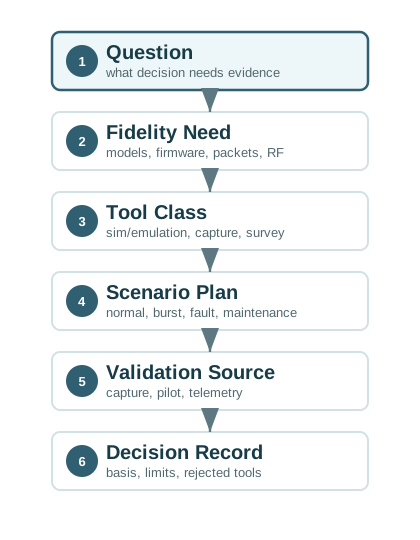
- The route in Figure: Tool selection route moves from the design question starts with the design question; check tool fit and field proof.
Major section
Match Tool Class to Evidence
ChirpStack or The Things Stack gateway logs can expose LoRaWAN joins, RSSI/SNR, frame counters, ADR behavior, and downlink limits.
- For a Thread or Zigbee mesh, the practitioner decision may be whether powered-router density and retry limits keep recovery inside the service target.
- For LoRaWAN, it may be whether spreading-factor distribution, duty-cycle limits, join capacity, and gateway backhaul leave enough margin.
- A useful tool-selection record is short but specific.
Major section
Match Tool Class to Evidence (continued)
For Wi-Fi, Ethernet, LTE-M, NB-IoT, or private cellular, the relevant evidence may shift toward DHCP, DNS, roaming, SIM lifecycle, APN/VPN routing, cloud reachability, and operational ownership.
- Wireshark or tshark can confirm MQTT, CoAP, TCP, TLS, BLE, or 802.15.4 packet behavior at a capture point. Iperf3 can test throughput and jitter on IP links.
- Broker logs, cloud IoT logs, RF survey results, and battery-current traces should be tied back to the model assumption they confirm or challenge.
- If a gateway log shows join failures in one loading bay, the simulation needs a site-specific coverage check.
Major section
Tool Output Validity Boundaries
Every tool has a validity boundary. Ns-3 results depend on the configured propagation model, traffic model, random seeds, and protocol modules.
- OMNeT++/INET results depend on selected components and simplified layers.
- Wireshark shows captured packets, not the packets that were lost before the capture point.
- A good tool-selection record states which boundary matters.
Major section
Tool Output Validity Boundaries (continued)
Operations dashboards show what the deployed platform retained, which may omit rejected packets, local outages, encrypted payload detail, or devices that never joined.
- For LoRaWAN, that may include regional duty-cycle limits, spreading factor, payload size, gateway placement, ADR, and downlink scarcity.
- For Thread or Zigbee, it may include 802.15.4 channels, route repair, router density, commissioning, and interference.
- The hidden mechanism is usually timing and loss.
Major section
Tool Output Validity Boundaries (continued)
For Wi-Fi, it may include channel width, roaming, airtime, DHCP/DNS behavior, backhaul capacity, and access-point logs.
- For a cellular design, the record may include modem firmware, carrier profile, APN, NAT behavior, coverage sample, SIM or eSIM lifecycle, power-save mode, and roaming assumptions.
- For an application-protocol claim, it may include MQTT session expiry, QoS, retained messages, keepalive, CoAP confirmable retransmission, TCP reconnect timing, TLS resumption, and broker throttling.
- A result that looks authoritative can still be wrong for the decision if one of those mechanisms is outside the tool.
Major section
What This Chapter Does
It helps you decide which type of evidence tool belongs in a network design workflow and what limits to write down before trusting the output.
- Model Packet-level simulation Use when routing, contention, queueing, protocol behavior, scale, or scenario sweeps are the main uncertainty.
- Code Firmware-aware emulation Use when the embedded stack, radio driver behavior, logs, or application firmware must be tested close to device code.
- Operate Field telemetry Use production and pilot metrics to catch drift, weak links, outage recovery, commissioning issues, and maintenance problems.
Deck summary
Key takeaways
Building the whole site first would cost too much.
- Leave out detail that cannot change the decision.
- Under the Hood examines event timing, radio models, repeated runs, and limits on the result.
- If the claim depends on packets, code, radio conditions, installed gateways, or operations telemetry, the tool has to match that claim rather than decorate the design.
- A network tool is only useful when it observes or models the behavior behind a real design decision.
Retrieval practice
Recall check 1 of 4

Blueprint Bina says: answer from memory, then check your reasoning.
Q1A classroom topology animation shows a route around a failed node. What claim can the team make?
Show answer
Answer: C The visual helps learning but cannot establish deployment performance.
Retrieval practice
Recall check 2 of 4
Blueprint Bina says: answer from memory, then check your reasoning.
Q2Metal shelving may block a warehouse radio path. Which evidence best addresses that concern?
Show answer
Answer: B The chapter assigns physical site conditions to field measurements.
Retrieval practice
Recall check 3 of 4
Blueprint Bina says: answer from memory, then check your reasoning.
Q3A reviewer asks why a team used packet capture instead of a radio simulator. Which record answers?
Show answer
Answer: C The selection record explains what the tool can show and why it was chosen.
Retrieval practice
Recall check 4 of 4
Blueprint Bina says: answer from memory, then check your reasoning.
Q4A simulation predicts good reconnect timing, but captures show repeated TLS handshakes after sleep. What should the team do?
Show answer
Answer: C Measurement evidence should confirm or challenge the simulation assumptions.
Print reference
Answers
Answer key.
- C · The visual helps learning but cannot establish deployment performance.
- B · The chapter assigns physical site conditions to field measurements.
- C · The selection record explains what the tool can show and why it was chosen.
- C · Measurement evidence should confirm or challenge the simulation assumptions.