Design Methodology · Study deck
Network Simulation: Selection Methods
A team can waste days in the wrong simulator.
Blueprint Bina is your guide for this deck.
After studying this chapter
Learning objectives
You will be able to:
- Explain: The team may combine a propagation estimate, The Things Stack or ChirpStack gateway metadata, RSSI/SNR samples, frame counters, spreading factors, ADR behavior, regional duty-cycle limits, and a pilot route.
- Explain: OMNeT++/INET or an ns-3 study can model topology and traffic, while a small physical 802.15.4 pilot checks channel interference, commissioning state, neighbor quality, and gateway logs.
- Explain: The pair turns Network simulation tool comparison separates packet-level research, protocol-framework studies, firmware testing, and mathematical analysis into something the team can verify.
- Validate references with a concrete scenario and pass criteria.
Major section
Match Tool to Network Claim
A network-design tool is credible only when its observation boundary matches the claim under review.
- RF coverage means where a radio signal reaches.
- 802.15.4 mesh recovery means how paths reform after a failure on that radio network.
- LoRaWAN gateway capacity means how much traffic one gateway can handle.
Major section
Evidence Tool Classes
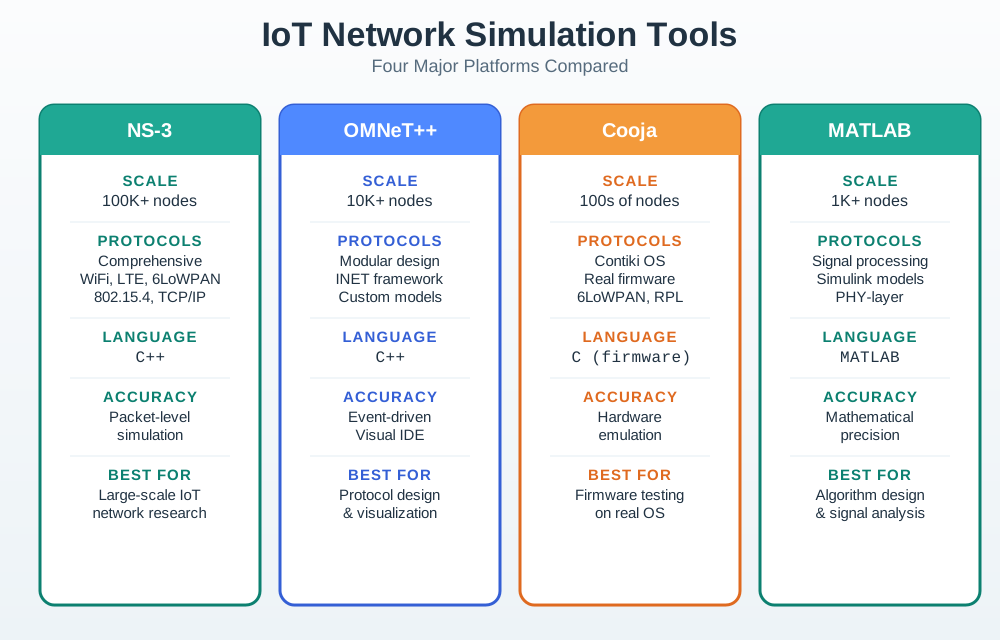
Claims that depend on hardware quirks or site-specific RF unless validated separately.
- Measured packet behavior, channel occupancy, gateway health, weak links, installation effects, and long-run drift.
- The pair turns Network simulation tool comparison separates packet-level research, protocol-framework studies, firmware testing, and mathematical analysis into something the team can verify.
Major section
Incremental Examples
Wireshark or tshark on a local broker path can show TCP, TLS, MQTT CONNECT/PUBLISH/PUBACK, CoAP confirmable messages, retransmissions, and payload size.
- Intermediate Example:: A design team studies whether Thread or Zigbee route repair stays inside the required recovery window after one router fails.
- OMNeT++/INET or an ns-3 study can model topology and traffic, while a small physical 802.15.4 pilot checks channel interference, commissioning state, neighbor quality, and gateway logs.
- The team may combine a propagation estimate, The Things Stack or ChirpStack gateway metadata, RSSI/SNR samples, frame counters, spreading factors, ADR behavior, regional duty-cycle limits, and a pilot route.
Major section
Simulation, Emulation, and Measurement
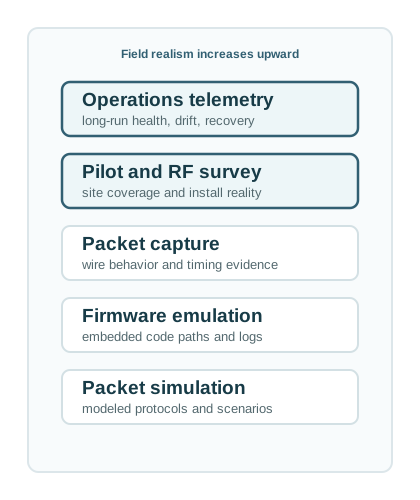
Firmware emulation adds code paths and logs; packet capture provides wire behavior and timing evidence.
- Pilot and RF survey add site evidence, while operations telemetry tracks ongoing health; field realism increases upward.
- A packet capture explains protocol behavior.
- Operations telemetry shows whether the deployment keeps working.
Try it: Simulation, Emulation, and Measurement in the chapter
Deck summary
Key takeaways
A network-design tool is credible only when its observation boundary matches the claim under review.
- Claims that depend on hardware quirks or site-specific RF unless validated separately.
- Wireshark or tshark on a local broker path can show TCP, TLS, MQTT CONNECT/PUBLISH/PUBACK, CoAP confirmable messages, retransmissions, and payload size.
- Firmware emulation adds code paths and logs; packet capture provides wire behavior and timing evidence.
Retrieval practice
Recall check 1 of 3

Blueprint Bina says: answer from memory, then check your reasoning.
Q1Place each tool-selection artifact where it lives so you can choose simulation, emulation, capture, or field measurement for the claim you need to test.
Show answer
Answer: A Place each tool-selection artifact where it lives so you can choose simulation, emulation, capture, or field measurement for the claim you need to test.
Retrieval practice
Recall check 2 of 3

Blueprint Bina says: answer from memory, then check your reasoning.
Q2A team wants to know whether a routing change reduces retry storms during gateway outage recovery. Which evidence approach is the best starting point?
Show answer
Answer: A Tool fit depends on the design question.
Retrieval practice
Recall check 3 of 3

Blueprint Bina says: answer from memory, then check your reasoning.
Q3A simulator predicts strong coverage, but the deployment site has metal shelving and unknown interference. What should be added before trusting the result?
Show answer
Answer: A Simulation can explore scenarios, but uncertain site conditions require measured validation such as RF surveys, captures, pilot logs, or gateway telemetry.
Print reference
Answers
Answer key.
- A · Place each tool-selection artifact where it lives so you can choose simulation, emulation, capture, or field measurement for the claim you need to test.
- A · Tool fit depends on the design question.
- A · Simulation can explore scenarios, but uncertain site conditions require measured validation such as RF surveys, captures, pilot logs, or gateway telemetry.