Testing & Validation · Study deck
Firmware Emulation and Debugging
Platform emulation runs the actual firmware image — the same bytes you would flash to the device — on a software model of the target machine.
Test Tessa is your guide for this deck.

After studying this chapter
Learning objectives
You will be able to:
- explain what emulation proves and what it still hands off to hardware testing
- identify where timing accuracy ends in an emulated environment
- Explain: Firmware is the software stored inside a device.
- Explain: The deeper sections compare simulation and emulation, timing, hardware links, and ways to keep a fast test honest as the product changes.
Major section
Start With the Firmware-on-a-Model Story
Firmware is the software stored inside a device.
- A model can supply sensor values, time, and link failures.
- Logic may stay in the model.
- Electrical and radio claims need bench or field evidence.
- The bytes are real, the breakpoints are real, and the state changes are real; the machine around them is the model.
Major section
Start With the Firmware-on-a-Model Story (continued)
The deeper sections compare simulation and emulation, timing, hardware links, and ways to keep a fast test honest as the product changes.
- That makes emulation a useful bridge between code review and hardware evidence.
- For everyday IoT teams, this is where an update path, parser, boot check, or driver decision can be inspected without waiting for a target device.
- The emulator can prove that the compiled code followed a path under a modeled input.
Major section
Overview: Running the Real Binary on a Modeled Machine
Emulation executes the actual firmware image on a software model of the target processor and its peripherals.
- The single most important idea is where the fidelity sits.
- But the world the code talks to — sensors, radios, buses, clocks — is still modeled, and often simplified or stubbed.
- The action is genuine; the surroundings are built and controlled.
- A simulation, by contrast, is the storyboard sketch of the stunt.
Major section
Overview: Running the Real Binary on a Modeled Machine (continued)
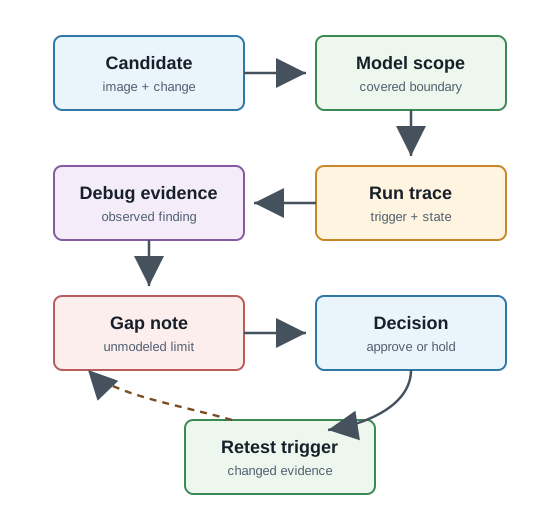
Debug evidence then records the observed state, and the gap note names behavior still requiring hardware.
- So an emulator pass is "this firmware logic executed correctly against these modeled peripherals," not "the device works." The evidence is bounded by which peripherals are modeled and how faithfully.
- If you only need the intuition, this layer is enough: emulation runs the real firmware on a modeled CPU and peripherals, so it gives true instruction-level behavior and full debugging early.
- Modeled peripheralsSensors, radios, buses, and clocks are modeled or stubbed; fidelity stops where the peripheral model does.
Major section
Overview: Running the Real Binary on a Modeled Machine (continued)
Its evidence is bounded by the peripheral models and the timing model, so a useful run records the artifact that ran, which boundary was modeled, and which physical behavior still needs hardware.
- Think of a stunt double who really performs the stunt — that is the real binary — but on a movie set rather than a real building.
- Emulation gives you the real action against a constructed set; the set's accuracy is exactly the boundary of what the run can prove.
- Beginner ExamplesRead these examples as a progression from the simplest observation to the boundary that still needs evidence.
Major section
Overview: Running the Real Binary on a Modeled Machine (continued)
The image is the real firmware artifact, while scope states which processor, peripherals, timing, and faults the emulated platform represents.
- This order connects early binary-level debugging to the chapter's running rule: preserve what the emulator proved without extending the claim beyond its model.
- The One-Minute ViewReal code, real debugging The actual binary runs, so boot, register state, and crashes are inspectable with breakpoints and single-step — before hardware.
- Finish by considering how a parser is run against recorded input bytes in the emulator to confirm it rejects a malformed message.
Major section
Practitioner: What Emulation Proves and What It Hands Off
Emulation is strong evidence for claims that live at the logic boundary and weak for claims that depend on the physical world the model simplifies.
- The job is to keep the trace tied to a specific artifact and to label the gap honestly.
- Faults that depend on real timing or analog input.
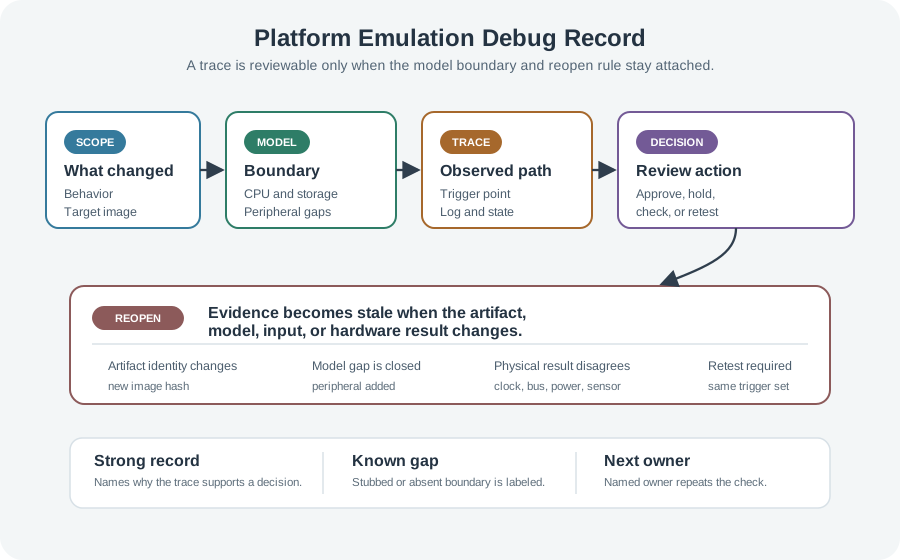
- The right response is not to reject the emulator; it is to label the gap and decide whether the candidate needs a hold, a hardware check, or a retest trigger.
- A screenshot or trace is not enough by itself; the record should say why the trace supports a decision.
Major section
Under the Hood: How Emulation Works and Where Timing Ends
The deeper layer is about why a confident emulator pass can still mislead.
- Three mechanisms matter: how an emulator executes the instructions, where peripheral models set the fidelity boundary, and why most emulators do not prove real-time timing.
- A fixed input makes an error path look exercised.
- A fresh emulator run.
Major section
Under the Hood: How Emulation Works and Where Timing Ends (continued)
Either way, the firmware's own bytes drive the run, which is why logic behavior is faithful.
- Full-system emulation models the processor plus memory and peripherals so an unmodified image boots as it would on the device; tools such as QEMU and Renode are recognizable examples used for embedded and IoT targets.
- The completeness of that modeled system — which peripherals exist and how accurately — is what determines how much of the device the run actually represents.
- A peripheral can be fully modeled, partially modeled, replaced with a fixed-input stub, or simply absent.
Major section
Under the Hood: How Emulation Works and Where Timing Ends (continued)
Peripheral Models Are the Fidelity BoundaryThe CPU may be modeled faithfully, but a device is mostly its peripherals, and each one is a modeling decision.
- A stubbed sensor returns a constant; an absent radio means radio code paths never run as they would.
- An old trace is cited after the image or model changed.
- Common PitfallsReview these failure modes in the order they can weaken or invalidate the result.
Major section
Under the Hood: How Emulation Works and Where Timing Ends (continued)
Most Emulation Is Not Cycle-AccurateFunctional, full-system emulators usually prioritize correct behavior and speed over exact timing: they are instruction-accurate, not cycle-accurate, and may run faster or slower than real time.
- That makes them excellent for logic and debugging and unreliable for claims about precise timing, interrupt latency, or hardware races — those need an explicitly cycle-accurate model or real hardware.
- Finish with Reusing a stale trace: A changed image or model can invalidate an old finding.
- This sequence connects each warning to the evidence a reviewer should demand before accepting the claim.
Major section
Summary
Emulation runs the real firmware image on a modeled CPU and peripherals; simulation models behavior, so the two produce different kinds of evidence.
- A debug finding is reviewable only when it ties the trace to a specific artifact identity and records scope, model, trace, decision, and a reopen rule.
- Claims that depend on analog input, radio, power, thermal, or real timing are hardware handoffs and should be named specifically, not waved off.
- Most functional full-system emulators are instruction-accurate, not cycle-accurate, so they cannot establish real-time deadlines or interrupt-latency claims without a cycle-accurate model or real hardware.
Deck summary
Key takeaways
Firmware is the software stored inside a device.
- The deeper sections compare simulation and emulation, timing, hardware links, and ways to keep a fast test honest as the product changes.
- Emulation executes the actual firmware image on a software model of the target processor and its peripherals.
- Debug evidence then records the observed state, and the gap note names behavior still requiring hardware.
- Its evidence is bounded by the peripheral models and the timing model, so a useful run records the artifact that ran, which boundary was modeled, and which physical behavior still needs hardware.
Retrieval practice
Recall check 1 of 3

Test Tessa says: answer from memory, then check your reasoning.
Q1What is the key difference between emulation and simulation, and why does it still leave emulator evidence bounded?
Show answer
Answer: D The code is real, but the modeled machine around it is the boundary; emulation proves logic behavior, not the physical world the model simplifies.
Retrieval practice
Recall check 2 of 3
Test Tessa says: answer from memory, then check your reasoning.
Q2What can the team accept from this emulator run, and what still needs testing?
Show answer
Answer: A The pass is real for the code path, but a fixed-input stub does not exercise the sensor-error behavior the change claims to handle.
Retrieval practice
Recall check 3 of 3
Test Tessa says: answer from memory, then check your reasoning.
Q3A team uses a fast full-system emulator and reports that the firmware meets a tight interrupt-response deadline because the emulated run finished in time. What is the strongest critique?
Show answer
Answer: D Functional emulation proves logic, not real-time timing; interrupt-latency deadlines require cycle accuracy or hardware.
Print reference
Answers
Answer key.
- D · The code is real, but the modeled machine around it is the boundary; emulation proves logic behavior, not the physical world the model simplifies.
- A · The pass is real for the code path, but a fixed-input stub does not exercise the sensor-error behavior the change claims to handle.
- D · Functional emulation proves logic, not real-time timing; interrupt-latency deadlines require cycle accuracy or hardware.