Testing & Validation · Study deck
Online Hardware Simulators
Online hardware simulators run a model of a microcontroller, sensor, or circuit in a browser, with no local toolchain and no physical parts.
Test Tessa is your guide for this deck.

After studying this chapter
Learning objectives
You will be able to:
- separate convenience from fidelity when using a shared browser-based simulator
- identify what an online simulator closes off and what it hands off to later testing
- evaluate reproducibility and idealized-model risk in an online simulator's results
- Explain: The test owner must state what that shared run proves and which physical effects the model leaves open.
Major section
Start With the Shared Browser Story
The test owner must state what that shared run proves and which physical effects the model leaves open.
- A shared simulation can speed review, but it cannot prove radio range, analog noise, heat, power, or real timing unless modeled and checked.
- This opening does not rank every online tool.
- Under the Hood examines model fidelity, timing, part behavior, collaboration, version drift, and evidence limits.
- That convenience is useful only when it is kept honest.
Major section
Overview: Convenience Is Not Fidelity
You assemble a circuit, load firmware, and run it — without installing a toolchain, soldering anything, or owning the part.
- Browser-based simulators such as Wokwi and Tinkercad Circuits make this immediate and shareable, which is genuinely valuable for learning, for quick scenario checks, and for handing a runnable example to another reviewer.
- None of that changes the fact that it runs a model, and a model represents some behavior and simplifies the rest.
Major section
Overview: Convenience Is Not Fidelity (continued)
The single most important idea is to separate two things that feel similar but are not: convenience and fidelity.
- A hosted simulator is fast, accessible, and easy to share — that is convenience.
- If you only need the intuition, this layer is enough: online simulators are fast, shareable models that run firmware and circuits in a browser.
- Beginner ExamplesRead these examples as a progression from the simplest observation to the boundary that still needs evidence.
Major section
Overview: Convenience Is Not Fidelity (continued)
Still a modelConvenience does not add fidelity; inputs are often idealized and the result holds only inside the model boundary.
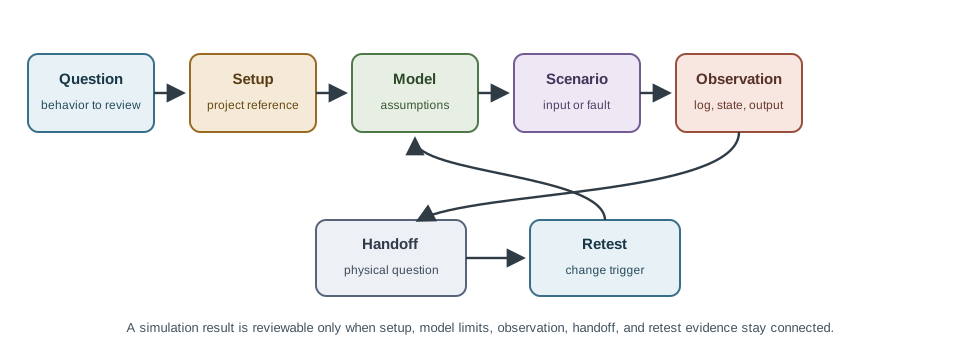
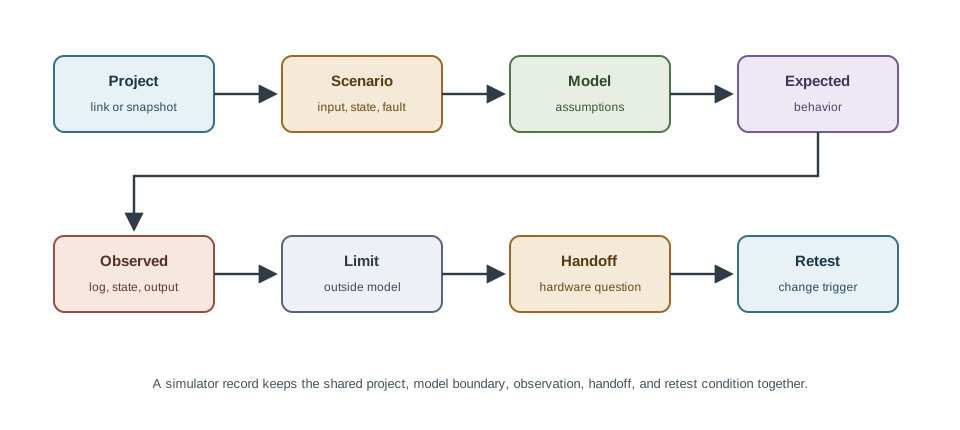
- Their evidence is bounded by the model, so a useful run records the project reference, the scenario, what was observed, and the specific physical questions — analog, radio, power, timing — the model could not close.
- An online hardware simulator sits at the convenient end: excellent for exploring logic and interfaces, not a substitute for the analog and physical fidelity a real board provides.
- If you can separate "easy to reach" from "close to reality," you have the core idea.
Major section
Overview: Convenience Is Not Fidelity (continued)
The final two stages keep convenience honest, connecting fast collaborative experiments to the chapter's broader rule that evidence must remain bounded by model fidelity.
- The One-Minute ViewInstant and shareable No toolchain, no parts, no setup; a scenario runs in the browser and travels as a link another reviewer can open.
- Finish by considering how a controlled invalid reading is injected to confirm the firmware reaches its error path — easy in the browser, awkward on a bench.
- No one would sign off a pilot on the phone app, because convenience and fidelity are different axes.
Major section
Practitioner: What They Close, What They Hand Off
Online simulators earn their place on bounded questions you can phrase as a repeatable scenario, and they fail when a claim depends on physical behavior the model never represented.
- Knowing which side of that line a question falls on is most of the skill.
- Which interface is modeled and the observed message.
- Faults that depend on electrical or event-order reality.
- Another reviewer can use them to repeat both the normal and invalid runs.
Major section
Practitioner: What They Close, What They Hand Off (continued)
The injected value is ideal, so start-up and out-of-range behavior on a real sensor remain open.
- Last, note the triggers for changes to state logic, sensor model, message shape, or real behavior.
- The record keeps useful logic proof while leaving physical claims outside the browser model.
- Worked Example: A Sensor Error PathSuppose a firmware change should reject an invalid sensor value and publish a status event.
Major section
Under the Hood: Reproducibility, Idealized Models, and the Reality Gap
A shared link runs but proves no specific change.
- The deeper layer is about why a confident browser pass can still mislead.
- A Shared Link Is Not Automatically a RecordThe convenience that makes online simulators shareable also creates a reproducibility trap.
- A project edited after sharing no longer matches the claim.
Major section
Under the Hood: Reproducibility, Idealized Models, and the Reality Gap (continued)
A reviewer who receives only a runnable link can see that something runs, but cannot tell which change it represents or what it was meant to prove.
- Online Models Idealize to Stay AccessibleTo run instantly in a browser and stay easy to use, online simulators typically model at a functional or behavioral level rather than reproducing analog physics or exact device timing.
- Inputs are often clean, controlled values; a modeled sensor may have no noise or drift, a modeled supply may never sag, and timing may be approximate.
- A re-run against the recorded snapshot.
Major section
Under the Hood: Reproducibility, Idealized Models, and the Reality Gap (continued)
Those idealizations are exactly what make the tool fast and approachable — and each one is a place where browser behavior can diverge from a real board.
- The skill is to record the idealizations so a reviewer knows which physical effects were assumed away.
- Firmware tuned until it is perfect in a browser simulator can still misbehave on hardware that has the noise, timing, and analog dynamics the model omitted.
- Common PitfallsReview these failure modes in the order they can weaken or invalidate the result.
Major section
Under the Hood: Reproducibility, Idealized Models, and the Reality Gap (continued)
Finish with Vague handoffs. "Needs a hardware test" does not tell the next reviewer which physical behavior to check.
- This sequence connects each warning to the evidence a reviewer should demand before accepting the claim.
- The strongest online-simulation evidence states the snapshot, the scenario, what was observed, and the specific physical question it handed onward.
- The Reality Gap Still AppliesThe gap between simulated and real behavior — the reality gap, or sim-to-real gap — does not disappear because the model is hosted and convenient.
Deck summary
Key takeaways
The test owner must state what that shared run proves and which physical effects the model leaves open.
- You assemble a circuit, load firmware, and run it — without installing a toolchain, soldering anything, or owning the part.
- The single most important idea is to separate two things that feel similar but are not: convenience and fidelity.
- Still a modelConvenience does not add fidelity; inputs are often idealized and the result holds only inside the model boundary.
- The final two stages keep convenience honest, connecting fast collaborative experiments to the chapter's broader rule that evidence must remain bounded by model fidelity.
Retrieval practice
Recall check 1 of 3

Test Tessa says: answer from memory, then check your reasoning.
Q1An online simulator runs firmware in the browser with no setup and passes. Why is that still bounded evidence rather than proof the device works?
Show answer
Answer: B Being hosted and instant does not raise fidelity; the run is bounded by the model and its assumptions.
Retrieval practice
Recall check 2 of 3
Test Tessa says: answer from memory, then check your reasoning.
Q2An online simulator shows firmware correctly rejecting an invalid sensor value, but the value was injected as a controlled input rather than read from a physical sensor. What should the review record conclude?
Show answer
Answer: A The simulator supports the logic path; physical sensor behavior is outside the model and must be named as a handoff.
Retrieval practice
Recall check 3 of 3
Test Tessa says: answer from memory, then check your reasoning.
Q3A teammate sends only a link to an online simulator project that 'shows the fix working.' What is the strongest review response, and why?
Show answer
Answer: C A bare link is not durable evidence; a captured snapshot, revision, scenario, and observation make the result reviewable and reproducible.
Print reference
Answers
Answer key.
- B · Being hosted and instant does not raise fidelity; the run is bounded by the model and its assumptions.
- A · The simulator supports the logic path; physical sensor behavior is outside the model and must be named as a handoff.
- C · A bare link is not durable evidence; a captured snapshot, revision, scenario, and observation make the result reviewable and reproducible.