Testing & Validation · Study deck
Hardware Simulation Fundamentals
Picture a team writing pump-control code before the test rig is free.
Test Tessa is your guide for this deck.

After studying this chapter
Learning objectives
You will be able to:
- test firmware against a model of the hardware instead of the physical device
- choose the kind of simulation appropriate to a reviewable scenario
- explain how fidelity, time-handling, and the reality gap limit a simulation's claim
- Explain: The test can reveal a bad rule today, but it cannot show whether the real level probe sticks or the motor draws too much current.
Major section
Start With the Hardware Stand-In Story
The test can reveal a bad rule today, but it cannot show whether the real level probe sticks or the motor draws too much current.
- The model can narrow the bench work, but it cannot replace a physical stop check.
- This opening does not prove the pump is ready.
- Practitioner defines the model boundary and handoff.
- Under the Hood examines model detail, repeat runs, rare faults, and the physical retest that closes each open question.
Major section
Overview: Testing Against a Model of the Hardware
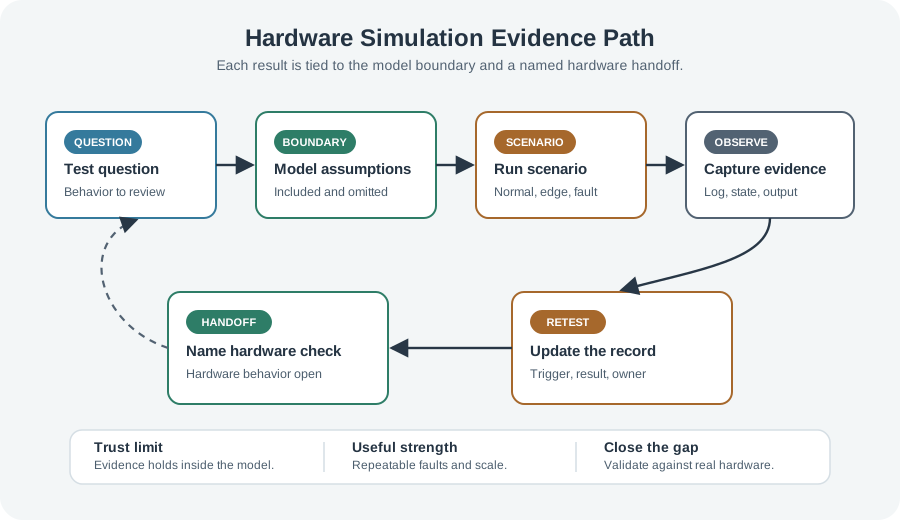
Hardware simulation tests IoT behavior against a software model of the device, network, or environment instead of the physical thing.
- Rather than wait for a board, a sensor, or a hundred deployed nodes, you describe how those parts behave and let firmware or a whole system run against that description.
Major section
Overview: Testing Against a Model of the Hardware (continued)
The single most important idea is that a simulation is a model, and every model includes some things and simplifies others.
- A useful one is built to answer a specific question, and it is trustworthy only within the boundary of what it represents.
- If you only need the intuition, this layer is enough: simulation runs firmware or a system against a model of the hardware, so it is fast, repeatable, and available early.
- A map is useful precisely because it leaves things out — a subway map shows which stops connect, not the true distances between them.
Major section
Overview: Testing Against a Model of the Hardware (continued)
Its evidence is bounded by the model's assumptions, so a useful simulation record always names what the model included, what it simplified, and what must still be checked on real hardware.
- It answers "how do I get from here to there" perfectly and "how far is it really" not at all.
- A simulation is the same: trustworthy for the questions it was drawn to answer, and silent or misleading about the ones it was not.
- The question says what the model must represent; assumptions disclose what it simplifies; and the repeatable run records the resulting behavior.
Major section
Overview: Testing Against a Model of the Hardware (continued)
The hardware handoff names physical effects still open, while the retest record identifies changes that invalidate the result.
- This path connects simulation's speed and determinism to an honest evidence boundary rather than a blanket claim that the hardware will work.
- The One-Minute View Fast, repeatable, early Software models run before hardware exists, repeat exactly, scale to many virtual nodes, and inject rare faults on demand.
- A model, not reality Every simulation includes some behavior and simplifies the rest; its evidence holds only inside that boundary.
Major section
Practitioner: Kinds of Simulation and Reviewable Scenarios
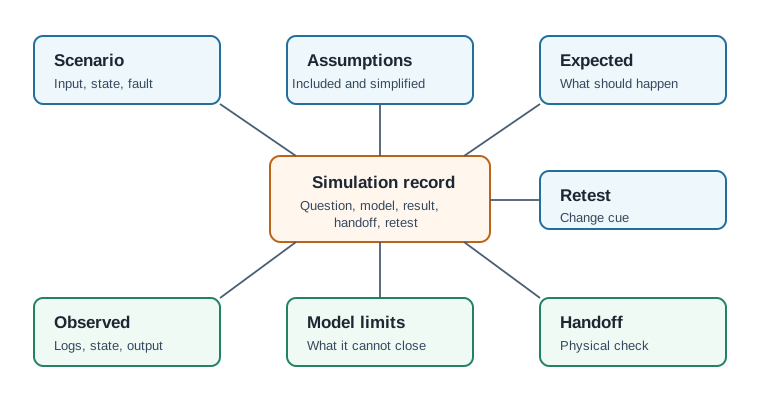
"Simulation" covers several techniques that model different parts of an IoT system, and choosing the right one starts with the question you are trying to answer.
- The determinism that makes this possible is the whole point — the same scenario gives the same result every run, so a fault you inject today can be reproduced exactly next month.
Try it: Practitioner: Kinds of Simulation and Reviewable Scenarios in the chapter
Major section
Under the Hood: Fidelity, Time, and the Reality Gap
The skill is choosing fidelity to match the question and recording the idealizations, so a reviewer knows which physical effects were assumed away.
- The deeper layer is about why a confident green simulation can still mislead.
- Wall-clock timing and races are not reproduced.
- A calibration run on hardware.
Major section
Under the Hood: Fidelity, Time, and the Reality Gap (continued)
Those simplifications are what make the model fast and are usually fine for logic questions — but each one is a place where simulated behavior can diverge from hardware.
- Questions about true timing belong to a hardware-in-the-loop setup or real hardware, where time is real rather than modeled.
- The defense is to validate the model itself — confirm it reproduces a known real measurement before trusting it on new predictions.
- Verifying that the model was built as intended is necessary, but it is not the same as validating that it is the right model for reality.
Major section
Under the Hood: Fidelity, Time, and the Reality Gap (continued)
An unvalidated model that has never been checked against reality produces confident numbers with no anchor; a validated one earns trust within the range it was checked against, and no further.
- Common Pitfalls Review these failure modes in the order they can weaken or invalidate the result.
- Finish with Vague handoffs. "Needs a real test" does not tell the next reviewer which physical behavior to check.
- This sequence connects each warning to the evidence a reviewer should demand before accepting the claim.
Deck summary
Key takeaways
The test can reveal a bad rule today, but it cannot show whether the real level probe sticks or the motor draws too much current.
- Hardware simulation tests IoT behavior against a software model of the device, network, or environment instead of the physical thing.
- The single most important idea is that a simulation is a model, and every model includes some things and simplifies others.
- Its evidence is bounded by the model's assumptions, so a useful simulation record always names what the model included, what it simplified, and what must still be checked on real hardware.
Retrieval practice
Recall check 1 of 3

Test Tessa says: answer from memory, then check your reasoning.
Q1Why is a simulation's result described as evidence bounded by its assumptions rather than proof that the device works?
Show answer
Answer: A Every model has a boundary; simulation evidence holds within it and must name the physical behavior it did not represent.
Retrieval practice
Recall check 2 of 3

Test Tessa says: answer from memory, then check your reasoning.
Q2You need to check how a routing protocol behaves across a hundred IoT nodes under heavy message loss, which your small bench cannot reproduce. Which simulation fits, and what stays open?
Show answer
Answer: A Network simulation is built for scale and impairment; it answers the protocol question but leaves real per-device radio behavior to later layers.
Retrieval practice
Recall check 3 of 3

Test Tessa says: answer from memory, then check your reasoning.
Q3A control algorithm performs perfectly in simulation, but the first hardware unit overshoots and oscillates. The simulation used an idealized, noise-free sensor and a perfectly responsive actuator that were never compared against real parts. What does this illustrate, and what should have been done?
Show answer
Answer: A A model that is never validated against reality can give confident but unanchored results; validating it and naming the idealizations would have set expectations before hardware.
Print reference
Answers
Answer key.
- A · Every model has a boundary; simulation evidence holds within it and must name the physical behavior it did not represent.
- A · Network simulation is built for scale and impairment; it answers the protocol question but leaves real per-device radio behavior to later layers.
- A · A model that is never validated against reality can give confident but unanchored results; validating it and naming the idealizations would have set expectations before hardware.