IoT Fundamentals · Study deck
Voice Compression: Samples, Companding, and Speech Models
A raw voice stream carries many sound samples.
Physics Phoebe is your guide for this deck.

After studying this chapter
Learning objectives
You will be able to:
- Calculate raw PCM bit rate from sample rate, bit depth, and channel count.
- Compare companding and speech-model codecs against link delay and loss.
- Explain: The deeper layer explains the bit-rate baseline, how companding squeezes more from each bit, and how coders reach low rates.
- Explain: The control plane carries the evidence that sets up or steers the conversation.
Major section
Under the Hood: From Samples to a Speech Model
The deeper layer explains the bit-rate baseline, how companding squeezes more from each bit, and how coders reach low rates.
- A compressor can spend short codes on common events and longer codes on rare events.
- Speech signals have similar structure across amplitude, time, and frequency.
- Two Ways to Be LossyCoder Family.
Major section
Under the Hood: From Samples to a Speech Model (continued)
The control plane carries the evidence that sets up or steers the conversation.
- Adjacent samples are often related, voiced speech has periodic energy, and different frequency bands carry different amounts of intelligibility.
- This baseline is the reference that compression improves upon.
- Assumes speech, adds complexity, can add artifacts.
Major section
Under the Hood: From Samples to a Speech Model (continued)
A speech source is shaped by the lungs, vocal folds, vocal tract, tongue, lips, and nasal passages, and the listener's ear and auditory system do not treat every sample error equally.
- The useful review dimensions are compression efficiency, reconstructed speech quality, algorithmic latency, error resilience on a lossy link, and computational complexity on the target device.
- By the sampling rule, an 8 kHz rate represents content up to about 4 kHz, which is enough for intelligible speech though narrower than the full range of hearing.
- That shift also explains why simple answering machines matter in an IoT course.
Major section
Under the Hood: From Samples to a Speech Model (continued)
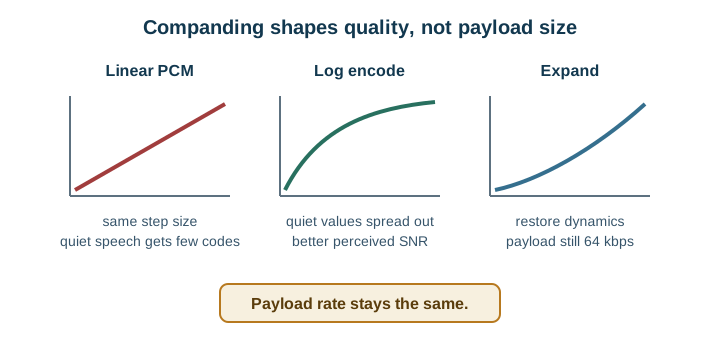
Mu-law and A-law are the classic companding laws that make those 8-bit samples more useful for speech than uniform linear steps.
- Companding: More From the Same BitsSpeech has a wide dynamic range, and quiet passages still carry meaning.
- In G.711 terms, mu-law and A-law are the two logarithmic companding rules used for narrowband PCM telephony.
- This algorithmic delay is separate from network delay.
Major section
Under the Hood: From Samples to a Speech Model (continued)
Lossy coding discards perceptually minor information for much larger savings and is the norm for voice.
- The comparison turns Companding changes how code steps are spent across speech levels; it improves perceived quality without changing the payload rate into a bounded: Companding: More From the Same Bits choice.
- Toll-free and emergency services show why that control plane is more than call setup.
- Variable-rate mobile codecs make that evidence especially important.
Major section
Under the Hood: From Samples to a Speech Model (continued)
A caution follows from the same CTI path: once software owns the voice interface, release evidence must include more than audio quality.
- The data plane is the sampled speech stream: one narrowband channel at 8 kHz and 8 bits/sample is a 64 kbps voice channel before packet headers.
- DTMF dialing is the compact example: each keypad symbol is encoded as one low-group tone and one high-group tone, so switching equipment or an IVR can recognize digits without interpreting speech.
- If the prediction is good, the error needs fewer bits than the original sample.
Major section
Under the Hood: From Samples to a Speech Model (continued)
The LPC review record should name what is being estimated, not only quote a low bit rate.
- For IoT voice and audio systems, this distinction is still practical: keep control events, call state, media packets, timestamps, and authentication evidence separate enough that audio loss does not silently become a command or routing failure.
- A service switching point attaches phones and call paths, a signal transfer point routes signaling messages through the control network, and a service control point hosts service logic or database lookups.
- Voice Quality EvidenceVoice quality is not proven by bit rate alone.
Major section
Under the Hood: From Samples to a Speech Model (continued)
A short speech segment is approximated as a weighted sum of previous samples plus an excitation term.
- The useful IoT transfer is not the acronym set; it is the habit of asking which component carries media, which component routes control evidence, and which database or policy service is allowed to change the session.
- A dialed 1-800 number can be translated through a service database before the voice path is connected, so the caller's digits, the lookup result, and the media circuit are separate evidence streams.
- AMR and AMR-WB modes make similar trade-offs across rates and bandwidths.
Major section
Under the Hood: From Samples to a Speech Model (continued)
Lossless Versus LossyLossless coding reconstructs the exact samples but achieves only modest, data-dependent compression, so it rarely fits tight voice links.
- Enhanced 911 adds the public-safety version of the lesson by routing a call toward the right public safety answering point and address record, often through Master Street Address Guide style data.
- For connected products, treat a voice prompt, keypad digit, support script, or dashboard button as a control action with an owner, log, timeout, and fallback path, not merely as audio.
- VoIP Over WirelessPacket voice adds protocol overhead around a small coded payload.
Major section
Under the Hood: From Samples to a Speech Model (continued)
That stack adds headers, algorithmic delay, packetization delay, arrival jitter, and fragmentation or goodput loss risk.
- A local recorder with remote playback became a network service that can store a message, notify another endpoint, expose a directory, route a caller through an IVR, and attach the result to a customer record.
- A 99.999% availability target still allows about five minutes of annual downtime, so emergency and public-safety voice paths cannot treat a cloud IVR, carrier route, or call-center integration as always available.
- Forgetting per-packet overhead: For tiny audio frames, headers can dominate the link.
Major section
Summary
Voice compression shrinks a bandwidth-hungry audio stream so speech fits a narrow, often lossy, IoT link.
- The classic narrowband PCM baseline is 8 kHz, 8-bit, single channel, which is 64 kbps before compression.
- Companding improves perceived quality at the same bit rate by giving quiet sounds finer quantization steps.
- Waveform coders reproduce the signal shape at moderate rates, while speech-model coders send vocal-tract parameters to reach much lower rates for speech only.
Deck summary
Key takeaways
The deeper layer explains the bit-rate baseline, how companding squeezes more from each bit, and how coders reach low rates.
- The control plane carries the evidence that sets up or steers the conversation.
- A speech source is shaped by the lungs, vocal folds, vocal tract, tongue, lips, and nasal passages, and the listener's ear and auditory system do not treat every sample error equally.
- Mu-law and A-law are the classic companding laws that make those 8-bit samples more useful for speech than uniform linear steps.
- Lossy coding discards perceptually minor information for much larger savings and is the norm for voice.
Retrieval practice
Recall check

Physics Phoebe says: answer from memory, then check your reasoning.
Q1A single-channel voice stream uses the classic narrowband baseline: 8 kHz sampling with 8-bit linear PCM. What is its uncompressed bit rate?
Show answer
Answer: D Multiply the sample rate by the bits per sample for one channel to get the PCM bit rate.
Print reference
Answers
Answer key.
- D · Multiply the sample rate by the bits per sample for one channel to get the PCM bit rate.