IoT Fundamentals · Study deck
Voice Compression: Codec and Link Constraints
A door intercom can sound clear on the bench but break into gaps on its radio link.
Physics Phoebe is your guide for this deck.

After studying this chapter
Learning objectives
You will be able to:
- test why voice gets compressed with a concrete scenario and pass criteria
- 'validate apply it: match the codec to the link with a concrete scenario and pass criteria'
- Explain: The audio format, packet overhead, loss, and delay must fit the same path.
- Explain: You will compare audio codecs against a PCM baseline and include packet costs when judging whether voice fits a link.
Major section
In 60 Seconds
The audio format, packet overhead, loss, and delay must fit the same path.
- Analog-to-digital converter means a circuit that turns microphone voltage into numbers; it is often shortened to ADC.
- Latency means the delay between speech and useful playback.
- This runway does not prove that one codec fits every voice task.
Major section
Start With the Story
You will compare audio codecs against a PCM baseline and include packet costs when judging whether voice fits a link.
- The mathematical gist: At the chapter's 8 kHz rate, Nyquist gives a 4 kHz content ceiling.
- Phoebe separates sample rate from bit depth and works the chapter's 9.9 dB quiet-talker case.
Major section
Why Voice Gets Compressed
Raw digital audio is bandwidth-hungry.
- Capturing speech as plain samples produces a steady stream of bits that can overwhelm the narrow, low-power links many IoT devices use.
- Voice compression shrinks that stream so speech fits the link.
- Compression sits after the same sampling and quantization steps covered in the ADC chapter.
Major section
Why Voice Gets Compressed (continued)
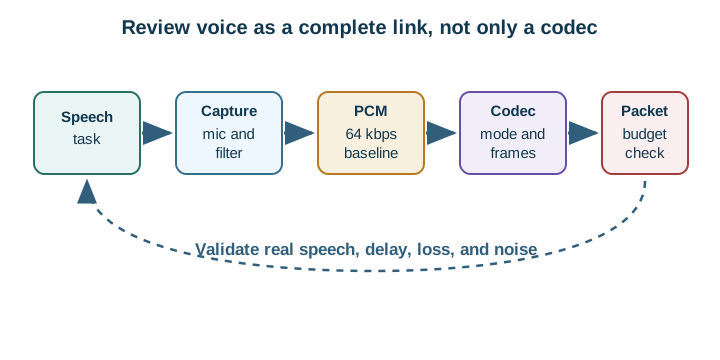
The path is familiar from sampling: a microphone signal is sampled and quantized into numbers, and then compressed before it is packetized and sent.
- Lossy compression is the norm for voice.
- Unlike a file you must reconstruct exactly, speech only needs to stay intelligible and natural enough, so voice codecs discard detail the ear barely notices in exchange for a much smaller stream.
- If this gives you the trade-off, you can stop here.
Major section
Why Voice Gets Compressed (continued)
Mind the delayInteractive conversation needs low end-to-end latency, which limits how much audio you can batch.
- Think of shorthand note-taking: you do not capture every word, only enough to reconstruct the meaning.
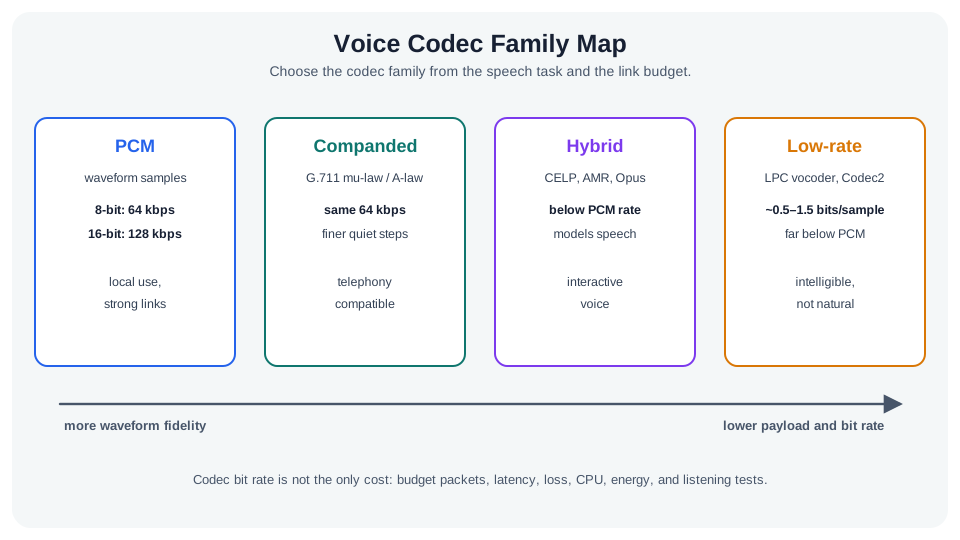
- Raw 8 kHz, 16-bit, mono PCM is 128 kbps before packet headers, and classic 8-bit narrowband PCM is still 64 kbps.
- Working on bench Wi-Fi does not prove a codec works over a constrained field link.
Major section
Apply It: Match the Codec to the Link
The practical job is to pick a codec and bit rate the link can sustain, size the packets to balance overhead against latency and loss, and confirm the result by listening over the real link.
- A practical review starts with the worst hour of the deployment, not the best bench measurement.
- Header Overhead Share.
Major section
Apply It: Match the Codec to the Link (continued)
Low, overhead is amortized.
- A Wi-Fi door station may have enough throughput but suffer roaming gaps and jitter when the access point is busy.
- An LTE-M tracker may have enough coverage for telemetry but limited uplink budget for live speech.
- The packet-size choice sits inside a longer voice path.
Major section
Apply It: Match the Codec to the Link (continued)
Validation uses real audio and a listening result to check the whole route.
- A phone-tethered wearable may depend on BLE connection interval and app foreground behavior.
- Size the packets: Each packet carries header overhead, so very small audio packets waste bandwidth on headers, while large packets add delay and lose more audio per dropped packet.
- If your job is to choose a codec and packet size, you can stop here.
Major section
Apply It: Match the Codec to the Link (continued)
The axis shows the trade-off between waveform fidelity and payload size; the lower note lists costs beyond codec bit rate.
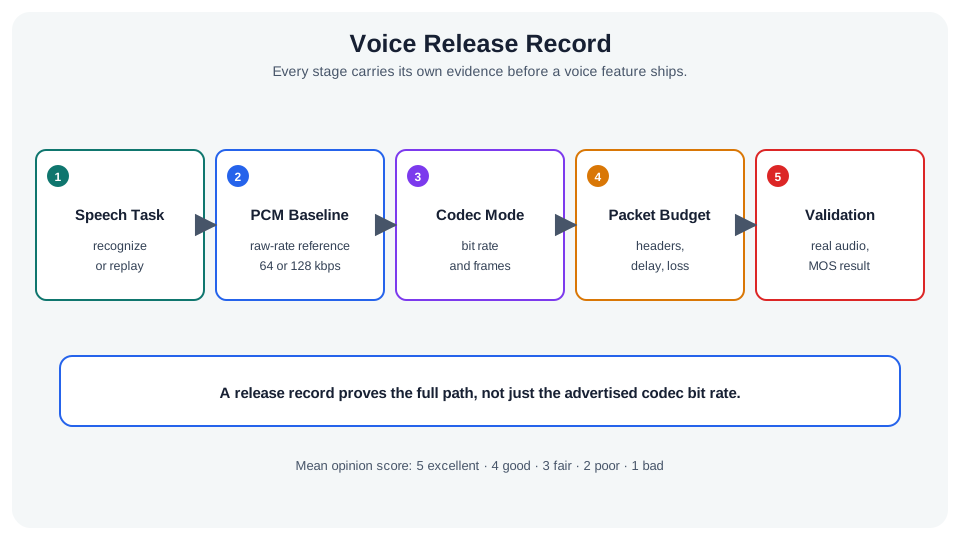
- In Figure: A release record proves the full path, the speech task asks whether the feature must support recognition or replay.
- A PCM baseline gives the raw-rate reference before the codec mode sets its bit rate and frame shape.
- The packet budget then adds headers, delay, and loss, which is why a codec rate alone cannot predict link use or live-call quality.
Major section
Apply It: Match the Codec to the Link (continued)
The record in Figure: A release record proves the full path links speech task, PCM baseline, codec mode, packet budget, and validation; notice why codec bit rate alone cannot release the path.
- Incremental PracticeBeginner For a one-way audio alert, explain why you can batch more audio per packet than for a live call.
- IntermediateGiven a very low reliable bit rate, argue why a speech-model coder may be necessary and what content it assumes.
- Validate with real speech: Listen to representative voices and conditions, because tone tests do not capture intelligibility or conversational delay.
Deck summary
Key takeaways
The audio format, packet overhead, loss, and delay must fit the same path.
- You will compare audio codecs against a PCM baseline and include packet costs when judging whether voice fits a link.
- Raw digital audio is bandwidth-hungry.
- The path is familiar from sampling: a microphone signal is sampled and quantized into numbers, and then compressed before it is packetized and sent.
- Mind the delayInteractive conversation needs low end-to-end latency, which limits how much audio you can batch.
Retrieval practice
Recall check 1 of 2

Physics Phoebe says: answer from memory, then check your reasoning.
Q1Why is lossy compression normal and acceptable for voice links?
Show answer
Answer: C Voice does not require exact-sample reconstruction, so dropping minor detail buys large savings.
Retrieval practice
Recall check 2 of 2
Physics Phoebe says: answer from memory, then check your reasoning.
Q2To cut header overhead, a team puts many audio frames into each packet on an interactive voice link. What is the main cost?
Show answer
Answer: C Batching amortizes headers but increases delay and the audio destroyed by each loss.
Print reference
Answers
Answer key.
- C · Voice does not require exact-sample reconstruction, so dropping minor detail buys large savings.
- C · Batching amortizes headers but increases delay and the audio destroyed by each loss.