IoT Fundamentals · Study deck
Signal Processing Essentials
Picture a vibration sensor reporting a smooth line while a brief machine strike disappears.
Physics Phoebe is your guide for this deck.

After studying this chapter
Learning objectives
A trustworthy signal path preserves the physical event and records evidence at each transformation.
- Trace conditioning, sampling, conversion, and filtering.Each step can remove or alter information.
- Compare raw and filtered evidence.A changed trace needs a faster reference and event capture.
- Choose settings from the event requirements.Accept a setting only after the relevant evidence passes.
Major section
In 60 Seconds
The number looks tidy, but the processing chain may have removed the event the team needed to see.
- Sampling rate means how many measurements are taken each second.
- Analog-to-digital converter means a circuit that turns a voltage into a number; it is often shortened to ADC.
- This runway does not prove that every signal is preserved.
Major section
Start With the Story
You will separate sampling, ADC resolution, and filtering decisions and identify the evidence each one needs.
- The physical signal arrives with limits that a poor sample, conversion, calibration, or filter choice can conceal rather than correct.
- The aligned processing chain preserves evidence before and after each transformation.
Major section
Turn a Signal into Trustworthy Evidence
Signal processing turns a sensor's changing electrical signal into digital evidence that software can trust.
- The essential choices are where the useful signal lives, how fast to sample it, how much ADC resolution is meaningful, what filtering belongs before or after conversion, and how the result will be validated.
Major section
Turn a Signal into Trustworthy Evidence (continued)
The important idea is that the best design is not the fastest or most precise possible.
- Oversized settings can record pages of noise; a good signal-processing design records the part that matters and can show why.
- For example, a motor-current monitor should preserve the short rise that marks a jam or stall, not merely the average current over a long window.
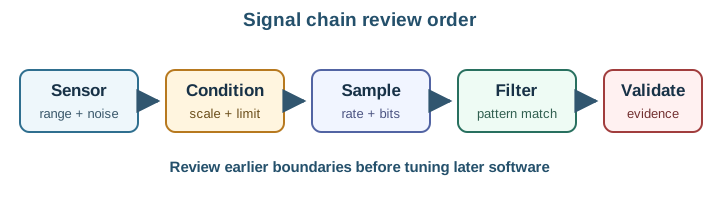
- The sensor starts with a physical range and its own noise.
Major section
Turn a Signal into Trustworthy Evidence (continued)
Sampling too slowly can make the pulse disappear; filtering too aggressively can make it look like a gentle ramp; choosing more ADC bits cannot help if the pulse was never captured.
- The useful design records enough raw evidence to show the event, then filters only the noise pattern that would mislead the decision.
- That record should include one raw trace, one filtered trace, and the reason the filter preserves the event.
- Conditioning scales and limits that output before sampling chooses a rate and bit depth.
- The sensor sets the signal range and noise the system must handle.
Major section
Turn a Signal into Trustworthy Evidence (continued)
Filtering then addresses a named pattern, such as a spike or jitter, rather than trying to repair an event that was never captured.
- For a motor-current pulse, keep a raw trace as well as the filtered trace so the team can see whether a short jam event survived.
- Conditioning scales and limits that signal before sampling fixes the rate and bit depth.
- If you can name the core decisions, you can stop here.
Major section
Apply It: Make a Signal-Processing Decision
Every decision should connect back to the phenomenon the product must preserve.
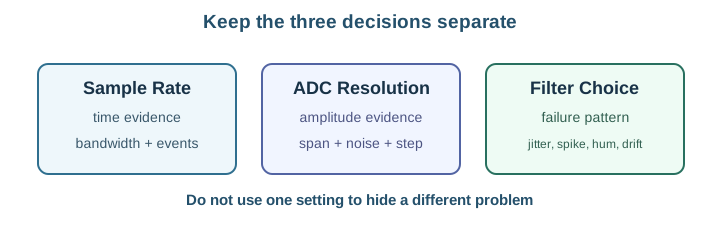
- ADC resolution is an amplitude choice: the span, noise, and code step show whether another bit would reveal meaningful change.
- A high rate cannot remove sensor noise, and extra bits cannot recover a pulse lost to slow sampling.
Major section
Apply It: Make a Signal-Processing Decision (continued)
Too coarse hides changes; too fine records noise and wastes budget.
- Each setting addresses a different problem, so one cannot justify the others.
- Useful bandwidth, event duration, anti-alias boundary, timestamp need.
- Too slow makes false patterns; too fast grows energy, storage, and transmission load.
Major section
Apply It: Make a Signal-Processing Decision (continued)
Sensor range, useful span, required change size, noise, reference, calibration.
- The wrong filter adds lag, smears faults, or removes the event you need.
- IntermediateFor a motor-current channel, write why bandwidth and sampling are checked before any smoothing.
- If you can make and record a defensible decision, you can stop here.
Major section
Under the Hood: Boundaries, Resolution Fit, and Filter Choice
The deeper layer explains why the order of the chain matters and how each setting is bounded by physics rather than by the largest available specification.
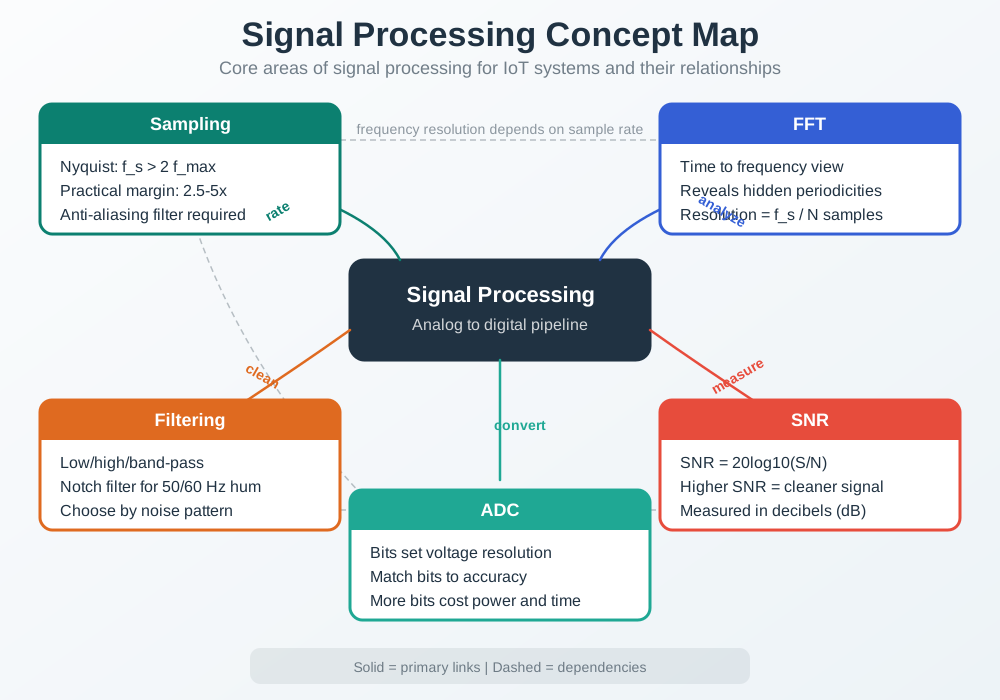
- A concept map keeps the dependencies visible.
- The analogue filter removes unwanted bands before the ADC.
- Bit depth controls a separate limit on small level changes.
Major section
Under the Hood: Boundaries, Resolution Fit, and Filter Choice (continued)
The Boundary RuleDigital filtering cannot recover information that the analog front end or sampling plan already lost.
- Sampling sets time resolution and anti-aliasing requirements; ADC range and bit depth set amplitude resolution; filtering changes lag and bandwidth; SNR limits whether the extra samples or extra bits are actually informative.
- The kept band gives a sound top frequency for the rate choice.
- Resolution FitResolution is an amplitude decision.
Major section
Under the Hood: Boundaries, Resolution Fit, and Filter Choice (continued)
In units, two samples per cycle times fmax cycles per second gives a bound of 2fmax samples per second.
- Aliasing, clipping, saturation, and an unsuitable reference range must be handled before or during conversion, not explained away afterward.
- Software can make a sampled sequence smoother, but it cannot prove that the lost information never mattered.
- If bench noise already jitters by several codes, adding more bits mostly records noise.
Major section
Under the Hood: Boundaries, Resolution Fit, and Filter Choice (continued)
The review should compare required physical change, conditioned voltage span, code step, and measured noise before declaring the resolution good enough.
- If analog noise, sensor accuracy, or calibration uncertainty is larger than the code step, extra bits may add no information.
- Worked example: a load-cell front end may need to detect a 10 g change on a 5 kg scale.
- Where Each Decision Is DevelopedThis chapter is a map.
Major section
Under the Hood: Boundaries, Resolution Fit, and Filter Choice (continued)
Moving averageUse when random jitter dominates and a slower response is acceptable.
- If the conditioned signal maps that change to less than one ADC code, the design needs more gain, a narrower reference, or a better converter.
- The same record should state which physical change the chosen code step can still separate.
- MedianUse when occasional isolated spikes appear and should not pull nearby readings.
Major section
Under the Hood: Boundaries, Resolution Fit, and Filter Choice (continued)
The response sketches show which frequencies pass or are rejected; use them to match the filter to the observed problem.
- Low-passUse when useful behavior is slower than the unwanted high-frequency noise.
- NotchUse when one known interference tone, such as mains hum, can be targeted.
- Common PitfallsTreating more data as better data: Higher rates and wider bit depths can grow files without preserving better evidence.
Major section
Under the Hood: Boundaries, Resolution Fit, and Filter Choice (continued)
Filtering before naming the failure pattern: A filter chosen without evidence can hide the event the system should detect.
- Fixing analog problems in software: Smoothing cannot undo clipping, reference mismatch, saturation, or aliased content.
- The focused chapters carry the deeper method for each decision: timing and Nyquist, code-step and filtering detail, and sensor dynamics.
- At this depth, signal processing is the evidence path between the physical world and a digital decision.
Deck summary
Key takeaways
The number looks tidy, but the processing chain may have removed the event the team needed to see.
- You will separate sampling, ADC resolution, and filtering decisions and identify the evidence each one needs.
- Signal processing turns a sensor's changing electrical signal into digital evidence that software can trust.
- The important idea is that the best design is not the fastest or most precise possible.
- Sampling too slowly can make the pulse disappear; filtering too aggressively can make it look like a gentle ramp; choosing more ADC bits cannot help if the pulse was never captured.
Retrieval practice
Recall check 1 of 3

Physics Phoebe says: answer from memory, then check your reasoning.
Q1A sampled signal looks unstable and hard to interpret. Which set of basics should be checked first?
Show answer
Answer: B Signal quality depends on sampling, filtering, calibration, sensor range, and the noise sources around the measurement.
Retrieval practice
Recall check 2 of 3
Physics Phoebe says: answer from memory, then check your reasoning.
Q2A sampled sensor trace looks smooth, but a faster reference capture shows brief pulses that never appear in the logged data. What should be reviewed first?
Show answer
Answer: C If the event is missed before or during sampling, no later filtering can recover it.
Retrieval practice
Recall check 3 of 3
Physics Phoebe says: answer from memory, then check your reasoning.
Q3A channel shows occasional isolated spikes. An engineer adds a long moving-average filter to remove them. What is the likely problem?
Show answer
Answer: C Averaging spreads a spike's energy and delays the response.
Print reference
Answers
Answer key.
- B · Signal quality depends on sampling, filtering, calibration, sensor range, and the noise sources around the measurement.
- C · If the event is missed before or during sampling, no later filtering can recover it.
- C · Averaging spreads a spike's energy and delays the response.