Cellular IoT · Study deck
Sigfox Continuity and Service Risks
A remote tank sensor may work well at the pilot site and still fail as a product.
Radio Remi is your guide for this deck.

After studying this chapter
Learning objectives
You will be able to:
- Explain why managed-service dependency belongs in Sigfox release review.
- Identify the evidence that proves a service dependency is acceptable for a given use case.
- Classify continuity risks across service evidence, callback ownership, monitoring, and replacement paths.
- Build an incident triage path that separates device, service, backend, application, and owner action.
Major section
Start With the Story
The radio service, message path, callback, account, and support process all belong to the result.
- A coverage colour on a map cannot prove those parts.
- The device team may change placement or retry rules.
- The service operator may own network records.
- The product team still owns the user promise and the fallback when evidence is missing.
Major section
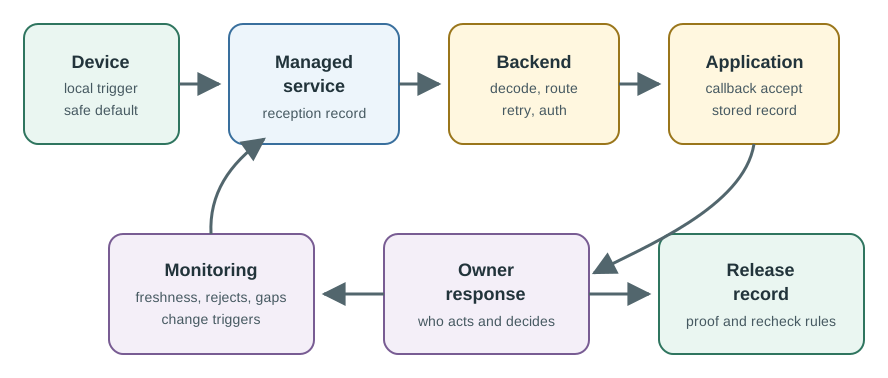
Service-Risk Review Map
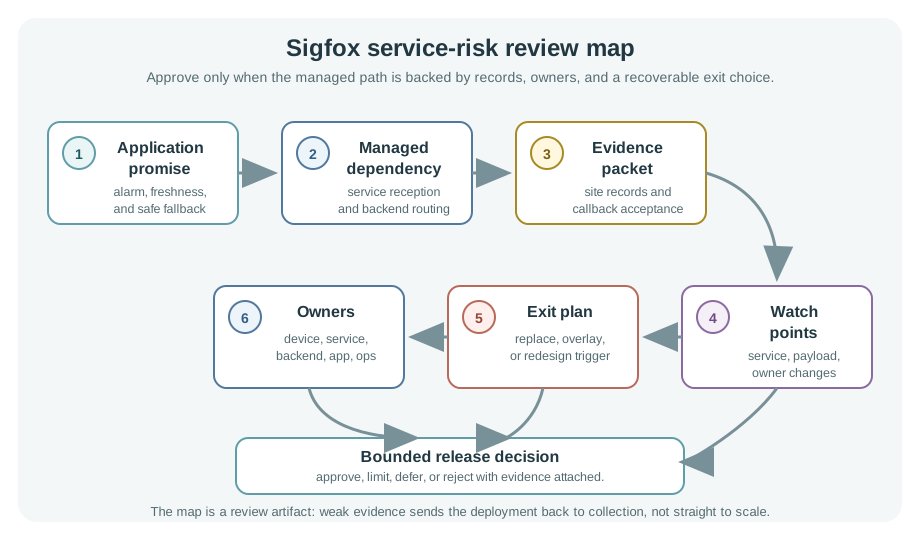
Each step turns an assumption into evidence that can be checked again later.
- The release record must join those separate proofs to an owner and a replacement trigger before scale is accepted.
Major section
Managed-Service Dependency
The order reveals where control changes hands and where evidence can stop: service reception alone cannot prove decoder correctness or application acceptance, while an alert without a named responder cannot protect continuity.
- Device Local promise The device should keep safe defaults and send compact records that match the application need.
Major section
Managed-Service Dependency (continued)
Sigfox can reduce infrastructure work for the product team, but that convenience changes who controls the receiving path.
- Service Reception evidence Representative locations should show usable service records under realistic placement and enclosure conditions.
- Backend Routing proof Decoders, callbacks, retry behavior, and authentication should be tested as release artifacts.
- Owners Response model Device, service, backend, application, and operations failures need named responders.
Major section
Continuity Risks to Track
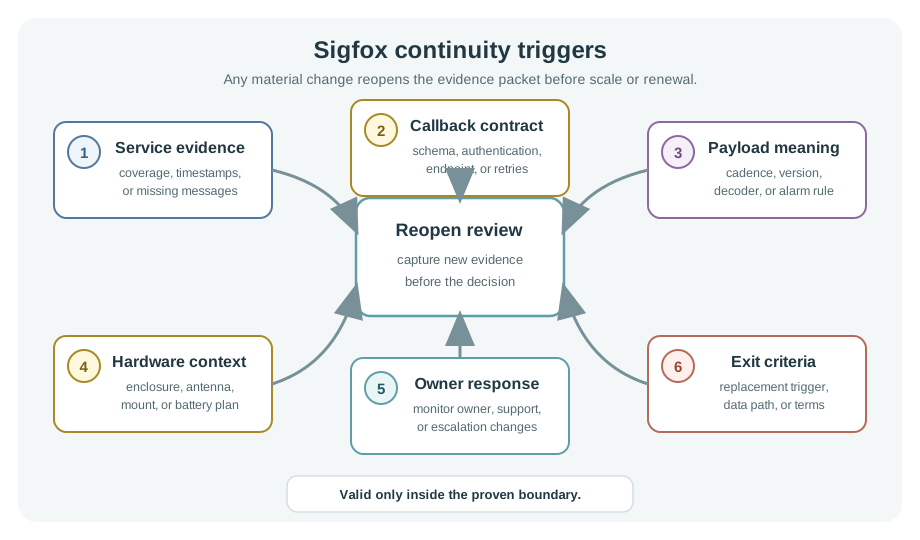
Continuity risk should be written as a checkable trigger, not as a vague warning.
- This loop connects continuity planning to observable operations: name the changed fact, gather replacement evidence, assign authority, and either update the release limits or choose another path.
- Data path Callback changes Recheck when decoder versions, callback schemas, authentication, or endpoint behavior changes.
Major section
Continuity Risks to Track (continued)
Service Evidence changes Recheck when representative reception records weaken, become inconsistent, or no longer cover the deployment promise.
- Device Product changes Recheck when firmware cadence, enclosure, antenna position, mounting class, or payload version changes.
- Lifecycle Exit triggers Recheck when service evidence cannot be restored, owners cannot respond, or the application promise changes.
- A strong review sits between those extremes: it records what has been proven, what has not been proven, and what would cause the team to revisit the design.
Major section
Incident Triage and Owner Response
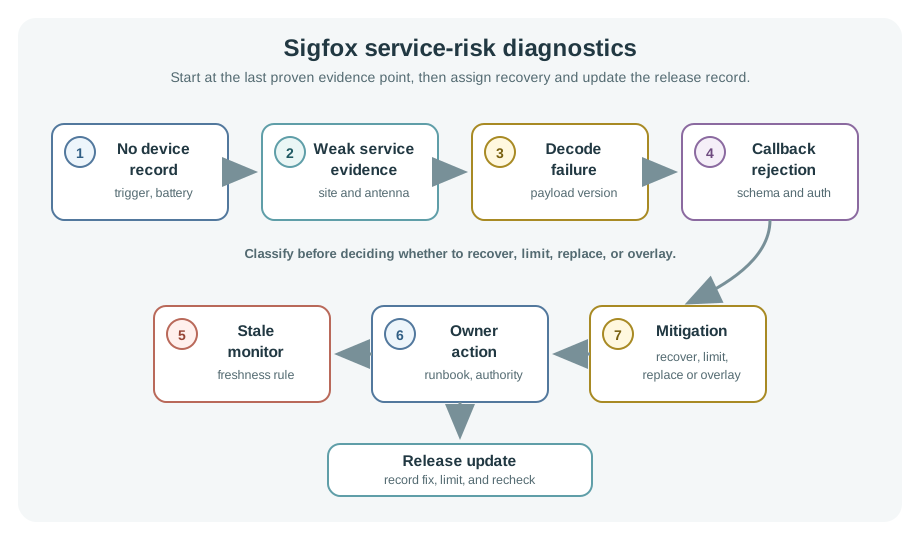
When a service-dependent deployment fails, do not start with a single favorite explanation.
- That order preserves causality and evidence: it distinguishes a radio or device failure from schema rejection, endpoint failure, stale monitoring, or an ownership gap, and it feeds the learned limit back into the continuity record.
Major section
Exit Planning Without Panic
An exit plan is not a decision to leave immediately.
- Trigger When to reconsider Define the evidence pattern that would move the deployment from watch, to limited release, to replacement work.
- Data What to preserve Keep payload contracts, decoder tests, callback schemas, device identifiers, and application records portable.
- Device What can change Record whether enclosure, antenna, firmware cadence, or radio module choices would block a future replacement path.
Major section
Continuity Dependency Record
Sigfox continuity risk is the risk that an application promise depends on a service path the product team does not fully own.
- The right response is not vague confidence; it is a record of what is proven, what is watched, who responds, and what changes force a new decision.
- A message in one layer does not prove success in the next.
- A good continuity record also says what evidence is missing.
Major section
Continuity Dependency Record (continued)
For a low-criticality meter reader, the acceptable record may be a representative sample of installed devices, regular freshness checks, and a written owner for stale-data incidents.
- For a public-warning use case, the same evidence would be too thin unless it also proves alert creation, escalation, and a recover-or-replace trigger.
- Missing evidence does not always mean "never use Sigfox"; it means the release decision must be limited to what has actually been proven.
- That distinction keeps pilots honest, prevents silent scope creep, and gives the next reviewer a concrete list of checks to complete before scale.
Major section
Sigfox Continuity Register
The continuity register is a living release artifact.
- Each row should say which part of the path is being trusted, what evidence proves it today, who owns the response, and what event reopens the decision.
- If any column is blank, the deployment may still be useful as a trial, but it is not yet a clean scale decision.
- A waste-bin sensor may tolerate missed reports for hours; a flood-warning sensor may need much tighter freshness and escalation.
Major section
Reception Is Not Application Success
If the last proven event is service reception, the next checks are decoder output, callback response, backend acceptance, freshness rule, and owner action.
- The device can be healthy while a callback credential expires.
- The service can receive the message while the payload version is no longer decoded.
- The same boundary logic protects exit planning.
Major section
Reception Is Not Application Success (continued)
Device firmware emits the payload, the service receives and routes it, a decoder interprets bytes, a callback delivers data, backend logic stores or rejects it, and the application turns it into a user-visible decision.
- A backend can store data while the alert owner never sees the incident.
- If the last proven event is application acceptance, the next checks move toward alert routing, workflow state, and customer-visible response.
- If a future replacement is needed, portable identifiers, payload contracts, decoder tests, and accepted application records make it possible to compare another communication path without losing the meaning of historical data.
Deck summary
Key takeaways
The radio service, message path, callback, account, and support process all belong to the result.
- Each step turns an assumption into evidence that can be checked again later.
- The order reveals where control changes hands and where evidence can stop: service reception alone cannot prove decoder correctness or application acceptance, while an alert without a named responder cannot protect continuity.
- Sigfox can reduce infrastructure work for the product team, but that convenience changes who controls the receiving path.
- Continuity risk should be written as a checkable trigger, not as a vague warning.
Retrieval practice
Recall check 1 of 5

Radio Remi says: answer from memory, then check your reasoning.
Q1A flood-warning pilot uses Sigfox drain-level sensors at five culverts. The service dashboard shows a few uplinks, but the city wants to scale to 180 sites before the rainy season. What is the best continuity review response?
Show answer
Answer: B Continuity review turns managed-service assumptions into evidence, owners, and recovery choices.
Retrieval practice
Recall check 2 of 5

Radio Remi says: answer from memory, then check your reasoning.
Q2A pilot has service records from one easy location, but no callback logs, no freshness monitor, and no named response owner. What is the strongest continuity finding?
Show answer
Answer: C Dependency evidence must follow the record from the device through service, backend, application, monitoring, and owners.
Retrieval practice
Recall check 3 of 5

Radio Remi says: answer from memory, then check your reasoning.
Q3After release, the device payload format changes and callback rejects begin to appear. Which continuity trigger should reopen the review?
Show answer
Answer: D Continuity triggers cover both service evidence and the downstream data path.
Retrieval practice
Recall check 4 of 5

Radio Remi says: answer from memory, then check your reasoning.
Q4A dashboard is stale. The service has recent records, but callback responses show repeated rejection after an application change. What should the review inspect first?
Show answer
Answer: B Incident triage follows evidence from the last proven point to the first failed point.
Retrieval practice
Recall check 5 of 5

Radio Remi says: answer from memory, then check your reasoning.
Q5Place each continuity record where it lives so you can connect a bounded application promise to service proof, accountable monitoring, and an exit decision.
Show answer
Answer: A Separate promise, managed-service proof, and continuity governance so you can see which risks are evidenced, owned, and reversible.
Q6A Sigfox service dashboard shows received messages, but the application did not raise customer alerts for several hours. What should the continuity review check first?
Show answer
Answer: C Service reception is only one boundary.
Print reference
Answers 1 of 2
Answer key.
- B · Continuity review turns managed-service assumptions into evidence, owners, and recovery choices.
- C · Dependency evidence must follow the record from the device through service, backend, application, monitoring, and owners.
- D · Continuity triggers cover both service evidence and the downstream data path.
- B · Incident triage follows evidence from the last proven point to the first failed point.
- A · Separate promise, managed-service proof, and continuity governance so you can see which risks are evidenced, owned, and reversible.
Print reference
Answers 2 of 2
Answer key.
- C · Service reception is only one boundary.