Cellular IoT · Study deck

Sigfox Deployment

Picture a flood gauge beside a river where no technician can watch it each day.

Radio Remi is your guide for this deck.

sigfoxdeployment
Radio Remi, the module guide, in a scene from this chapter.
iotclass.org

After studying this chapter

Learning objectives

You will be able to:

  • Explain: A Sigfox-style deployment is ready to scale only when the team can prove messages arrive from representative devices, in representative places, with the final payload, cadence, provisioning path, callback route, and operations owner.
  • Explain: The release packet should make identity, provisioning, decoder configuration, callback ownership, monitoring, device replacement, and retirement visible enough that operations can maintain the estate without rediscovering the pilot assumptions.
  • Explain: Each device must have an identity record, activation state, payload decoder, callback route, application mapping, monitoring rule, and support owner before it is installed where recovery is expensive.
iotclass.org

Major section

Start With the Story · Phoebe's Field Notes: Why a Moving Tracker Keeps Its Antenna Nearly Isotropic

A desk test succeeds, but trees, ground, weather, antenna angle, and service coverage change the real path.

  • The field lead must prove that useful records arrive from the hard locations.
  • A quiet record must be marked missing or stale, not assumed safe.
iotclass.org

Major section

Device Management And Operations · Payload Cadence And Use-Case Fit

Device management starts before installation.

  • The release packet should make identity, provisioning, decoder configuration, callback ownership, monitoring, device replacement, and retirement visible enough that operations can maintain the estate without rediscovering the pilot assumptions.
  • Deployment approval should prove that the payload and cadence match the use case.
  • A compact telemetry product can fit Sigfox well; a product that needs rich transfer, frequent commands, or low-latency control should reopen the technology decision.
iotclass.org

Major section

Worked Deployment Examples · No-Hardware Lab Practice

For an asset tracker, release evidence should show representative mounting positions, expected movement states, message freshness windows, and owner response when updates stop.

  • For a meter or environmental sensor, the evidence should show payload meaning, site materials, enclosure effects, callback acceptance, and exception handling before scale.
  • When hardware is not available, run the deployment review as a table-top lab.
  • The lab should not claim field readiness; it should prove that the team can ask for the right evidence before devices are installed.

Try it: Worked Deployment Examples · No-Hardware Lab Practice in the chapter

iotclass.org

Major section

Site Evidence Before Scale · Check 2: Site Evidence
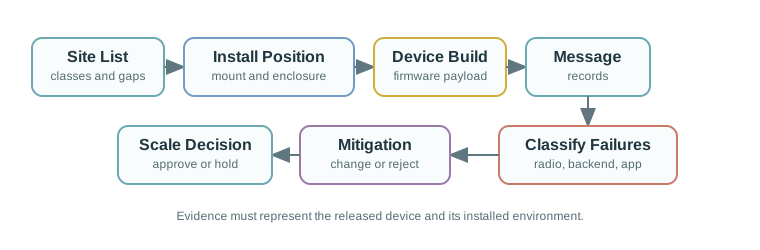
Deployment planning starts with a site list, but release approval depends on representative records.

  • Classify any failure at the first unsupported boundary, choose a mitigation, then decide whether that site class may scale.
Sigfox site evidence packet showing site list, installation position, device build, message records, failure classification, mitigation choice, and scale decision.
iotclass.org

Major section

Provisioning and Backend Dry Run

Provisioning is not paperwork after the radio works.

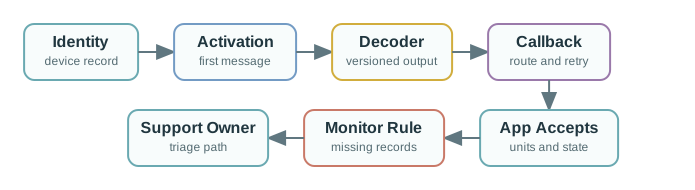
  • Each device must have an identity record, activation state, payload decoder, callback route, application mapping, monitoring rule, and support owner before it is installed where recovery is expensive.
  • Monitoring Assign an owner Every missing-device alert, decoder error, callback failure, and service incident needs a named triage path.
Sigfox provisioning dry run showing device identity, activation record, payload decoder, callback route, application acceptance, monitor rule, and support owner.
iotclass.org

Major section

Check 3: Provisioning · Rollout Waves and Stop Rules
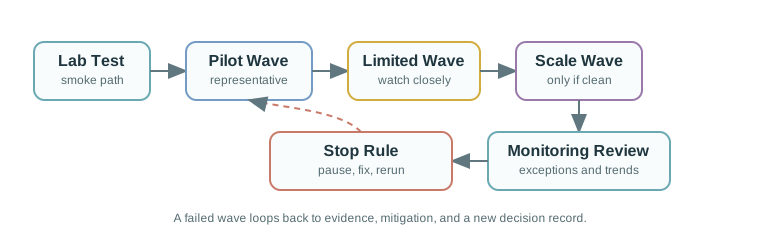
Monitoring continues across the waves; a stop symptom loops back to correction rather than becoming an undocumented exception.

  • The progression connects sample size to confidence: each wave needs an entry rule, observation window, stop rule, exception log, rollback action, and decision owner.
Sigfox rollout wave plan showing lab smoke test, representative pilot, limited rollout, scale rollout, monitoring review, and stop rule feedback.
iotclass.org

Major section

Check 4: Rollout Control · Operations Handoff
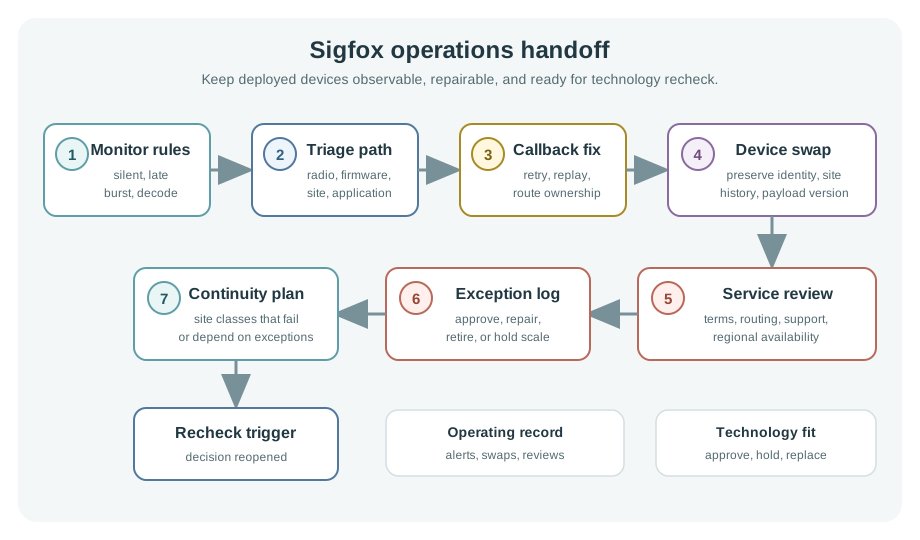
The deployment is not complete when the last device is installed.

  • Exception review and the continuity plan determine whether the mitigation remains supportable, while the recheck trigger returns material changes to technology review.
  • This loop connects installation to long-term ownership; alerts without authority, swap records, escalation, and exit criteria are not an operational handoff.
Sigfox operations handoff showing monitor rules, incident triage, callback repair, device swap, service change review, exception review, continuity plan, and recheck trigger.
iotclass.org

Major section

Deployment Anti-Patterns to Reject · Release Readiness Packet
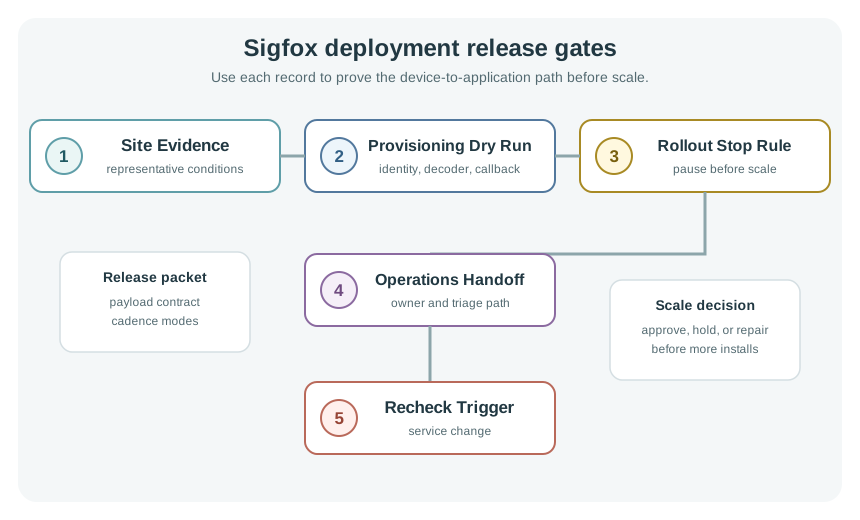
Planning-only Approving from a planning view A planning view helps choose pilot locations.

  • Aggregate-only Hiding site-class failures A strong overall delivery summary can still hide one failing site class.
  • No exit Ignoring recheck triggers Managed-service deployments need a written trigger for service, payload, cadence, site, ownership, or product changes.
Sigfox deployment release gates showing site evidence, provisioning dry run, rollout stop rule, operations handoff, and recheck trigger.
iotclass.org

Major section

Practice Interaction: Label the Diagram · Deployment Evidence Chain
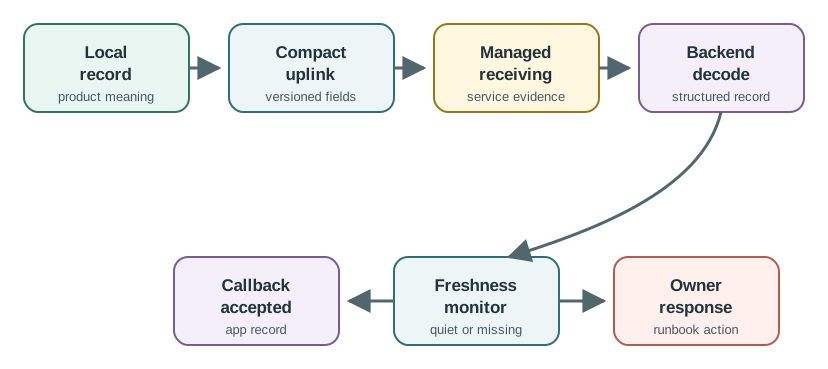
A Sigfox-style deployment is ready to scale only when the team can prove messages arrive from representative devices, in representative places, with the final payload, cadence, provisioning path, callback route, and operations owner.

  • The deployment risk is not only radio coverage.

Why it matters

This evidence-first stance is especially important for managed LPWAN because the project does not directly control every network element.

Sigfox evidence chain from local device record through compact uplink, managed reception, backend decode, callback acceptance, freshness monitoring, and owner response.
iotclass.org

Major section

Sigfox Release Record

The release record should make every deployment assumption testable.

  • It should show which sites were represented, which devices were provisioned, which payloads were decoded, and which owner responds when a message is late or missing.
  • If the promise is a daily meter reading, the record needs freshness evidence and a missing-reading response.
  • If the promise is an alarm, it needs worst-case latency, callback failure handling, and a safe local behavior while the device is silent.
iotclass.org

Major section

Managed Service Ownership Review

Managed LPWAN can simplify network ownership, but it does not remove responsibility for the deployment.

  • A deployment gate must test the whole chain, not just the radio hop.
  • Those boundaries fail in different ways.
  • Callback trouble looks like rejected, duplicated, late, or unactioned records.
  • Downlink limits make ownership explicit.

Key terms

Provisioning changes
Provisioning changes are another hidden failure mode.
iotclass.org

Major section

Managed Service Ownership Review (continued)

The result should be a named exception and response path, not only a failed test note.

  • Ownership trouble looks like an alert that is visible but not assigned to someone with authority to act.
  • Provisioning changes are another hidden failure mode.
  • The radio evidence may look healthy while the application record is wrong.
iotclass.org

Deck summary

Key takeaways

A desk test succeeds, but trees, ground, weather, antenna angle, and service coverage change the real path.

  • Device management starts before installation.
  • For an asset tracker, release evidence should show representative mounting positions, expected movement states, message freshness windows, and owner response when updates stop.
  • Deployment planning starts with a site list, but release approval depends on representative records.
  • Provisioning is not paperwork after the radio works.
iotclass.org

Retrieval practice

Recall check 1 of 6

Radio Remi says: answer from memory, then check your reasoning.

Q1A team has a compact payload and a working lab message, but it has not tested the device inside the real enclosure at representative installation locations. What should happen before deployment approval?

AHold approval until real site evidence covers the release path
BApprove deployment because the payload and lab message already prove the design
CSkip the pilot and rely on a planning view of service availability
DDelay only the application integration while deploying devices in the field
Show answer

Answer: A Sigfox deployment readiness depends on evidence across the full device-to-application path, not only payload fit or a lab transmission.

iotclass.org

Retrieval practice

Recall check 2 of 6

Radio Remi says: answer from memory, then check your reasoning.

Q2A pilot report says, 'Messages were received from five devices on a desk near the office window.' The production devices will be mounted inside equipment cabinets. What is the strongest review finding?

ADesk-near-window evidence does not cover cabinet installs
BThe pilot validates reception; cabinet mounting is an assembly detail
CThe only missing item is a larger device count
DThe team should remove the enclosure requirement from the deployment record
Show answer

Answer: A A pilot must represent the installation environment.

iotclass.org

Retrieval practice

Recall check 3 of 6

Radio Remi says: answer from memory, then check your reasoning.

Q3A deployment plan registers devices but leaves callback retries, decoder versioning, and missing-message ownership for operations to define later. What is the deployment risk?

AThe device-to-application path is not release ready
BThere is no risk if the radio message reaches the managed-service backend
CThe issue can be ignored because callbacks are unrelated to deployment
DThe only required fix is to increase the normal reporting cadence
Show answer

Answer: A A dry run must prove the backend and operating path that will support the installed devices.

iotclass.org

Retrieval practice

Recall check 4 of 6

Radio Remi says: answer from memory, then check your reasoning.

Q4A project wants to install all devices at once because the pilot devices worked. The pilot did not include callback outage testing or installer handoff. What is the best deployment response?

AUse rollout waves with stop rules for operations defects
BInstall everything immediately because the radio path was already proven
CReplace the pilot record with a summary that hides the missing tests
DSkip monitoring until the second maintenance cycle
Show answer

Answer: A Deployment waves reduce risk by making operational and backend failures visible before full rollout.

iotclass.org

Retrieval practice

Recall check 5 of 6

Radio Remi says: answer from memory, then check your reasoning.

Q5Place each deployment control where it lives so you can prove the field path, bound rollout risk, and hand an observable service to operations.

ASite Evidence
BProvisioning Dry Run
CRollout Stop Rule
DOperations Handoff
Show answer

Answer: A Follow field proof, rollout control, and operational learning so you can scale only the Sigfox conditions that were actually tested and owned.

iotclass.org

Retrieval practice

Recall check 6 of 6

Radio Remi says: answer from memory, then check your reasoning.

Q6A Sigfox pilot sends messages from three lab devices, but the rollout plan has no missing-message stop rule or operations owner. What is the strongest deployment review finding?

AAdd release evidence, stop rules, and ownership
BTreat any successful lab message as site proof
CRemove monitoring so failures cannot block scale
DRename payload fields before the release meeting
Show answer

Answer: A Lab messages prove only a narrow path.

iotclass.org

Print reference

Answers 1 of 2

Answer key.

  1. A · Sigfox deployment readiness depends on evidence across the full device-to-application path, not only payload fit or a lab transmission.
  2. A · A pilot must represent the installation environment.
  3. A · A dry run must prove the backend and operating path that will support the installed devices.
  4. A · Deployment waves reduce risk by making operational and backend failures visible before full rollout.
iotclass.org

Print reference

Answers 2 of 2

Answer key.

  1. A · Follow field proof, rollout control, and operational learning so you can scale only the Sigfox conditions that were actually tested and owned.
  2. A · Lab messages prove only a narrow path.
iotclass.org