Actuators & Control · Study deck
Servo Motors: Position, Motion, and Power
A vent may be told to half open yet press against its stop.
Motor Max is your guide for this deck.

After studying this chapter
Learning objectives
You will be able to:
- Explain: For smooth motion from 0° to 180° over 1 second at 50 Hz, you send 50 commands with angular step $\Delta\theta = 180/50 = 3.6°$ per frame.
- Explain: A bare motor can spin, but the useful story is angle, holding torque, travel limits, and evidence that the louver reached the intended position.
- Explain: Pulse-width modulation means controlling a signal by changing how long each pulse stays on; it is often shortened to PWM.
- Explain: The design still has to prove power margin, linkage geometry, calibrated pulse widths, and safe behavior at the ends of travel.
Major section
Start With the Story
The command alone cannot show whether the mechanism moved safely or reached the requested angle.
- An actuator means a part that turns an electrical command into physical action.
- Pulse-width modulation means controlling a signal by changing how long each pulse stays on; it is often shortened to PWM.
Major section
Start With the Story (continued)
This runway does not prove that one servo fits every load.
- The deeper sections explain torque, pulse calibration, gearing, power margin, linkage geometry, feedback, and safe travel limits.
- A bare motor can spin, but the useful story is angle, holding torque, travel limits, and evidence that the louver reached the intended position.
- The design still has to prove power margin, linkage geometry, calibrated pulse widths, and safe behavior at the ends of travel.
Major section
Servo Motor Fundamentals
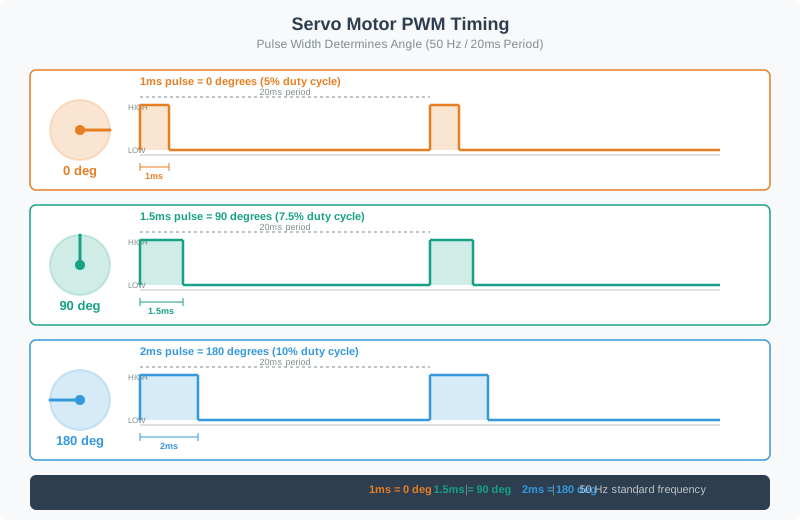
Servo motors provide precise angular positioning (typically 0-180 degrees) using command pulses.
- The package simplifies control but does not remove stall-current or load-margin checks.
- The internal potentiometer continuously measures shaft position, and the control circuit compares this to the commanded position from the PWM signal.

Major section
Putting Numbers to It
At 50 Hz, the period is $T = 1/50 = 20$ ms.
- A 1.5 ms pulse for 90° means duty cycle $D = 1.5/20 = 0.075 = 7.5\%$.
- For smooth motion from 0° to 180° over 1 second at 50 Hz, you send 50 commands with angular step $\Delta\theta = 180/50 = 3.6°$ per frame.
Deck summary
Key takeaways
The command alone cannot show whether the mechanism moved safely or reached the requested angle.
- This runway does not prove that one servo fits every load.
- Servo motors provide precise angular positioning (typically 0-180 degrees) using command pulses.
- At 50 Hz, the period is $T = 1/50 = 20$ ms.
Retrieval practice
Recall check

Motor Max says: answer from memory, then check your reasoning.
Q1A smart air vent needs to move a louver to 30, 60, or 90 degrees and hold that angle against light airflow. Which actuator choice best matches the job?
Show answer
Answer: A Servo motors are the usual fit when an IoT device needs simple commanded angles with built-in feedback and holding torque.
Print reference
Answers
Answer key.
- A · Servo motors are the usual fit when an IoT device needs simple commanded angles with built-in feedback and holding torque.