Design Patterns · Study deck
Service Resilience: Breakers, Retries, and Timeouts
A blind retry can run one actuator command twice.
Blueprint Bina is your guide for this deck.

After studying this chapter
Learning objectives
You will be able to:
- Explain: Normal device traffic reaches capacity before the dependency failure; synchronized clients then retry on the same schedule, creating a second spike above server capacity precisely while the service is trying to recover.
- Explain: The exhausted analytics partition rejects or queues analytics work inside its own budget, while the telemetry and notification partitions retain workers and connections for their separate service obligations.
- Explain: Cancel work: Propagate cancellation so downstream services stop doing work after the caller no longer needs the result.
- Explain: A database query, external API, model inference endpoint, or message broker takes much longer than expected.
Major section
Failure Modes in IoT Services
A database query, external API, model inference endpoint, or message broker takes much longer than expected.
- A recovering dependency receives synchronized traffic and fails again.
- A lost acknowledgement makes a caller retry a command that already succeeded.
- One dependency consumes the shared worker pool, connection pool, queue, or rate limit.
Major section
Failure Modes in IoT Services (continued)
Healthy features are blocked by an unhealthy dependency.
- Cloud services are unreachable but the edge gateway, local device network, or cached configuration still works.
- The system needs a local or degraded operating mode.
- One malformed message fails repeatedly and blocks a queue consumer.
- The pipeline needs retry limits and a dead-letter route.
Major section
Circuit Breaker Pattern
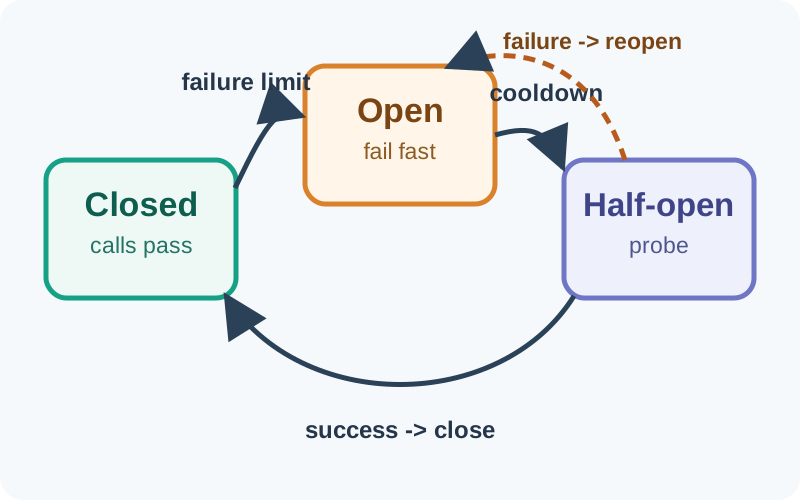
A circuit breaker is a state machine around a dependency call.
- It decides whether the caller should attempt the dependency now or fail fast and use fallback behavior.
- A timer alone does not declare the dependency healthy: probe outcomes do.
- Calls do not reach the dependency.
- The caller returns fallback behavior quickly and protects its own resource pool.
Major section
Retry, Backoff, and Jitter
Retries are useful only when the failure is likely transient and the operation is safe to repeat.
- A retry policy should answer four questions before it is enabled.
- Reads are usually safe.
- Writes need idempotency keys, command sequence numbers, or server-side deduplication.
- Retries must fit inside the caller's total deadline.
Major section
Retry, Backoff, and Jitter (continued)
Connection resets, rate limits, and temporary unavailability can be retry candidates.
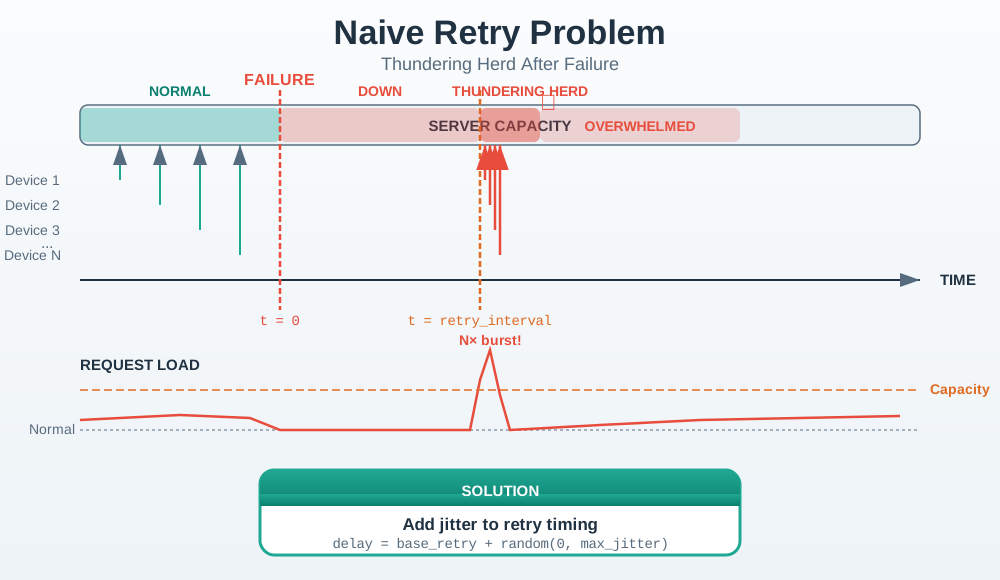
- Normal device traffic reaches capacity before the dependency failure; synchronized clients then retry on the same schedule, creating a second spike above server capacity precisely while the service is trying to recover.
- Invalid input, authorization failure, and missing resources usually are not.
- Exponential backoff reduces pressure.
Major section
Timeouts and Deadlines
Resilient services usually need both.
- A status request may have a small budget; a firmware transfer may have a larger one.
- Cancel work: Propagate cancellation so downstream services stop doing work after the caller no longer needs the result.
- The service may open circuits or use fallback unnecessarily.
Major section
Bulkhead Pattern
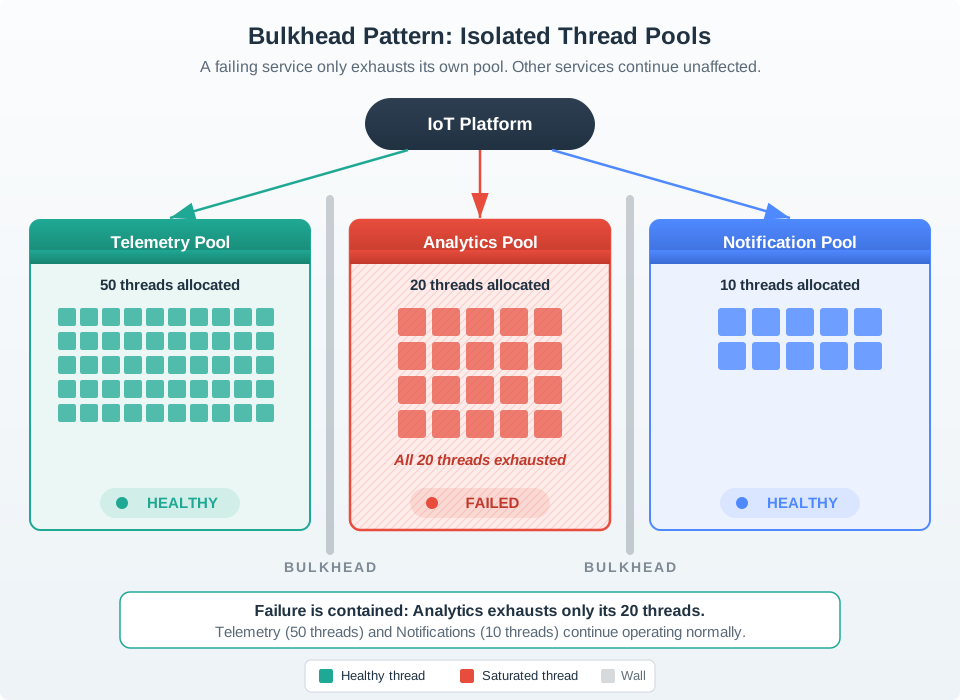
Bulkheads limit the blast radius of a dependency, tenant, device fleet, or workload class.
- The goal is simple: one failing dependency should not consume all resources that healthy work needs.
- The exhausted analytics partition rejects or queues analytics work inside its own budget, while the telemetry and notification partitions retain workers and connections for their separate service obligations.
Major section
Fallback and Graceful Degradation
Fallback is not the same as hiding the problem.
- A good fallback is honest, useful, and bounded.
- For high-risk physical actions, require an operator to confirm state rather than silently retrying.
- When no safe fallback exists, fail clearly and preserve resources instead of pretending the action succeeded.
Major section
Common Pitfalls
Increasing timeouts may hide symptoms while making resource exhaustion worse.
- Failing fast protects resources, but the product still needs a user-visible or workflow-visible degraded result.
- One pool for every downstream call makes one slow dependency everyone's incident.
- Backoff without jitter can still synchronize clients.
- Jitter is essential for device fleets.
Major section
Summary
Retries need idempotency, backoff, jitter, and a retry budget.
- Circuit breakers fail fast after repeated failure signals and use half-open probes for recovery.
- Bulkheads isolate resource pools so healthy features keep working.
- Fallback behavior should be explicit, tested, observable, and honest about degraded mode.
Deck summary
Key takeaways
A database query, external API, model inference endpoint, or message broker takes much longer than expected.
- Healthy features are blocked by an unhealthy dependency.
- A circuit breaker is a state machine around a dependency call.
- Retries are useful only when the failure is likely transient and the operation is safe to repeat.
- Connection resets, rate limits, and temporary unavailability can be retry candidates.
Retrieval practice
Recall check 1 of 6

Blueprint Bina says: answer from memory, then check your reasoning.
Q1A telemetry enrichment service calls a machine-learning endpoint. The endpoint starts timing out. After repeated timeouts, the caller opens its circuit breaker and serves last-known enrichment metadata from cache. What is the main benefit?
Show answer
Answer: A Circuit breakers prevent cascading failure by stopping calls that are likely to waste resources.
Retrieval practice
Recall check 2 of 6

Blueprint Bina says: answer from memory, then check your reasoning.
Q2A gateway sends a command to unlock a service cabinet. The network drops before the gateway receives the acknowledgement. The command may have succeeded. What should the retry policy require before sending the command again?
Show answer
Answer: B Retries for actuator and provisioning commands need idempotency.
Retrieval practice
Recall check 3 of 6

Blueprint Bina says: answer from memory, then check your reasoning.
Q3A service call has a two-second user deadline. The first attempt to a downstream service fails after 1.8 seconds. What should a well-designed retry policy do next?
Show answer
Answer: A Retries belong inside a deadline and retry budget.
Retrieval practice
Recall check 4 of 6

Blueprint Bina says: answer from memory, then check your reasoning.
Q4Place each control where it lives so you can predict how a service call stops, recovers, and degrades when its dependency fails.
Show answer
Answer: A These regions connect the decision from evidence to action so you can predict how a service call stops, recovers, and degrades when its dependency fails.
Retrieval practice
Recall check 5 of 6

Blueprint Bina says: answer from memory, then check your reasoning.
Q5A configuration service returns HTTP 503 during a rolling restart. Device clients need to retry, but the platform has hundreds of thousands of devices. Which retry behavior is most appropriate?
Show answer
Answer: A Retry storms are common in device fleets.
Retrieval practice
Recall check 6 of 6

Blueprint Bina says: answer from memory, then check your reasoning.
Q6Which statement best describes the difference between a circuit breaker and a bulkhead?
Show answer
Answer: A Circuit breakers and bulkheads solve different parts of the resilience problem.
Print reference
Answers
Answer key.
- A · Circuit breakers prevent cascading failure by stopping calls that are likely to waste resources.
- B · Retries for actuator and provisioning commands need idempotency.
- A · Retries belong inside a deadline and retry budget.
- A · These regions connect the decision from evidence to action so you can predict how a service call stops, recovers, and degrades when its dependency fails.
- A · Retry storms are common in device fleets.
- A · Circuit breakers and bulkheads solve different parts of the resilience problem.