Design Patterns · Study deck
Service Resilience: Operating Context and Control Map
A remote command crosses services that can fail at different speeds.
Blueprint Bina is your guide for this deck.

After studying this chapter
Learning objectives
You will be able to:
- Explain how slow dependencies create cascading failures in service-oriented IoT systems.
- Choose between timeout, retry, circuit breaker, bulkhead, rate limit, and fallback controls for a given failure mode.
- Configure retries around idempotency, exponential backoff, jitter, and deadline budgets.
- Describe the closed, open, and half-open states of a circuit breaker.
Major section
Minimum Viable Understanding
Timeouts and deadlines define the maximum wait: Without a deadline, slow dependencies can hold resources until healthy work is starved.
- Retries are for transient and safe operations: Retry reads, idempotent writes, or writes with request IDs; do not blindly retry commands that may have already changed the physical world.
- Circuit breakers fail fast after repeated failure signals: They protect callers from wasting resources on a dependency that is already failing.
- Bulkheads isolate resource pools: Separate workers, queues, connection pools, and rate budgets keep one dependency from consuming the whole service.
Major section
Resilience Protects The Caller First
Resilience is not about making every dependency succeed.
- In a service-oriented IoT platform, a device-command API may depend on an authorization service, a device registry, a broker, a notification provider, a time-series store, and a support-ticket integration.
- A repeated status read is usually harmless.
- Resilience controls therefore protect the caller in layers.
Major section
Resilience Protects The Caller First (continued)
Think about a gateway that sends cold-room temperature readings and accepts remote defrost commands.
- If any one of those dependencies hangs, the caller needs a controlled answer before its worker pool, queue, or user-facing deadline is exhausted.
- A deadline bounds the total wait.
- A retry policy decides whether another attempt is safe and useful.
Major section
Resilience Protects The Caller First (continued)
Fallback behavior keeps the product honest with cached state, queued state, read-only mode, local control, manual confirmation, or explicit unavailability.
- A repeated unlock, valve change, alarm acknowledgement, firmware enrollment, billing activation, or certificate-rotation command can change the physical world or the security state twice.
- A per-attempt timeout prevents one dependency call from consuming the whole budget.
- A circuit breaker stops calling a dependency that is already failing.
Major section
Resilience Protects The Caller First (continued)
Each control is small, but together they prevent one unhealthy path from becoming a platform outage.
- A retry policy that is acceptable for GET /devices/{id}/state may be unsafe for POST /commands/unlock unless the command carries an idempotency key, sequence number, or receiver-side deduplication rule.
- A bulkhead limits the resources one dependency or tenant can consume.
- A fallback tells the user, device, or operator what still works while degraded.
Major section
Resilience Protects The Caller First (continued)
Telemetry can often be buffered, retried with backoff and jitter, and replayed through MQTT, Kafka, RabbitMQ, or a cloud queue because duplicate readings can be deduplicated by device id, timestamp, and message id.
- A defrost command is different: if the acknowledgement is lost, the gateway must not repeat the command unless the device can recognize the same command id and return the prior result.
- Deadlines stop slow dependencies from holding workers, sockets, and queue slots after the user-visible budget is gone.
- In IoT systems, that distinction matters because retries can duplicate real-world actions.
Major section
Set The Policy For One Command Call
A retry policy whose success rate is low during incidents may be load amplification.
- The caller should not wait forever, retry blindly, or let the authorization dependency consume the same worker pool that serves read-only status.
- If authorization returns a transient 503 after 120 ms and the command id is stable, one retry with jitter may still fit.
- A fallback nobody sees in metrics is not an operational fallback.
Major section
Set The Policy For One Command Call (continued)
If authorization is unavailable, the API may reject new unlock commands with a clear unavailable response, allow read-only status checks, keep diagnostics available, and ask an operator to confirm local state.
- If the device is offline, the API may queue only commands that are safe to execute later and label them pending.
- If the command may have already reached the device, the API should store the command id and wait for a status transition instead of creating a second physical action.
- Deadline: a two-second command path might allocate 500 ms per authorization attempt and reserve time for fallback response handling.
Major section
Policies Need Runtime Signals
Production resilience depends on metrics and enforcement points, not just diagrams.
- Libraries and platforms such as Resilience4j, Polly, Envoy, Linkerd, Istio, OpenTelemetry, Prometheus, Grafana, Kafka, RabbitMQ, Redis, and cloud queues can provide the pieces, but the policy still has to match the workload.
- The data model behind the policy should preserve enough context to explain an incident.

Major section
Policies Need Runtime Signals (continued)
The implementation needs one place where the caller budget, attempt timeout, retry eligibility, breaker state, bulkhead reservation, fallback selection, and telemetry recording are enforced consistently.
- If the caller retries before reserving a bulkhead slot, the retry can crowd out healthier work.
- If it calls the dependency before checking an open breaker, it wastes resources on a path already known to be unhealthy.
- If it starts another attempt after the overall deadline is gone, the result cannot help the user and may slow recovery.
- Dead letters: poison telemetry or command-status messages need bounded attempts and a dead-letter topic, queue, or table for operator review.
Major section
Policies Need Runtime Signals (continued)
If it returns fallback without recording why, operators cannot tell whether users saw cached data, queued work, read-only mode, or explicit unavailability.
- OpenTelemetry spans can connect the caller, dependency, queue, and fallback path; Prometheus counters can track rates; logs can carry the command id needed for support to reconcile a physical action.
- A resilience design is ready when operators can see which policy acted, which request was protected, and which product behavior the user or device received.
- Retries: exponential backoff with jitter prevents synchronized device fleets from creating a second outage during recovery.
Major section
Resilience Control Map
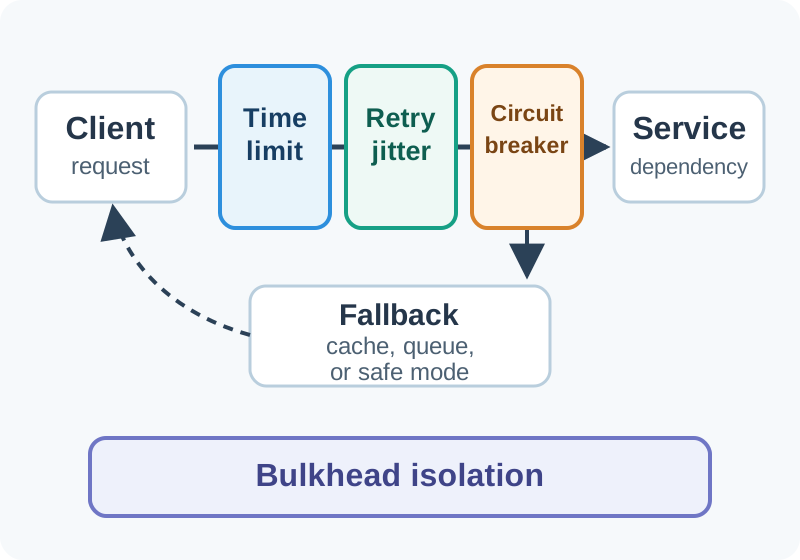
A resilient service call is a chain of small controls.
- Each control has a narrow job.
- Each control therefore needs its own limit and outcome.
- Observability closes the chain by recording which layer acted, how much budget remained, whether downstream work was attempted, and what degraded or failed result the user actually received.
Major section
Resilience Control Map (continued)
Caps the total time a caller is willing to spend.
- It should include connection time, processing time, retries, and fallback selection.
- It needs a retry budget, exponential backoff, jitter, and an idempotency rule.
- Track deadline exhaustion, retry attempts, open circuits, fallback use, queue growth, and user impact.
Deck summary
Key takeaways
Timeouts and deadlines define the maximum wait: Without a deadline, slow dependencies can hold resources until healthy work is starved.
- Resilience is not about making every dependency succeed.
- Think about a gateway that sends cold-room temperature readings and accepts remote defrost commands.
- Fallback behavior keeps the product honest with cached state, queued state, read-only mode, local control, manual confirmation, or explicit unavailability.
- Each control is small, but together they prevent one unhealthy path from becoming a platform outage.
Retrieval practice
Recall check 1 of 4

Blueprint Bina says: answer from memory, then check your reasoning.
Q1A device-command API calls a cloud authorization service. The authorization service sometimes hangs for many seconds. The command API starts running out of worker threads, so unrelated read-only status requests become slow too. Which control should be the first protection on the authorization call?
Show answer
Answer: A A timeout or deadline is the first guardrail for a slow dependency.
Retrieval practice
Recall check 2 of 4
Blueprint Bina says: answer from memory, then check your reasoning.
Q2A command call times out after the server may have applied it. Which retry policy is safe?
Show answer
Answer: B Retry policy must account for idempotency, spacing, and the remaining deadline.
Retrieval practice
Recall check 3 of 4
Blueprint Bina says: answer from memory, then check your reasoning.
Q3A failed dependency begins to recover. What should a circuit breaker do before normal traffic resumes?
Show answer
Answer: A Closed admits calls, open blocks them, and half-open admits limited recovery probes.
Retrieval practice
Recall check 4 of 4
Blueprint Bina says: answer from memory, then check your reasoning.
Q4Authorization is down, but status reads must remain available. Which boundary review is strongest?
Show answer
Answer: B Resource isolation and an explicit degraded outcome keep unrelated safe work available.
Print reference
Answers
Answer key.
- A · A timeout or deadline is the first guardrail for a slow dependency.
- B · Retry policy must account for idempotency, spacing, and the remaining deadline.
- A · Closed admits calls, open blocks them, and half-open admits limited recovery probes.
- B · Resource isolation and an explicit degraded outcome keep unrelated safe work available.