Sensors & Measurement · Study deck
Sensor Specifications
Picture a freezer alarm set at minus 15 degrees.
Physics Phoebe is your guide for this deck.

After studying this chapter
Learning objectives
A specification becomes useful only when its conditions match the field decision.
- Range, accuracy, resolution, and response time describe different channel limits.The freezer alarm can show tiny temperature steps while the stated measurement error remains wider than the gap that controls its decision.
- Closely repeated readings can still disagree with a trusted reference.Precision describes agreement between repeats, so a smooth, repeatable result needs a separate reference comparison before its accuracy can support the alarm.
- Supply, temperature, mounting, and sampling mode can change specification validity.A sensor that works on the bench can respond differently inside the real case, with field wiring, moisture, vibration, or another power mode.
- Installed reference tests must connect the reading with its decision.The record needs the actual range, error, speed, and environmental conditions together with a review trigger for drift or changed hardware.
Major section
Start With the Measurement Story (1/2)
Extra display digits cannot compensate for a wider measurement error.
- Resolution is the smallest output step, while accuracy concerns reference agreement.The freezer alarm set at minus 15 degrees cannot rely on extra display digits when the stated error exceeds the alarm gap.
- Precision is agreement among repeats without proof of correctness.A sensor can produce closely grouped readings that remain biased, so the repeated values still need comparison with a trusted reference.
Major section
Start With the Measurement Story (2/2)
- Response time determines when a real change becomes a settled reading.A fast alarm needs the tolerance band, step direction, and test conditions because rising and falling inputs can have different settling behaviour.
- The test must include the installed case and operating conditions.A bench-calibrated sensor can lag the real process when its enclosure slows heat transfer, leaving the dashboard value too late for the decision.
Major section
Specifications Need Conditions (1/2)
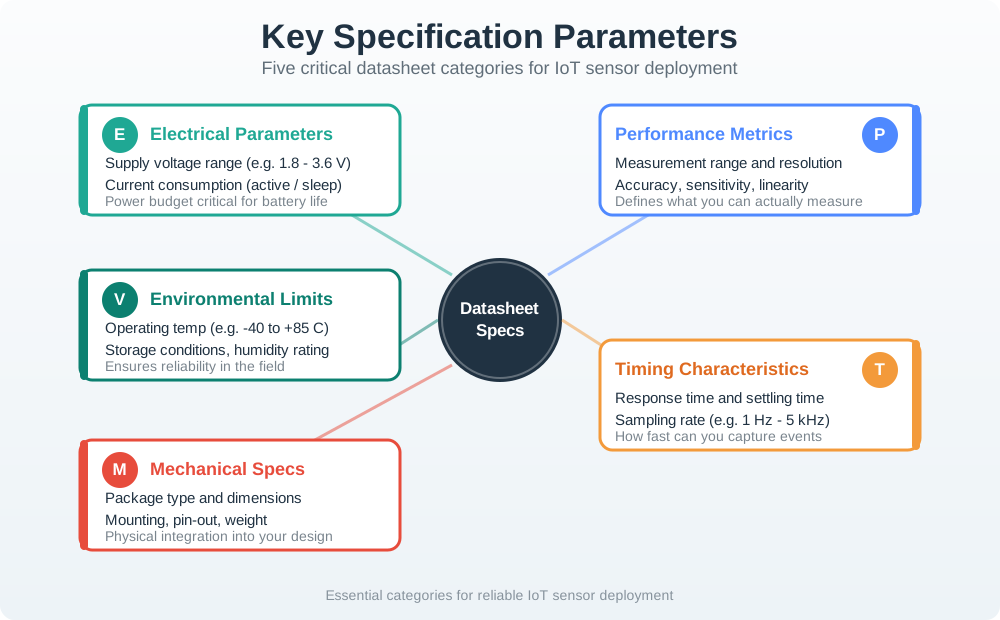
This diagram groups the conditions that must support a usable sensor reading.
- Electrical parameters constrain supply and connection to the measurement circuit.The diagram’s 1.8–3.6 V supply range sits beside active and sleep current, connecting electrical compatibility with the battery budget for the installation.
- Performance metrics separate range and resolution from accuracy and sensitivity.Many displayed digits cannot establish a correct reading, so each measurement claim needs conditions and calibration evidence for the same installed use case.
Major section
Specifications Need Conditions (2/2)
- Timing characteristics constrain when a changed input becomes useful data.Response, settling, and sampling rate describe different timing limits, making the actual step response part of an alarm or control-loop review.
- Mechanical and environmental limits determine whether the installation can work.Package and mounting must fit the measurement location, while operating temperature, storage, and humidity ratings limit what the remaining diagram categories can promise.
Major section
Error Sources and Evidence Limits (1/2)
A sensor reading passes through several stages where error can enter.
- The physical condition must reach the sensing element first.The cold-chain monitor’s enclosure can slow heat transfer, so a valid-looking dashboard number may trail the product temperature that the alarm needs.
- The circuit, interface, and firmware must preserve the signal’s meaning.A failure in conditioning, transmission, parsing, or application interpretation can look like a sensor fault even when the sensing element is working.
Major section
Error Sources and Evidence Limits (2/2)
- Offset and scale errors may be corrected against a valid reference.A consistent high or low reading may need bias correction, while an incorrect change across the span can require more than one calibration point.
- Noise, drift, and lag need different evidence and corrective actions.Random variation may need filtering, drift requires reference rechecks, and slow response may require different placement or a revised control expectation.
Major section
Overshoot, damping, and settling (1/2)
Step-response shape matters when an alarm reacts before the sensor settles.
- An underdamped response can overshoot and ring after a sudden change.A pressure diaphragm or accelerometer proof mass can briefly report beyond the final value, misleading an alarm that samples immediately after the step.
- A critically damped response reaches its final value quickly without overshoot.The chapter describes this response as close to the shortest settling approach without overshoot, distinguishing speed from a temporarily exaggerated reading.
Major section
Overshoot, damping, and settling (2/2)
- An overdamped response has a slow approach without overshoot.The smoother approach trades speed for stability, so avoiding a false extreme does not establish that the sensor is fast enough for control.
- A settling-time claim needs its response shape and tolerance band.Ringing can look like real process oscillation, making the actual installed step response stronger timing evidence than a published response-time number alone.
Major section
Useful bits and the cost of averaging (1/2)
Averaging trades observation time for reduced independent random noise.
- Nominal ADC code width does not establish useful measurement resolution.The 16-bit example has a 16-count noise band, giving a conservative range-based estimate of 12 effective bits rather than 16 stable bits.
- Independent zero-mean noise can decrease when samples are averaged.For 8 counts RMS input noise, averaging 64 independent samples gives 1 count RMS; correlated noise and drift need separate evidence.
Major section
Useful bits and the cost of averaging (2/2)
- A longer averaging window can hide a short event.At 1 ksample/s, the non-overlapping 64-sample mean spans 64 ms, trading reduced noise for a longer wait before the result is available.
- A quieter trace cannot repair nonlinearity or reference movement.Missing codes, nonlinear transfer behaviour, and a moving reference remain checks in the specification record even when averaging reduces random variation.
Major section
Resolve a Pressure Channel From Limits to Timing (1/2)
This specification map connects a pressure channel's limits with its control decision.
- Electrical limits determine whether supply and input range fit the channel.A pressure sensor can fit the pipe thread yet fail the control loop if its electrical requirements do not match the measurement circuit.
- Performance limits separate ideal converter steps from actual sensor accuracy.The 0–20 V, 16-bit example gives a 0.305 mV ideal step, but sensor accuracy is only ±20 mV under the stated conditions.
Major section
Resolve a Pressure Channel From Limits to Timing (2/2)
- Timing limits determine whether the averaging window can follow the event.The pressure channel’s 64 ms mean can smooth or delay a 20 ms valve fault, so the display cannot prove the peak was captured.
- Environmental limits distinguish measurement operation from storage survival.The example’s 85 °C storage rating cannot justify measurement at 75 °C when the listed operating limit is only 60 °C.
Activity 1 · Predict
✎ Catch a brief pressure fault

I want you to check whether a smooth trace can still miss the event that matters.
On paper, compare the chapter’s 20 ms valve fault with its 64 ms averaging window. Can the displayed mean prove that the peak was captured? Explain why, and name the timing evidence you would request.
3 minutes · Pen and paper · Answer: Activity 1
Pause for eight seconds: can a 64 ms mean prove a 20 ms peak was captured?
Major section
Resolution and response time
Converter resolution and averaging cannot substitute for sensor accuracy or timely fault detection.
- A 0.305 mV converter step cannot overcome ±20 mV sensor accuracy.The 16-bit converter divides the 0–20 V input into fine codes, but extra codes cannot make the installed pressure channel equally accurate.
- A 1 ms sampling interval does not establish sensor response time.At 1,000 samples/s the circuit records once each millisecond, while the sensing element and installation still determine when the physical change becomes measurable.
- A 64 ms averaging window can smooth a 20 ms fault.The mean may delay or reduce the brief valve event, so a smooth displayed value cannot prove that the pressure peak was captured.
- The control decision needs raw timing and actual sensor-response evidence.The installed channel and alarm must detect the brief fault under operating conditions, connecting the sampling record with the pressure sensor’s step response.
Deck summary
Key takeaways
A dependable specification record connects every number with its evidence boundary.
- Small output steps do not prove agreement with the true value.The freezer display can change in tiny increments while the sensor’s stated error remains too wide for the alarm decision at minus 15 degrees.
- Reference checks must cover the installed range and environmental conditions.Mounting, enclosure heat transfer, moisture, vibration, and power mode can change whether a bench specification still applies to the channel in service.
- Averaging can reduce random noise while delaying an alarm result.A 64 ms pressure mean may smooth a 20 ms valve fault, so the record must retain raw timing and actual sensor-response evidence.
- Drift and installation changes can require renewed calibration and field validation.A new enclosure, replaced sensor, firmware change, failed reference check, or unexplained alarm behaviour can reopen the earlier specification decision.
Retrieval practice
Recall check 1 of 5
Physics Phoebe says: answer from memory, then check your reasoning.
Q1A sensor passes an installed test. What makes its specification record useful after a field change?
Show answer
Answer: C The evidence and retest trigger show when the claim must be reopened.
Retrieval practice
Recall check 2 of 5
Physics Phoebe says: answer from memory, then check your reasoning.
Q2A sensor reports temperature in 0.01 degree steps, but its accuracy claim is much wider than the decision threshold. What should the review conclude?
Show answer
Answer: A Resolution controls output granularity; accuracy and calibration evidence control whether the value is close enough to truth.
Retrieval practice
Recall check 3 of 5
Physics Phoebe says: answer from memory, then check your reasoning.
Q3A team chooses a sensor because it is inexpensive, but the field environment causes frequent drift and replacement visits. Which specification review was incomplete?
Show answer
Answer: A Sensor selection should include deployment evidence, not only unit price.
Retrieval practice
Recall check 4 of 5
Physics Phoebe says: answer from memory, then check your reasoning.
Q4A calibrated sensor is repeatable on the bench, but after installation its readings lag the real process because the enclosure slows heat transfer. Which boundary should be reviewed first?
Show answer
Answer: A The bench calibration may still be valid, but the installed response lag can invalidate the application decision.
Retrieval practice
Recall check 5 of 5
Physics Phoebe says: answer from memory, then check your reasoning.
Q5A team approves a sensor from its fine display steps and low price. Which specification record makes the decision traceable?
Show answer
Answer: A Correct: the record connects the measurement claim to evidence and lifetime fit.
Print reference
Answers
Answer key.
- C · The evidence and retest trigger show when the claim must be reopened.
- A · Resolution controls output granularity; accuracy and calibration evidence control whether the value is close enough to truth.
- A · Sensor selection should include deployment evidence, not only unit price.
- A · The bench calibration may still be valid, but the installed response lag can invalidate the application decision.
- A · Correct: the record connects the measurement claim to evidence and lifetime fit.
Print reference
Activity 1 answer
Model answer.
Predict: No. The 64 ms mean can smooth or delay the 20 ms event. Keep the raw sample timing and actual sensor step response, then test whether the installed channel and alarm detect the brief fault.