Sensors & Measurement · Study deck

Common Sensors and MEMS

Imagine a smart room needs to know whether it is hot, bright, noisy, occupied, or unsafe.

Physics Phoebe is your guide for this deck.

sensortypescommon
Physics Phoebe, the module guide, in a scene from this chapter.
iotclass.org

After studying this chapter

Learning objectives

You will be able to:

  • Explain: On the lower row,: Proximity groups ultrasonic, IR, ToF, and capacitive ranging even though they observe different physical effects, while: Accelerometer connects MEMS and piezoelectric devices to vibration and tilt.
  • Explain: That path connects the hardware to the comparison record: illumination geometry, integration time, surface distance, channel calibration, and saturation must be controlled before two candidates can be compared fairly.
  • Explain: In Figure: A TCS3200 color-sensor board beside a diagram of, the coloured channels show that even “light” may mean several wavelength bands rather than one brightness value.
  • Explain: The fan bearing adds a placement test.
iotclass.org

Major section

A Clear First Route

The team must choose a sensor family for each real change.

  • This page starts with one job.
  • A family name does not prove that one part will work in the final site.
  • This first route is a guide to the main choice.
  • The Practitioner sections add a full part record, side-by-side tests, fit, and calibration.
iotclass.org

Major section

Phoebe's Field Notes: The Thermocouple Reading That Needs a Second Number

The mathematical gist.: A thermocouple measures a difference, $V=S(T_{hot}-T_{cold})$, not an absolute temperature.

  • With the chapter's catalog-typical Type K sensitivity of 41 µV/°C, 4.10 mV means a 100.0 °C junction difference.

Numbers to remember

4.10 mV4.10 mV means a 100.0 °C junction difference.
100.0 °C4.10 mV means a 100.0 °C junction difference.
22.0 °CIf the instrument's cold junction is 22.0 °C
iotclass.org

Major section

Sensor Families, Not Guarantees
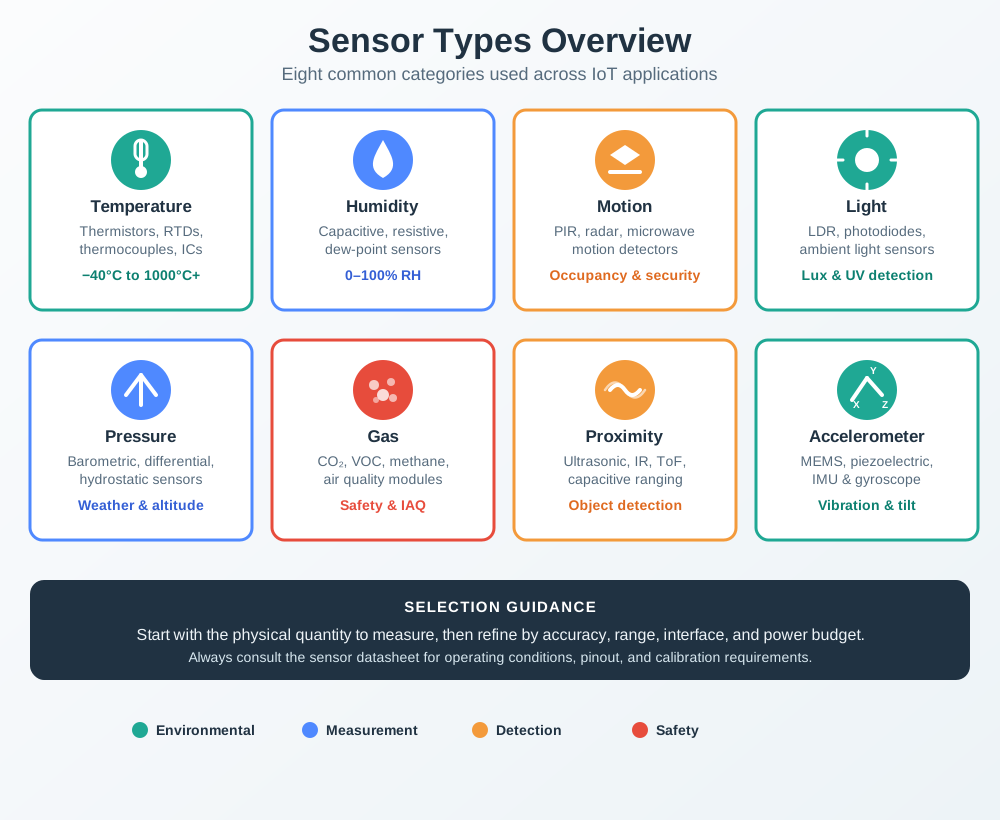
It makes the physical quantity and the typical sensing method visible together, which is the distinction the selection review needs.

  • On the lower row,: Proximity groups ultrasonic, IR, ToF, and capacitive ranging even though they observe different physical effects, while: Accelerometer connects MEMS and piezoelectric devices to vibration and tilt.
Overview of common IoT sensor families including temperature, humidity, motion, light, pressure, gas, proximity, and accelerometer sensors.
iotclass.org

Major section

Evidence-Based Comparison

The selected channel becomes a frequency output that the controller counts; it is not already a calibrated colour name.

  • That path connects the hardware to the comparison record: illumination geometry, integration time, surface distance, channel calibration, and saturation must be controlled before two candidates can be compared fairly.
A TCS3200 color-sensor board beside a diagram of its red, green, blue photodiode array and frequency output
iotclass.org

Major section

Match a Greenhouse Need to a Sensor Family

A greenhouse controller needs leaf-zone temperature, damp-air warning, door position, and fan vibration.

  • In Figure: A TCS3200 color-sensor board beside a diagram of, the coloured channels show that even “light” may mean several wavelength bands rather than one brightness value.
  • The fan bearing adds a placement test.

Key terms

If the cold junction
If the cold junction is 22 °C, compensation gives \(100+22=122\ ^\circ\text{C}\).

Numbers to remember

22 °CIf the cold junction is 22 °C
Overview of common IoT sensor families including temperature, humidity, motion, light, pressure, gas, proximity, and accelerometer sensors.
iotclass.org

Major section

Match a Greenhouse Need to a Sensor Family (continued)

An accelerometer on the rigid motor housing sees vibration better than the same sensor on a loose plastic guard.

  • For the hot-water pipe, a Type K thermocouple producing 4.10 mV at 41 µV/°C represents a junction difference of \(4100/41=100\ ^\circ\text{C}\).
  • If the cold junction is 22 °C, compensation gives \(100+22=122\ ^\circ\text{C}\).
  • Sensor family and physical coupling must both match the greenhouse question.
iotclass.org

Deck summary

Key takeaways

The team must choose a sensor family for each real change.

  • The mathematical gist.: A thermocouple measures a difference, $V=S(T_{hot}-T_{cold})$, not an absolute temperature.
  • It makes the physical quantity and the typical sensing method visible together, which is the distinction the selection review needs.
  • The selected channel becomes a frequency output that the controller counts; it is not already a calibrated colour name.
  • A greenhouse controller needs leaf-zone temperature, damp-air warning, door position, and fan vibration.
iotclass.org

Retrieval practice

Recall check 1 of 3

Physics Phoebe says: answer from memory, then check your reasoning.

Q1A team chooses a popular humidity sensor module for a cold-storage alert because it is common in IoT tutorials. What should the review ask first?

AWhether the module has example code, because example code proves measurement quality.
BWhether the part is cheap enough to buy in bulk, because cost is the only selection criterion.
CNothing else, because common modules are interchangeable.
DWhether the sensor family, range, accuracy, response time, enclosure, calibration, interface.
Show answer

Answer: D A common sensor family starts the search, but the accepted sensor must match the application evidence and operating conditions.

iotclass.org

Retrieval practice

Recall check 2 of 3

Physics Phoebe says: answer from memory, then check your reasoning.

Q2A wearable activity prototype uses an accelerometer successfully on a desk, then moves to wrist-worn use. What evidence should the practitioner add?

AAxis orientation, mounting, sample rate, filtering, saturation, user variability, event labels.
BThe part number and bench calibration record, reused for the wrist deployment.
COnly whether the I2C bus still returns values.
DNo added evidence if the prototype used a common MEMS sensor.
Show answer

Answer: A Practitioner review compares sensor families by the evidence they preserve in the target installation, not by part familiarity.

iotclass.org

Retrieval practice

Recall check 3 of 3

Physics Phoebe says: answer from memory, then check your reasoning.

Q3A distance sensor works on a flat white target in the lab but fails when installed over angled dark material. What is the best under-the-hood response?

AIgnore the failure because the sensor family is still a distance sensor.
BReopen the sensor selection because target material, angle, field of view, reflected signal.
CIncrease dashboard decimal places to make the distance value look more precise.
DRemove diagnostics so the installation appears simpler.
Show answer

Answer: B Common sensor families still need field evidence for physical boundaries such as target, mounting, environment, power, and lifecycle.

iotclass.org

Print reference

Answers

Answer key.

  1. D · A common sensor family starts the search, but the accepted sensor must match the application evidence and operating conditions.
  2. A · Practitioner review compares sensor families by the evidence they preserve in the target installation, not by part familiarity.
  3. B · Common sensor families still need field evidence for physical boundaries such as target, mounting, environment, power, and lifecycle.
iotclass.org