Sensors & Measurement · Study deck
Sensor Classifications
Imagine a team must sort light, strain, gas, and motion sensors before it compares parts.
Physics Phoebe is your guide for this deck.

After studying this chapter
Learning objectives
You will be able to:
- Explain: Under the output classification, with a 3.3 V supply and a 10 kΩ series resistor, the wet current is 3.3/(10{,}000+2{,}000)=0.000275 A, or 0.275 mA.
- Explain: A candidate can fit one axis and fail another, so the elimination examples below deliberately carry measurement, signal, energy, and physical coupling together.
- Explain: For the conductivity measurement, suppose tap water gives 2 kΩ between the probes while dry air is effectively open circuit.
- Explain: Inter Integrated Circuit (I2C) is a short wired link that lets chips share data on a board.
Major section
A Clear First Route
The team needs a map that rules out weak choices early.
- Inter Integrated Circuit (I2C) is a short wired link that lets chips share data on a board.
- This page starts with one job.
- Last, choose place the sensor in useful groups and pick the group that fits the job.
- They do not reverse its main claim.
Major section
A Clear First Route (continued)
A group helps the search but cannot prove field fit.
- This first route is a guide to the main choice.
- The Practitioner sections add selection records, output types, power roles, and side-by-side checks.
- Under the Hood adds conversion boundaries, analogue paths, digital links, cross effects, and hard limits.
- A person may inspect the site.
Major section
A Clear First Route (continued)
If two sources differ, keep that fact in the record.
- A late result may be true about the past and still be unsafe now.
- A missing result is also useful news when the system shows it at once.
- A local rule may hold a safe state.
- A remote team may ask for more proof.
Major section
Classification Narrows the Search
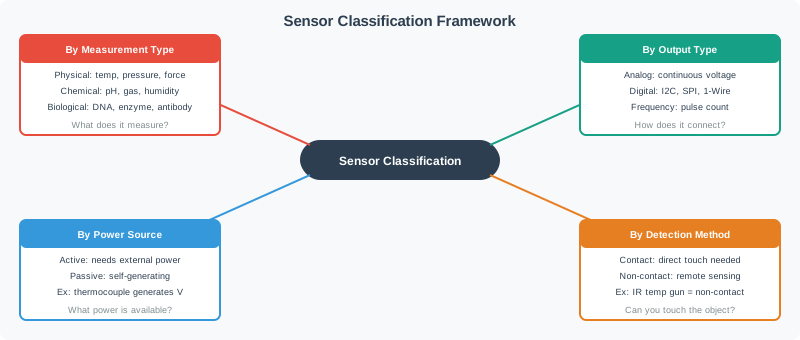
Classification is useful only when it removes unsuitable measurement paths.
- A candidate can fit one axis and fail another, so the elimination examples below deliberately carry measurement, signal, energy, and physical coupling together.
Major section
Classify a Tap-Water Alarm Four Ways
For the conductivity measurement, suppose tap water gives 2 kΩ between the probes while dry air is effectively open circuit.
- Under the output classification, with a 3.3 V supply and a 10 kΩ series resistor, the wet current is 3.3/(10{,}000+2{,}000)=0.000275 A, or 0.275 mA.
Deck summary
Key takeaways
The team needs a map that rules out weak choices early.
- A group helps the search but cannot prove field fit.
- If two sources differ, keep that fact in the record.
- Classification is useful only when it removes unsuitable measurement paths.
- For the conductivity measurement, suppose tap water gives 2 kΩ between the probes while dry air is effectively open circuit.
Retrieval practice
Recall check 1 of 3

Physics Phoebe says: answer from memory, then check your reasoning.
Q1A team says a sensor is suitable because it belongs to the right general category, such as a motion sensor. What should the review ask next?
Show answer
Answer: B The category starts the search, but the design still needs measurement purpose, signal path, interface, and evidence limits.
Retrieval practice
Recall check 2 of 3

Physics Phoebe says: answer from memory, then check your reasoning.
Q2A battery IoT device can use either an analog resistive sensor or a digital bus sensor for the same physical condition. Which comparison is most useful?
Show answer
Answer: C A practical classification compares the full evidence path, not only the physical quantity being measured.
Retrieval practice
Recall check 3 of 3

Physics Phoebe says: answer from memory, then check your reasoning.
Q3Why can two sensors in the same broad category still require different IoT design reviews?
Show answer
Answer: D Classification is useful only when it keeps the boundary details that affect evidence quality.
Print reference
Answers
Answer key.
- B · The category starts the search, but the design still needs measurement purpose, signal path, interface, and evidence limits.
- C · A practical classification compares the full evidence path, not only the physical quantity being measured.
- D · Classification is useful only when it keeps the boundary details that affect evidence quality.