Sensors & Measurement · Study deck
Braitenberg Vehicles: Sensing to Action
Picture a two-sensor robot that turns toward a lamp with one wiring rule and away with another.
Physics Phoebe is your guide for this deck.

After studying this chapter
Learning objectives
You will be able to:
- Explain how Braitenberg vehicles map sensor inputs to actuator outputs using wiring topology and polarity
- Design simple reactive systems using direct sensor-to-actuator connections
- Predict emergent behaviors from different sensor-actuator coupling configurations
- Evaluate when Braitenberg-style reactive control is sufficient versus when AI/ML is required
Major section
Start With the Measurement Story
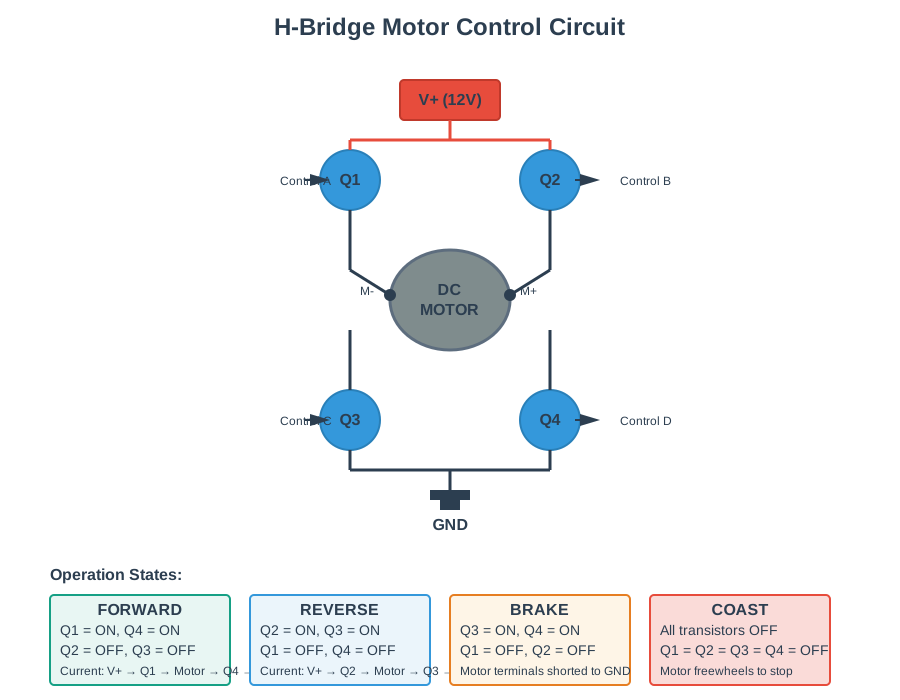
An actuator means a part that turns an electrical command into physical action.
- Duty cycle means the share of time a repeating control signal stays active.
- This runway does not prove intelligence or safe autonomy.
- The deeper sections explain excitatory and inhibitory coupling, direct and crossed wiring, emergent paths, calibration, and behavior limits.
Major section
In 60 Seconds
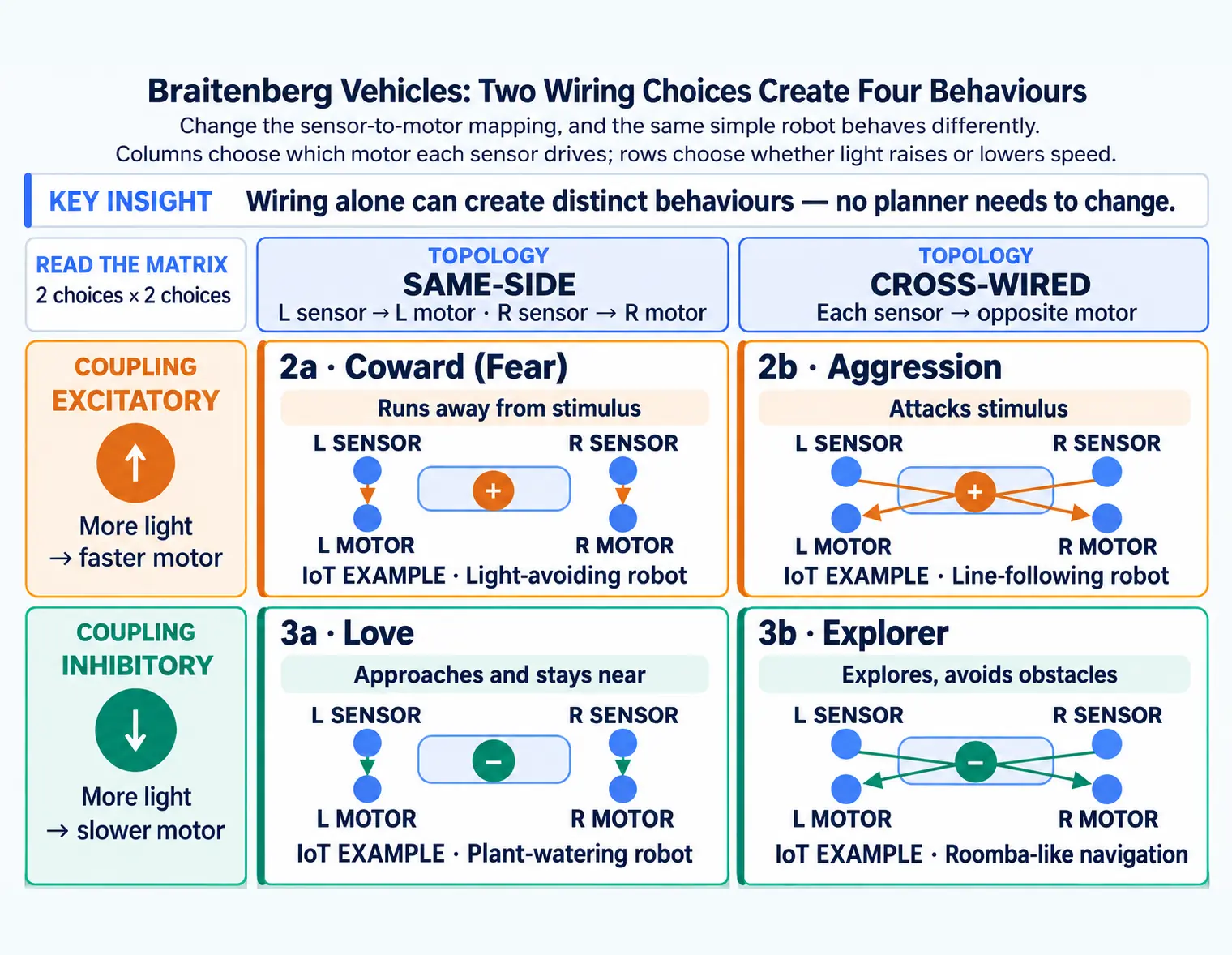
Same-side excitatory wiring creates avoidance ("fear"), cross-wired excitatory creates approach at speed ("aggression"), same-side inhibitory creates gentle approach and stop ("love"), and cross-wired inhibitory creates exploration.
- Many real IoT systems -- thermostats, motion-activated lights, fan controllers -- are essentially Braitenberg vehicles.
Major section
Sensor Readings to Behavior
Valentino Braitenberg's thought experiments showed that a vehicle with only sensors and motors can appear to have fear, aggression, attraction, or exploration.
- The trick is not a hidden mind; it is the mapping from each sensor to each motor.
- The simplest, Vehicle 1, has a single sensor driving a single motor: more stimulus means more speed.
Major section
Start Simple, Then Prove You Need More
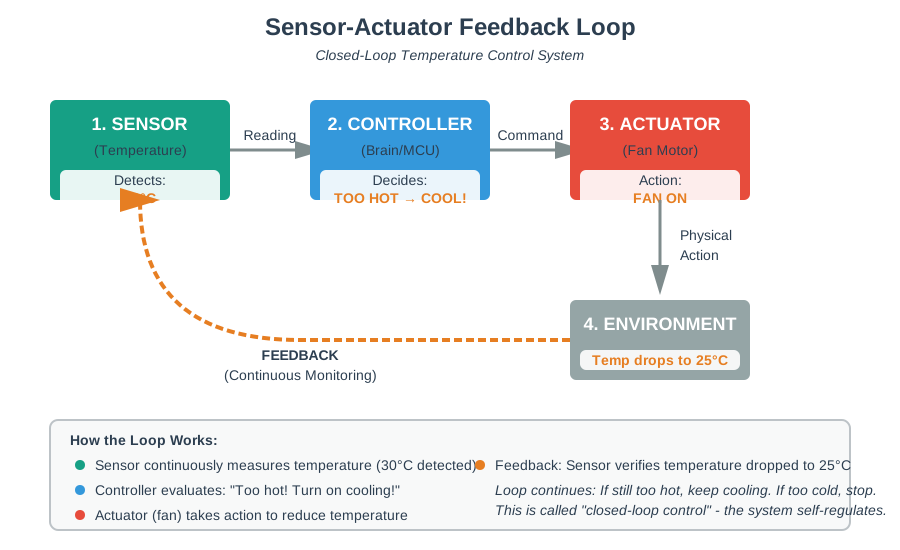
You have now seen the same rule in moving robots and everyday IoT devices.
- Reactive control is not always enough, but it is often the correct first design.
- The next question is how long a simple reflex can carry a product before memory, mapping, or pattern recognition becomes necessary.
Major section
Build a Light-Following Plant Pot
Two LDRs sense light direction, two small DC motors rotate the base, and the controller should maximize sunlight without camera vision or cloud logic.
- The left LDR drives the right motor, the right LDR drives the left motor, and stronger light means more motor speed.
- Battery life depends on duty cycle.
Major section
Build a Light-Following Plant Pot (continued)
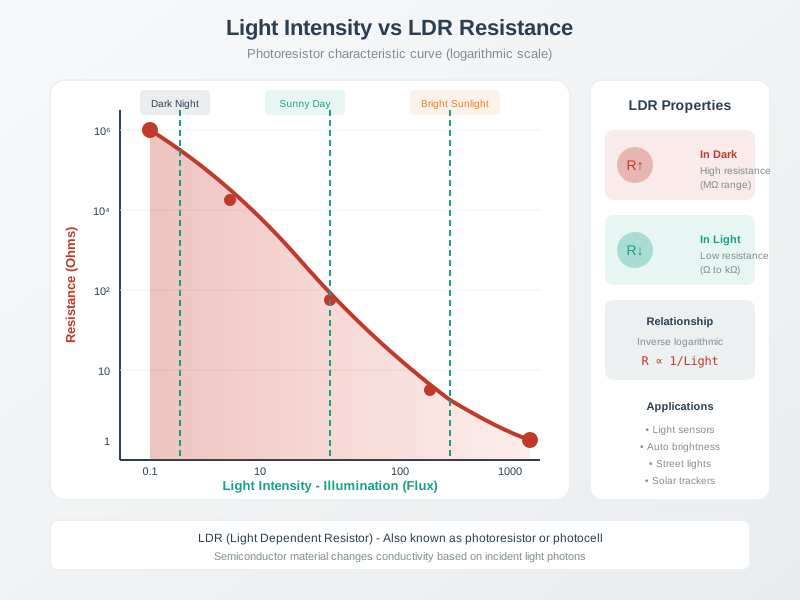
If light is on the left, the right motor speeds up and the pot turns left.
- Measured behavior should match the wiring: far-left light makes the right motor faster so the pot turns left; centered light gives equal motor speeds; far-right light makes the left motor faster.
- When the pot is nearly centered, sensor noise can make it jitter.
- Result: the pot rotates toward the brightest light source and stops when aligned.
Major section
Choose Reactive Control or AI/ML
For fail-safe or sub-100 ms behavior, keep the reactive path in control even when ML is added.
- On an ESP32-class system, the reactive path usually has smaller code, shorter active windows, less training work, and more predictable failure modes.
- The simple baseline is a Braitenberg-style mapping.
Major section
Choose Reactive Control or AI/ML (continued)
That mapping is predictable, fast, and easy to test.
- The mistake: a team builds an "AI-powered smart fan" before testing whether temperature can directly drive fan speed.
- The Braitenberg rule has no hidden state, updates immediately, and remains easy to test.
- This keeps deterministic safety while allowing later optimization.
Major section
One-Button Behavior Switching
A one-button mode switch is a compact way to test whether you can predict behavior before watching the robot move.
- The important learning point is the mapping, not the boilerplate pin setup.
- After filling both gaps, trace the complementary final line—left_motor.duty(right)—to confirm that each sensor controls the opposite wheel.
Deck summary
Key takeaways
An actuator means a part that turns an electrical command into physical action.
- Same-side excitatory wiring creates avoidance ("fear"), cross-wired excitatory creates approach at speed ("aggression"), same-side inhibitory creates gentle approach and stop ("love"), and cross-wired inhibitory creates exploration.
- Valentino Braitenberg's thought experiments showed that a vehicle with only sensors and motors can appear to have fear, aggression, attraction, or exploration.
- You have now seen the same rule in moving robots and everyday IoT devices.
- If light is on the left, the right motor speeds up and the pot turns left.
Retrieval practice
Recall check 1 of 3

Physics Phoebe says: answer from memory, then check your reasoning.
Q1You want a robot to approach a heat source and stop near it (not crash into it). Which Braitenberg wiring?
Show answer
Answer: B Same-side inhibitory (Vehicle 3a: Love) creates approach + slowing behavior.
Retrieval practice
Recall check 2 of 3

Physics Phoebe says: answer from memory, then check your reasoning.
Q2In a Braitenberg Vehicle 2b (cross-wired, excitatory), what behavior does the robot exhibit toward a light source?
Show answer
Answer: B In Vehicle 2b (cross-wired excitatory), the left sensor drives the right motor and vice versa.
Q3Which of the following real-world IoT systems is essentially a Braitenberg vehicle?
Show answer
Answer: D A thermostat is essentially a Braitenberg vehicle: the temperature sensor (input) directly controls the heater (actuator) through a simple threshold relationship.
Retrieval practice
Recall check 3 of 3

Physics Phoebe says: answer from memory, then check your reasoning.
Q4Place each Braitenberg mechanism where it lives so you can predict motion from a wiring rule rather than treating behaviour as hidden software.
Show answer
Answer: A Place each Braitenberg mechanism where it lives so you can predict motion from a wiring rule rather than treating behaviour as hidden software.
Q5Complete the Braitenberg vehicle light-following behavior:
Show answer
Answer: A Braitenberg Vehicle 2b (attraction) cross-wires sensors to opposite motors.
Print reference
Answers 1 of 2
Answer key.
- B · Same-side inhibitory (Vehicle 3a: Love) creates approach + slowing behavior.
- B · In Vehicle 2b (cross-wired excitatory), the left sensor drives the right motor and vice versa.
- D · A thermostat is essentially a Braitenberg vehicle: the temperature sensor (input) directly controls the heater (actuator) through a simple threshold relationship.
- A · Place each Braitenberg mechanism where it lives so you can predict motion from a wiring rule rather than treating behaviour as hidden software.
Print reference
Answers 2 of 2
Answer key.
- A · Braitenberg Vehicle 2b (attraction) cross-wires sensors to opposite motors.