Sensors & Measurement · Study deck
Braitenberg Transfer Tuning
A reactive rule only works if the sensor curve and motor response are understood.
Physics Phoebe is your guide for this deck.

After studying this chapter
Learning objectives
You will be able to:
- Explain why a sensor transfer function can change a Braitenberg vehicle's apparent behavior.
- Predict where LDR compression, saturation, and response lag will cause steering errors.
- Tune divider, dead-band, scaling, and motor mapping choices from bench evidence.
- Implement and test multi-mode reactive behavior before escalating to AI/ML.
Major section
Transfer Function as Behavior
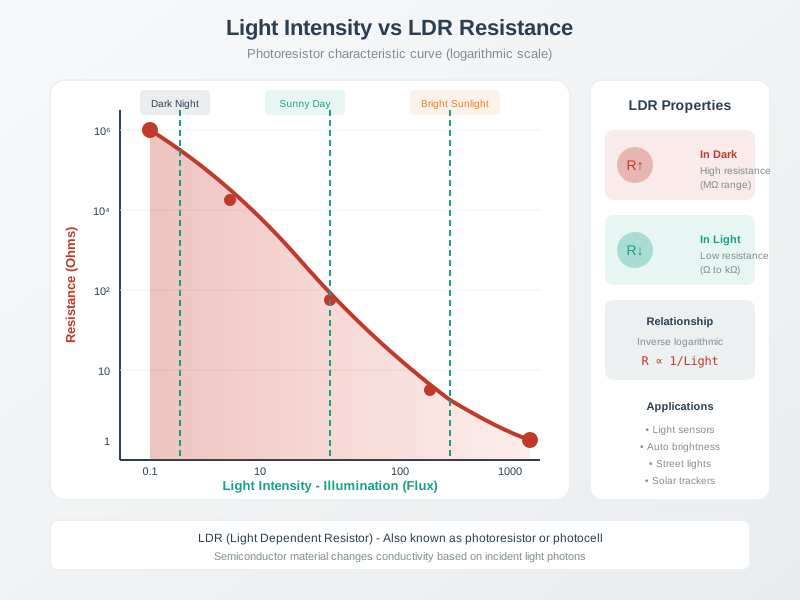
A light sensor that responds steeply in dim conditions but barely at all in bright ones will make a vehicle lunge toward a distant lamp yet crawl once it is close.
- The shape of the curve — where it is steep, where it flattens — is the design.
- Intuition: the transfer function is the vehicle's reflexes.
Major section
Transfer Function as Behavior (continued)
For a light-following robot, the curve is part of the steering loop.
- If the left light sensor climbs from 10 to 100 lux while the right sensor stays near 10 lux, the left-side signal changes strongly and the vehicle turns.
- If both sensors are already near saturation at 900 and 1000 lux, the signal difference may be tiny even though the physical light difference is real.
- A useful bench check is to sweep the sensor with a desk lamp before connecting the motors.
- A gentle, gradual curve gives calm, proportional reactions; a steep or saturating curve gives twitchy, all-or-nothing ones.
Major section
Photoresistor Compression Loop
Sensitivity is the local slope of the transfer function, and for many real sensors that slope changes along the curve.
- A photoresistor (LDR/CdS cell) is a classic example: its resistance follows a power law in illuminance, so it is compressive.
- The sensor is far more responsive in dim light than bright.
Major section
Photoresistor Compression Loop (continued)
Each 10x jump in light multiplies R by the same 0.20, so the resistance CHANGE shrinks: 8 kΩ then 1.6 kΩ.
- The first 10x light increase moves the signal by about 1.10 V; the next 10x increase moves it by only 0.42 V.
- A microcontroller or motor driver sees those voltages, not the lux directly.
- So the effective vehicle rule is not "turn proportional to light"; it is "turn proportional to the conditioned voltage curve.".
Major section
Common Pitfalls
An excitatory connection increases motor speed when the sensor signal increases; an inhibitory connection decreases motor speed.
- Swapping these causes vehicles to move opposite to intended — approach instead of avoid.
- If the sensor output range drives motor speed directly without scaling, the motor may always run at maximum or minimum speed with little intermediate behavior.
- Physical motors have inertia and time constants (50-500 ms) that lag behind rapidly changing sensor inputs, causing jittery oscillatory motion.
Deck summary
Key takeaways
A light sensor that responds steeply in dim conditions but barely at all in bright ones will make a vehicle lunge toward a distant lamp yet crawl once it is close.
- For a light-following robot, the curve is part of the steering loop.
- Sensitivity is the local slope of the transfer function, and for many real sensors that slope changes along the curve.
- Each 10x jump in light multiplies R by the same 0.20, so the resistance CHANGE shrinks: 8 kΩ then 1.6 kΩ.
- An excitatory connection increases motor speed when the sensor signal increases; an inhibitory connection decreases motor speed.
Retrieval practice
Recall check 1 of 3

Physics Phoebe says: answer from memory, then check your reasoning.
Q1In a Braitenberg vehicle where a light sensor drives a motor directly, what does the sensor's transfer function determine?
Show answer
Answer: A With the sensor wired to the motor, the shape of the stimulus-to-signal curve becomes the behaviour.
Retrieval practice
Recall check 2 of 3

Physics Phoebe says: answer from memory, then check your reasoning.
Q2A photoresistor's resistance changes a lot per lux in dim light but very little per lux in bright light. What does this say about its sensitivity?
Show answer
Answer: A A compressive curve has a steep slope at low levels and a shallow slope at high levels, so sensitivity varies along it.
Retrieval practice
Recall check 3 of 3

Physics Phoebe says: answer from memory, then check your reasoning.
Q3A light-seeking Braitenberg vehicle behaves well far from a lamp but stops responding to changes once it is close. The sensor curve flattens at high light. What is happening?
Show answer
Answer: A A flattening (saturating) curve has near-zero local slope, so the driven behaviour stalls at high light.
Print reference
Answers
Answer key.
- A · With the sensor wired to the motor, the shape of the stimulus-to-signal curve becomes the behaviour.
- A · A compressive curve has a steep slope at low levels and a shallow slope at high levels, so sensitivity varies along it.
- A · A flattening (saturating) curve has near-zero local slope, so the driven behaviour stalls at high light.