Sensors & Measurement · Study deck

Biomimetic Sensing: Lessons From Human Skin

Check the engineering price.

Physics Phoebe is your guide for this deck.

sensortypesbiomimetic
Physics Phoebe, the module guide, in a scene from this chapter.
iotclass.org

After studying this chapter

Learning objectives

You will be able to:

  • Explain: A touch receptor also encodes more than "pressed" or "not pressed." For a stronger indentation, the nerve fires a denser burst of spikes; as the stimulus becomes familiar, that pulse density decays.
  • Explain: Near-surface Merkel and Meissner receptors support fine contact and changing touch, deeper Ruffini and Pacinian structures respond to stretch and vibration, and free nerve endings contribute temperature and pain signals.
  • Explain: The engineering analogy is an event stream whose rate carries amplitude at the moment of change, while adaptation keeps a steady condition from consuming bandwidth forever.
iotclass.org

Major section

Start With the Measurement Story

Machine learning means using examples to build a rule that can score new data.

  • Many small sensors can improve cover but add wires and drift.
  • Local processing can cut messages but may hide detail.
  • A learned rule can spot patterns, yet it can fail on new surfaces or damage.
  • Those need physical tests.
iotclass.org

Major section

Start With the Measurement Story (continued)
This robot-hand story cannot prove that biology is perfect or that copying a shape will work.

  • The deeper work tests the borrowed rule without treating nature as a finished product plan.
  • Biomimetic sensing starts by asking what nature already solves well: detecting touch, vibration, chemicals, orientation, flow, or light under messy conditions.
  • The engineering task is to borrow the principle, then prove it fits the device.
iotclass.org

Major section

In 60 Seconds

Human skin contains 5 million sensors across five specialized receptor types, consuming only 10mW total.

  • The mathematical gist.: Sampling at $f_s$ can preserve only frequencies below $f_s/2$ without folding.
  • This chapter's 1,000 samples/s raw stream has a 500 Hz Nyquist ceiling; after decimation to 100 samples/s the ceiling is 50 Hz.
iotclass.org

Major section

Skin's Multi-Scale Sensor Architecture
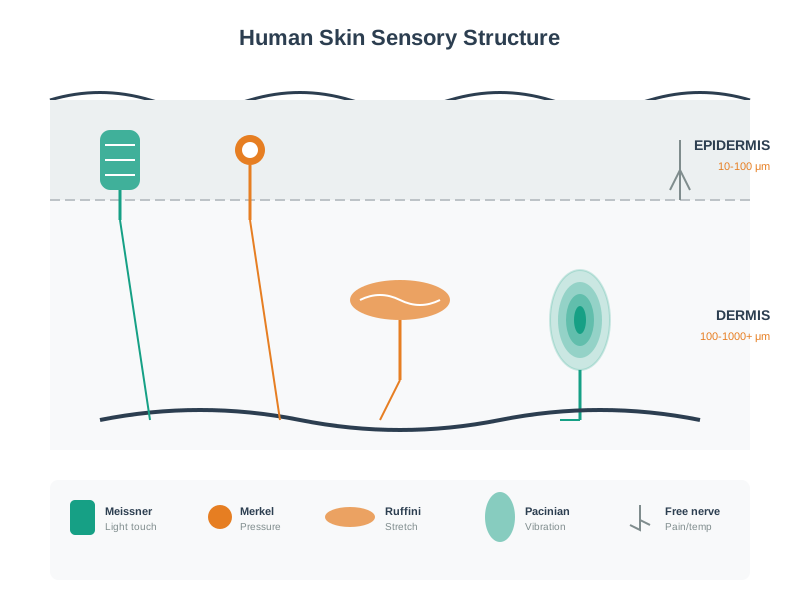
Human skin does not rely on a single sensor type.

  • Near-surface Merkel and Meissner receptors support fine contact and changing touch, deeper Ruffini and Pacinian structures respond to stretch and vibration, and free nerve endings contribute temperature and pain signals.
  • Receptor type is only half the architecture; response over time is the other half.
Human skin sensory structure: specialized receptors sit at different depths and respond to different touch, stretch, vibration, pain, and temperature signals
iotclass.org

Major section

Skin's Multi-Scale Sensor Architecture (continued)

The architecture distributes sensing by modality and dynamics; it does not ask one universal element to preserve every property of contact.

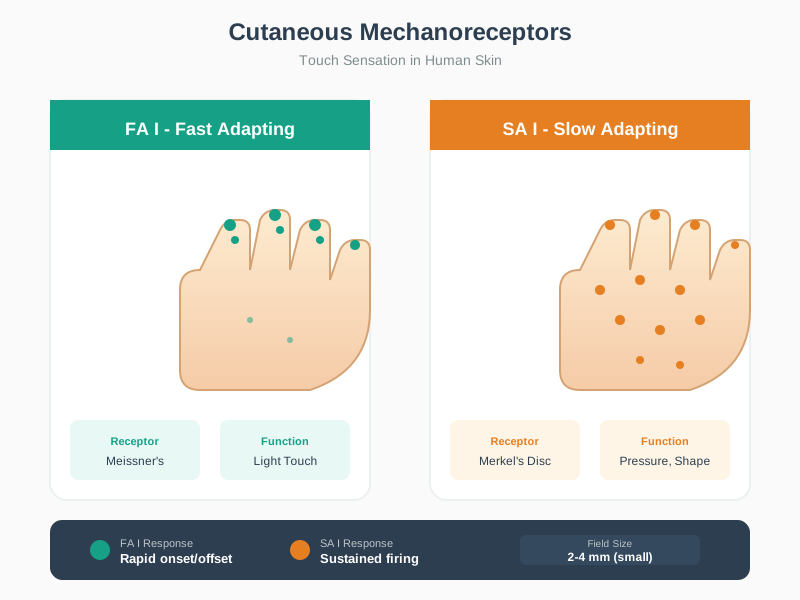
  • The fast-adapting path emphasises change and then quiets during a steady condition, whereas the slow-adapting path continues to represent sustained pressure or shape.
  • An IoT analogue therefore needs both event evidence and baseline evidence when the application cares about transitions and persistent state.
  • This comparison leads directly into the chapter's adaptive-sampling pattern: report fast changes promptly without discarding the slower absolute measurement.
iotclass.org

Major section

Key Biomimetic Design Principles

The engineering analogy is an event stream whose rate carries amplitude at the moment of change, while adaptation keeps a steady condition from consuming bandwidth forever.

  • Biological Insight:: Skin uses different receptors for different frequency ranges (0.5 Hz to 500 Hz).
  • Biological Insight:: Skin has overlapping sensor coverage.
  • The result is a 99.85% reduction.

Numbers to remember

~5Myet only ~5M signals/sec reach the cortex (99% filtered locally).
99%yet only ~5M signals/sec reach the cortex (99% filtered locally).

Why it matters

If LiDAR fails, the vehicle should reduce speed and continue with radar plus camera rather than failing silently.

iotclass.org

Major section

Key Biomimetic Design Principles (continued)

Damage to one receptor type doesn't cause total failure.

  • The useful insight is not the exact numbers; it is that one sensor stream cannot see every time scale.
  • Biological Insight:: Merkel discs (slow adapting) continuously report pressure, while Pacinian corpuscles (fast adapting) only respond to changes.
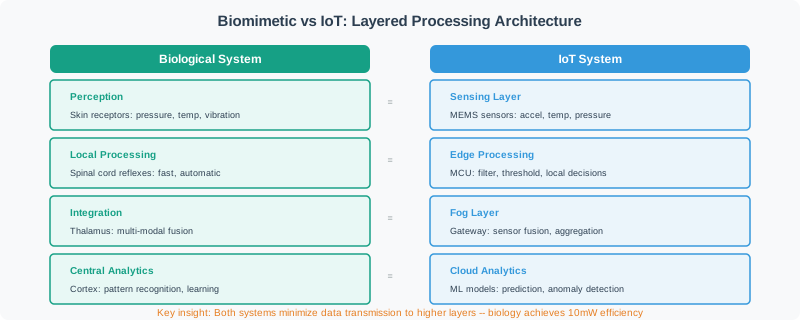
  • Biological Insight:: Significant signal processing occurs in nerve endings and spinal cord before reaching the brain.
iotclass.org

Major section

Key Biomimetic Design Principles (continued)

A touch receptor also encodes more than "pressed" or "not pressed." For a stronger indentation, the nerve fires a denser burst of spikes; as the stimulus becomes familiar, that pulse density decays.

  • This yields a massive bandwidth reduction: 5M sensors at ~100 Hz produce ~500M signals/sec at the receptor level, yet only ~5M signals/sec reach the cortex (99% filtered locally).
  • Stage 1: decimate: Hardware filtering reduces 100,000 readings/sec to 10,000 samples/sec.
  • Stage 2: edge filter: Discarding normal behavior reduces 10,000 samples/sec to 500 samples/sec.
iotclass.org

Deck summary

Key takeaways

Machine learning means using examples to build a rule that can score new data.

  • This robot-hand story cannot prove that biology is perfect or that copying a shape will work.
  • Human skin contains 5 million sensors across five specialized receptor types, consuming only 10mW total.
  • Human skin does not rely on a single sensor type.
  • The architecture distributes sensing by modality and dynamics; it does not ask one universal element to preserve every property of contact.
iotclass.org

Retrieval practice

Recall check 1 of 2

Physics Phoebe says: answer from memory, then check your reasoning.

Q1A PIR (passive infrared) motion sensor only triggers when something moves - it doesn't report anything when the room is still. This is an example of which biological sensor type?

ASlow adapting sensor (like Merkel discs)
BFast adapting sensor (like Pacinian corpuscles)
CMulti-scale sensor
DRedundant sensor
Show answer

Answer: B PIR sensors are fast adapting - they detect changes in infrared radiation (motion) but don't report a constant 'no motion' signal.

iotclass.org

Retrieval practice

Recall check 2 of 2

Physics Phoebe says: answer from memory, then check your reasoning.

Q2A smart factory uses 100 vibration sensors sampling at 1000 Hz. The raw data costs $129,600/month in cloud ingestion fees. After applying 3-stage hierarchical processing (decimation, edge filtering, compression), the cost drops to under $200/month. Which biological parallel best explains this approach?

ASkin receptors filter 99% of stimuli locally before signals reach the brain
BDifferent skin receptors detect different frequency ranges
CSkin has overlapping sensor coverage for fault tolerance
DFast-adapting receptors only respond to changes, saving neural bandwidth
Show answer

Answer: A Hierarchical processing mirrors the biological nervous system: skin receptors perform analog-to-digital conversion, peripheral nerves filter insignificant changes, the spinal cord recognizes patterns, and only ~1% of original signals reach the cortex.

iotclass.org

Print reference

Answers

Answer key.

  1. B · PIR sensors are fast adapting - they detect changes in infrared radiation (motion) but don't report a constant 'no motion' signal.
  2. A · Hierarchical processing mirrors the biological nervous system: skin receptors perform analog-to-digital conversion, peripheral nerves filter insignificant changes, the spinal cord recognizes patterns, and only ~1% of original signals reach the cortex.
iotclass.org