Sensors & Measurement · Study deck

Accuracy, Precision, Drift, and Hysteresis

Picture a room sensor that matches a reference at rest but misses every fast temperature change.

Physics Phoebe is your guide for this deck.

sensortypesaccuracy
iotclass.org

After studying this chapter

Learning objectives

You will be able to:

  • Explain: A soil-moisture node gives ADC codes with a standard deviation of about 12 counts when the probe is held in one sample.
  • Explain: Tighten random scatter by averaging uncorrelated samples, limiting bandwidth, and using a lower-noise front-end — the tools that do nothing for accuracy.
  • Explain: A test that only ramps pressure upward will report excellent repeatability and completely miss this 0.5 kPa direction-dependent error.
  • Explain: A tank gauge can repeat the same wrong level all morning and then wander farther as its body warms.
iotclass.org

Major section

Start With the Measurement Story

Bandwidth means the range of change rates a sensor can follow well enough for the intended decision.

  • A tidy graph can hide three different problems: readings can be wrong, scattered, or slowly moving over time.
  • The first step is to separate accuracy, precision, drift, hysteresis, and repeatability before choosing a fix.
  • After those are handled, the next common failure is misclassifying the remaining measurement error.
iotclass.org

Major section

Four Sensor Error Terms
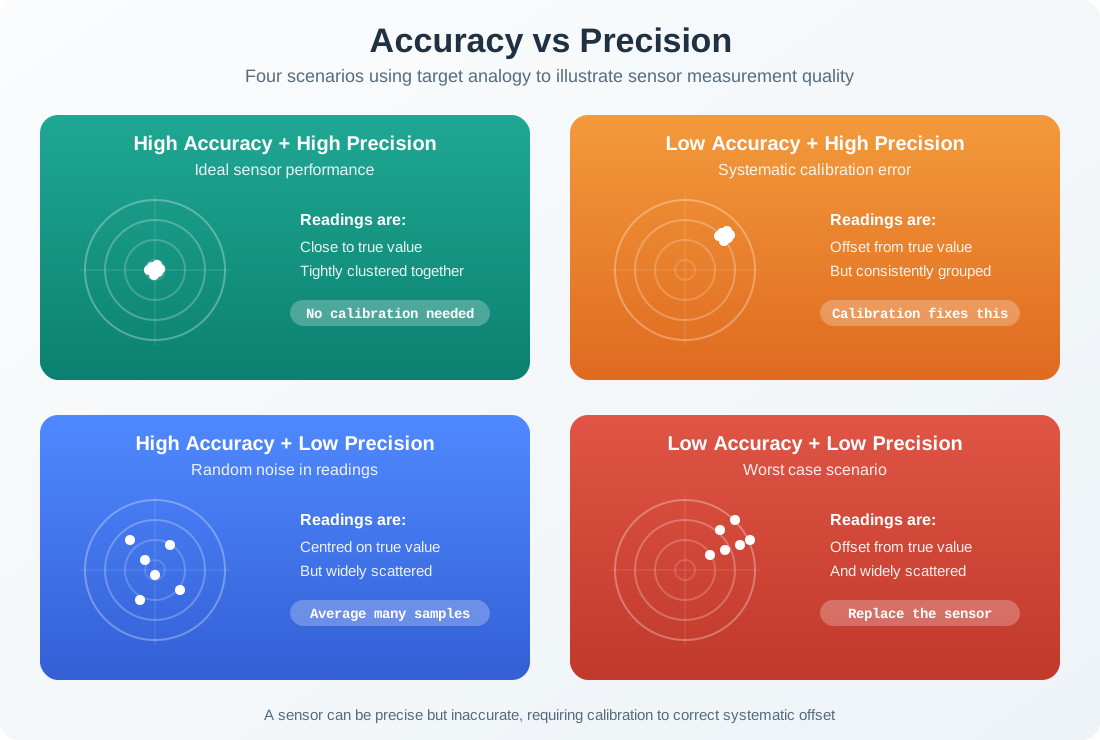
They sound related, but they are independent, and confusing them leads to fixing the wrong problem.

  • The readings cluster tightly, so the sensor is precise.
  • A temperature reference says the chamber is 25.0 °C.
Four target-style panels compare sensor readings that are accurate and precise, precise but biased, accurate but noisy, or neither accurate nor precise.
iotclass.org

Major section

Accuracy-Precision Confusion

A pressure sensor spanning 0–100 kPa is specified with 0.5% full-scale hysteresis.

  • …depending on whether you reached 50 kPa while pressure was rising or falling.
  • A test that only ramps pressure upward will report excellent repeatability and completely miss this 0.5 kPa direction-dependent error.
  • A soil-moisture node gives ADC codes with a standard deviation of about 12 counts when the probe is held in one sample.
iotclass.org

Major section

Different Errors Need Remedies

The reason the distinction matters is that each of the four has a different cure.

  • Averaging and higher resolution do nothing for a bias; only comparison against a known standard does.
  • Tighten random scatter by averaging uncorrelated samples, limiting bandwidth, and using a lower-noise front-end — the tools that do nothing for accuracy.
  • A one-time calibration cannot hold back drift.
iotclass.org

Major section

Separate Bias, Scatter, and Time in One Tank

A tank gauge can repeat the same wrong level all morning and then wander farther as its body warms.

  • That pattern is precise at first, inaccurate against the ruler, and later affected by drift.
  • If the mean becomes 50.9 cm after a hot afternoon, the extra +0.4 cm is drift evidence.
Four target-style panels compare sensor readings that are accurate and precise, precise but biased, accurate but noisy, or neither accurate nor precise.
iotclass.org

Deck summary

Key takeaways

Bandwidth means the range of change rates a sensor can follow well enough for the intended decision.

  • They sound related, but they are independent, and confusing them leads to fixing the wrong problem.
  • A pressure sensor spanning 0–100 kPa is specified with 0.5% full-scale hysteresis.
  • The reason the distinction matters is that each of the four has a different cure.
  • A tank gauge can repeat the same wrong level all morning and then wander farther as its body warms.
iotclass.org

Retrieval practice

Recall check 1 of 6

Physics Phoebe says: answer from memory, then check your reasoning.

Q1A pressure sensor varies by approach direction and also changes at a fixed input over time. Which tests separate the errors?

ACompare rising and falling sweeps, then repeat a fixed-input test over time.
BRepeat only rising sweeps on one day.
CAverage all readings without their direction or date.
DCheck only the display resolution.
Show answer

Answer: A Direction tests expose hysteresis; a timed fixed-input series exposes drift.

iotclass.org

Retrieval practice

Recall check 2 of 6

Physics Phoebe says: answer from memory, then check your reasoning.

Q2A sensor gives five readings that are all within 0.01 units of each other, but all are about 3 units above the true value. How would you describe it?

APrecise but inaccurate: the readings repeat tightly
BAccurate but imprecise, because the readings are consistent.
CDrifting, because the values are wrong.
DSuffering hysteresis, because it is off by a constant.
Show answer

Answer: A Tight clustering is precision; being off the true value is an accuracy or bias problem.

iotclass.org

Retrieval practice

Recall check 3 of 6

Physics Phoebe says: answer from memory, then check your reasoning.

Q3A sensor display looks steady, but calibration bias and drift remain. What belongs in its error budget?

ATreat calibration bias as proof of high precision.
BKeep bias, random scatter, drift, and hysteresis as separate terms.
CUse only the number of display digits.
DKeep only random scatter after averaging.
Show answer

Answer: B Each error source needs its own allowance and evidence.

iotclass.org

Retrieval practice

Recall check 4 of 6

Physics Phoebe says: answer from memory, then check your reasoning.

Q4A team averages 1000 samples to try to fix a sensor that reads consistently 4% high. The average is rock-steady but still 4% high. Why?

AThey did not average enough samples; 10000 would remove the 4%.
BAveraging reduces random noise (precision-limited error).
CThe 4% error is quantization noise, which averaging cannot touch.
DThe sensor has perfect accuracy but poor precision.
Show answer

Answer: B Bias is an accuracy problem; only calibration against a reference removes it, not more samples.

iotclass.org

Retrieval practice

Recall check 5 of 6

Physics Phoebe says: answer from memory, then check your reasoning.

Q5A stable indoor sensor was calibrated a year ago and now reads about 1.5% off, having slowly changed over the months at constant conditions. Which error is this, and what is the remedy?

AHysteresis, fixed by approaching the value from one direction only.
BPoor precision, fixed by averaging more samples.
CDrift: a slow change over time at constant input.
DInsufficient resolution, fixed by a higher-bit ADC.
Show answer

Answer: C A gradual change over months at steady input is drift.

iotclass.org

Retrieval practice

Recall check 6 of 6

Physics Phoebe says: answer from memory, then check your reasoning.

Q6A level gauge may have bias of 0.4 cm, residual scatter of 0.1 cm, drift of 0.3 cm, and hysteresis of 0.2 cm. What conservative worst-case error should accompany a reading?

A±1.0 cm
B±0.1 cm
C±0.5 cm
D±0.7 cm
Show answer

Answer: A Correct: add the possible magnitudes when their signs could reinforce each other.

iotclass.org

Print reference

Answers

Answer key.

  1. A · Direction tests expose hysteresis; a timed fixed-input series exposes drift.
  2. A · Tight clustering is precision; being off the true value is an accuracy or bias problem.
  3. B · Each error source needs its own allowance and evidence.
  4. B · Bias is an accuracy problem; only calibration against a reference removes it, not more samples.
  5. C · A gradual change over months at steady input is drift.
  6. A · Correct: add the possible magnitudes when their signs could reinforce each other.
iotclass.org