Specialized Architectures · Study deck
Sensor Trust: Production Records
A trust score changes after a lost packet, but no one can say why.
Blueprint Bina is your guide for this deck.

After studying this chapter
Learning objectives
You will be able to:
- Explain: Reviewers challenge weak evidence before actions become automatic, and usually choose a bounded response such as reducing reliance, requesting corroboration, or routing around the affected path while the record remains open.
- Explain: A review should show what the system expected, what it observed, how the classification was chosen, what action follows, and what new evidence would change the decision.
- Explain: The action boundary then states what may change and where the response stops, and the retest trigger names evidence that confirms, changes, or closes the decision.
- Identify review gaps before behavior logic is trusted by downstream decisions.
Major section
Sensor Behavior Production Record
The label may shape an alert, a route, or the data that people trust.
- A strong label built from weak evidence can block good data or hide a real fault.
- A safe review keeps the action small while doubt remains.
- The records and worked reviews later in the chapter provide that detail.
- The review should be conservative.
Major section
Sensor Behavior Production Record (continued)
This chapter is the review checkpoint between behavior concepts and implementation.
- A production record is where a behavior label becomes an operating commitment.
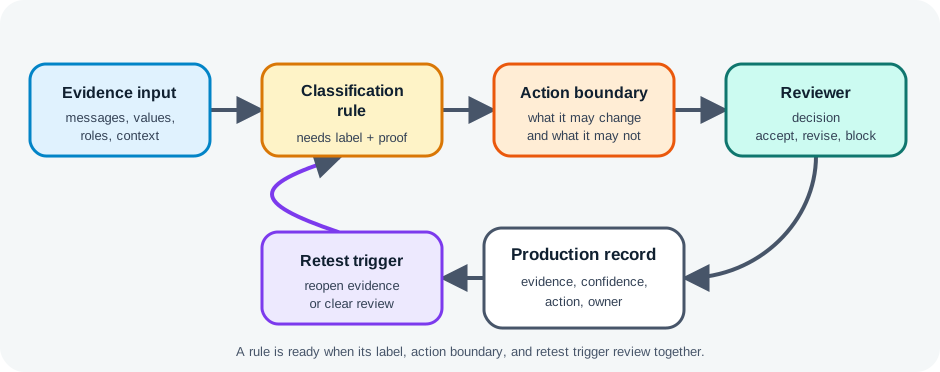
- The review is complete only when the classification, rule, action, owner, and retest trigger are visible to the people who must maintain the system.
- It should ask whether the evidence and action are reviewable.
Major section
Sensor Behavior Production Record (continued)
Sensor behavior logic becomes production-ready when each classification can be reviewed from evidence rather than from assumptions.
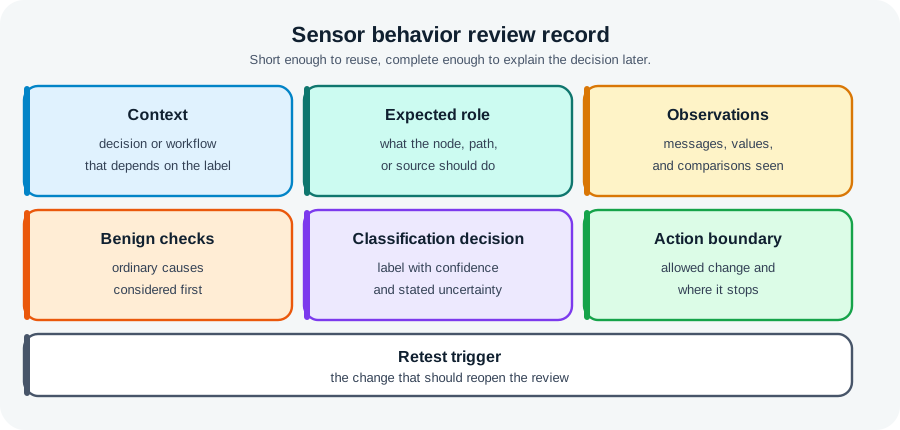
- A review should show what the system expected, what it observed, how the classification was chosen, what action follows, and what new evidence would change the decision.
- It turns the behavior vocabulary from earlier chapters into a release record that reviewers can inspect, challenge, and retest.
- Trust Management: how cooperation evidence can influence routing and trust decisions.
Major section
Sensor Behavior Production Record (continued)
Dumb Nodes & Recovery: how limited diagnostic evidence should be handled conservatively.
- A classification rule is not ready if it cannot explain the expected role, observations, confidence, action, and retest trigger.
- Reviewers challenge weak evidence before actions become automatic, and usually choose a bounded response such as reducing reliance, requesting corroboration, or routing around the affected path while the record remains open.
- The production review gate connects behaviour evidence to a decision record.
Major section
Sensor Behavior Production Record (continued)
This order prevents an automatic label from escaping the decision boundary it was designed to protect.
- The review ends only when it names the condition that would confirm, downgrade, or clear the label.
- The reviewer then accepts, revises, or blocks the rule based on evidence quality.
- No retest trigger: The label can persist even after conditions change.
Major section
Sensor Behavior Production Record (continued)
The production record preserves evidence, confidence, action, and owner, while the final trigger names the change that reopens review.
- A review record should be short enough to use repeatedly and complete enough to explain the decision later.
- Benign checks come before classification so ordinary explanations are considered before assigning a label and confidence.
- Any threshold or policy in this chain must be recorded as local configuration rather than presented as a universal fact.
Major section
Sensor Behavior Production Record (continued)
The action boundary then states what may change and where the response stops, and the retest trigger names evidence that confirms, changes, or closes the decision.
- A strong review asks practical questions before a rule becomes part of the production path.
- The production review should not ask only whether the label sounds reasonable.
- The rule should preserve that local evidence and action boundary instead of removing the source from every future use.
Major section
Sensor Behavior Production Record (continued)
Concrete example: a cold-chain review rule may flag a trailer temperature source as misleading for the current shipment decision when it reports plausible values that repeatedly conflict with adjacent package probes and door-state evidence.
- Action larger than evidence: The rule changes more of the system than the evidence supports.
- Fix this by naming the evidence that would confirm, change, or clear the label.
- Mixed review purpose: The page tries to be a taxonomy, implementation guide, case study, and assessment all at once.
- If the evidence is incomplete, use a weaker label, request corroboration, or keep the record open.
Major section
Sensor Behavior Production Record (continued)
The chapter's key standard is traceability: a behavior label should connect to expected role, observations, benign checks, confidence, action boundary, and retest trigger.
- If the evidence supports action, scope that action to the affected decision and preserve enough context for later review.
- Production review for sensor behavior should include monitoring, classification quality, false positives, update paths, and operator action rules.
- Trust Management then shows how cooperation evidence influences bounded route and trust decisions.
Deck summary
Key takeaways
The label may shape an alert, a route, or the data that people trust.
- This chapter is the review checkpoint between behavior concepts and implementation.
- Sensor behavior logic becomes production-ready when each classification can be reviewed from evidence rather than from assumptions.
- Dumb Nodes & Recovery: how limited diagnostic evidence should be handled conservatively.
- This order prevents an automatic label from escaping the decision boundary it was designed to protect.
Retrieval practice
Recall check 1 of 4
Blueprint Bina says: answer from memory, then check your reasoning.
Q1A release rule labels a sensor misleading after one contradictory reading and may disable every downstream use of that sensor. What should the production reviewer decide?
Show answer
Answer: B Production review traces evidence into a classification and permits only an action proportional to that evidence, with explicit ownership and a trigger that reopens the decision.
Retrieval practice
Recall check 2 of 4
Blueprint Bina says: answer from memory, then check your reasoning.
Q2How should reviewers handle a misleading-node label with this evidence missing?
Show answer
Answer: B Production review requires traceability.
Retrieval practice
Recall check 3 of 4
Blueprint Bina says: answer from memory, then check your reasoning.
Q3A route-only trust downgrade reaches its review expiry, but no fresh forwarding check is available. What should the production record show?
Show answer
Answer: A Trace expiry and new evidence through confidence and an action scoped to the affected route.
Retrieval practice
Recall check 4 of 4
Blueprint Bina says: answer from memory, then check your reasoning.
Q4A trust rule changes its local threshold and assigns a new route label. What must the production record retain?
Show answer
Answer: A A production trust record links observations and local policy to confidence and the affected action boundary.
Print reference
Answers
Answer key.
- B · Production review traces evidence into a classification and permits only an action proportional to that evidence, with explicit ownership and a trigger that reopens the decision.
- B · Production review requires traceability.
- A · Trace expiry and new evidence through confidence and an action scoped to the affected route.
- A · A production trust record links observations and local policy to confidence and the affected action boundary.