Specialized Architectures · Study deck
Sensor Trust: Evidence and Review
A sensor reading should not trigger action until its source, age, quality, and limits can be reviewed.
Blueprint Bina is your guide for this deck.

After studying this chapter
Learning objectives
You will be able to:
- Identify the evidence a trust-management rule needs before it affects routing or data acceptance.
- Separate observation evidence, trust state, action boundary, confidence, and retest trigger.
- Explain why local trust thresholds must be documented as configuration rather than universal facts.
- Choose bounded trust actions that protect the affected decision without overclaiming intent.
Major section
Begin With One Report You No Longer Trust
A score may aid rank, but it does not prove motive.
- One odd event may come from a weak link, a full queue, a low cell, or harmful action.
- The first choice is not whether the node is good or bad.
- This first pass does not supply one rule for every site.
Major section
In 60 Seconds
A useful trust decision does not guess motive.
- It records expected behavior, observed cooperation evidence, related checks, a local scoring rule or label, the bounded action, and the retest trigger that could change the decision.
- This chapter is about implementation decisions, not a universal trust algorithm.
- The safest design is reviewable: the system should be able to explain why trust changed, which decision was affected, and what evidence would restore, revise, or escalate the trust state.
Major section
Minimum Viable Understanding
A bounded action may reduce reliance, request corroboration, avoid one route, or keep the record open.
- Trust is a current decision state based on evidence, not a permanent identity for a node.
- Cooperation evidence must be tied to an expected role such as forwarding, acknowledging, sensing, or corroborating, and the rule must preserve the observations and related checks behind its decision.
- Every trust decision also needs a retest trigger capable of confirming, changing, or clearing the current state.
Major section
Trust Review Loop
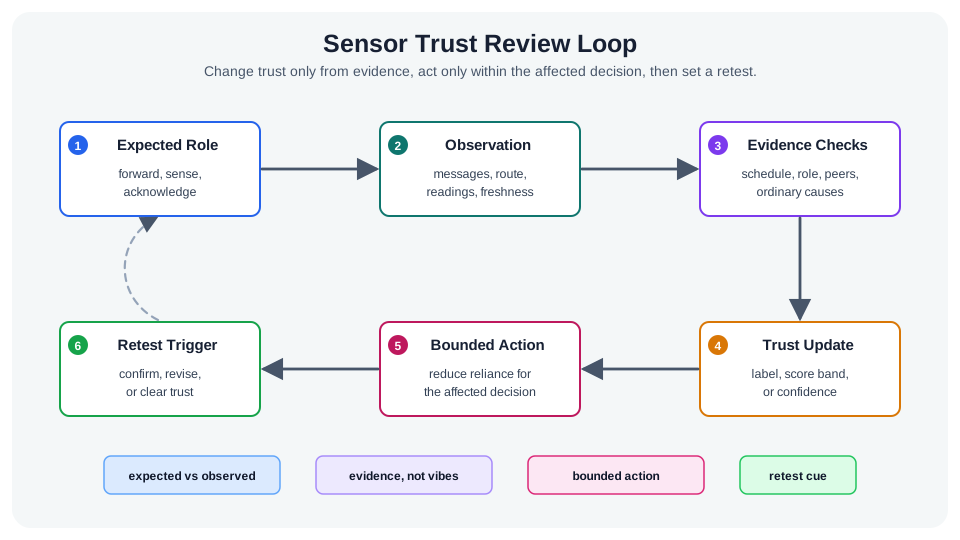
The trust review loop starts with an expected role and ends with a bounded action plus a retest trigger.
- The bounded-action stage states which decision changes and which decisions remain untouched.
- Finish with the evidence that will reopen, clear, or escalate the record.
Major section
Trust Evidence Record
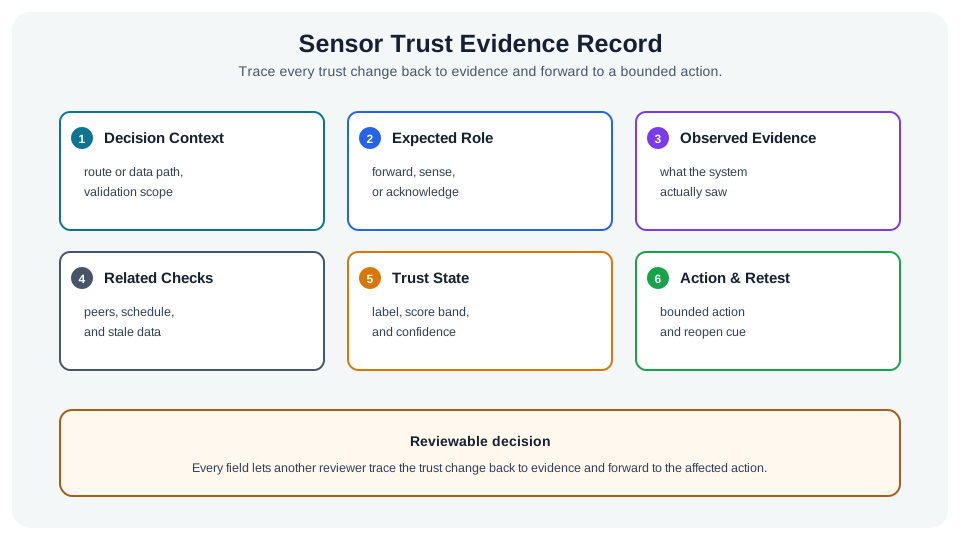
A trust decision should leave behind a compact record.
- The record is not a log dump; it is the minimum review material needed to understand and challenge the decision later.
- The action boundary states what may change and where it must stop, while the retest trigger names evidence that restores, revises, or closes the decision.
Major section
Bounded Trust Actions
Trust actions match the evidence.
- The system may request corroboration before accepting a reading, prefer a path with stronger cooperation evidence for the affected route, or avoid relying on a suspect node for shared work while review remains open.
- It may mark a source unavailable for the current decision rather than hide the gap, or leave trust unchanged when evidence is too thin.
- None of these outcomes justifies permanent exclusion by default: the action states exactly what changes and which future evidence could change it back.
Major section
Worked Review: Forwarding Trust Gate
Scenario: a node is expected to relay messages for a path, but the review record shows inconsistent cooperation.
- The node still reports its own readings, so the issue is not simple silence.
- Concrete example: a parking-lot mesh node sends its own occupancy readings but inconsistently forwards neighboring bay-status records during the same review windows.
- If evidence is thin, the trust state should remain suspect rather than selfish or malicious.
Major section
Worked Review: Forwarding Trust Gate (continued)
This review is useful because it protects a route decision while preserving uncertainty.
- The trust action can reduce reliance on that node for the affected relay path while still preserving its own local readings with their normal quality checks.
- Trust decision: The local rule reduces reliance on that node for the affected route.
- The action does not discard the node's unrelated sensing evidence, and it does not assign intent beyond the record.
Deck summary
Key takeaways
A score may aid rank, but it does not prove motive.
- A useful trust decision does not guess motive.
- A bounded action may reduce reliance, request corroboration, avoid one route, or keep the record open.
- The trust review loop starts with an expected role and ends with a bounded action plus a retest trigger.
- A trust decision should leave behind a compact record.
Retrieval practice
Recall check 1 of 2

Blueprint Bina says: answer from memory, then check your reasoning.
Q1A relay misses three acknowledgements, but its parent link is degraded and nearby relays show the same loss pattern. What is the sound trust-management response?
Show answer
Answer: B Trust management compares expected cooperation with observations and related checks, then changes reliance only for the affected decision and keeps the state reversible through retest evidence.
Retrieval practice
Recall check 2 of 2
Blueprint Bina says: answer from memory, then check your reasoning.
Q2A trust rule lowers confidence in a relay node, but the record does not show the expected role, observed forwarding evidence, related checks, or retest trigger. What should a reviewer do first?
Show answer
Answer: D Trust management is reviewable when the decision can be traced from expected role and observations to trust state, bounded action, and retest trigger.
Print reference
Answers
Answer key.
- B · Trust management compares expected cooperation with observations and related checks, then changes reliance only for the affected decision and keeps the state reversible through retest evidence.
- D · Trust management is reviewable when the decision can be traced from expected role and observations to trust state, bounded action, and retest trigger.