IoT Fundamentals · Study deck
Sensor-to-Network Pipeline
Picture a freezer probe that produces the number 612.
Physics Phoebe is your guide for this deck.

After studying this chapter
Learning objectives
Trace every handoff and keep enough context to interpret a reading later.
- Follow sensing, conversion, formatting, and delivery.Compare each handoff input with its output.
- Preserve identity, time, unit, quality, and version.Context keeps a value interpretable across the pipeline.
- Separate measurement faults from link faults.The evidence must identify the failing boundary.
Major section
In 60 Seconds
By the time the cloud screen shows four degrees, several steps have changed that number.
- If the unit, time, probe identity, or conversion version is lost, the final value can look exact while meaning something else.
- An analog-to-digital converter is a part that turns a changing electrical signal into numbered steps.
- At every hand-off, keep the original identity, time, unit, quality state, and version that explains how the value was made.
Major section
In 60 Seconds (continued)
The receiver should distinguish a bad measurement from a damaged message and an old message from a new one.
- This trace does not teach every sensor circuit, filter, or radio choice.
- The deeper sections show how sampling, quantization, calibration, packet fields, and link evidence protect the same meaning across the full chain.
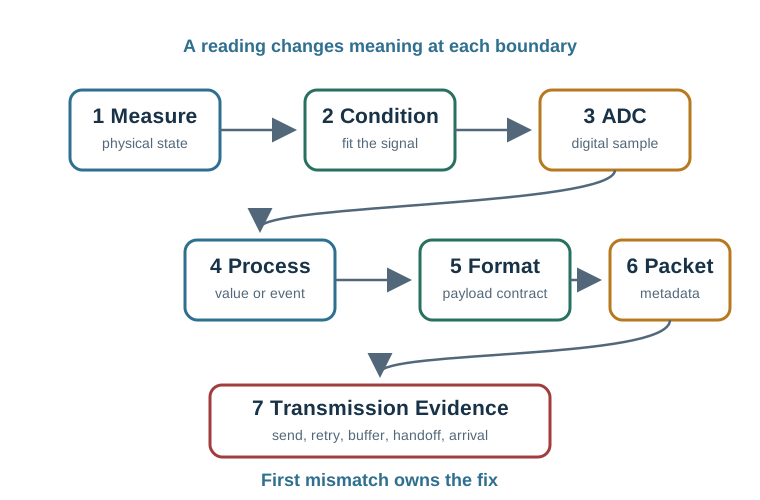
- A delivered sensor reading is a relay across measurement, conditioning, conversion, processing, formatting, packet assembly, and transmission.
Major section
Start With the Story
You will trace a reading through seven stages and locate the first boundary where its value or context changes incorrectly.
- The first handoffs change the reading’s form, and the red trace identifies the earliest boundary where output no longer agrees with input.
Major section
Sensor Operation in One Minute
A sensor is a transducer: it responds to a physical quantity such as temperature, light, pressure, or motion and produces a signal that changes with that quantity.
- The signal may be analog—such as a voltage, current, resistance, or capacitance—or it may already be a digital value produced by electronics inside the sensor.
Major section
Sensor Operation in One Minute (continued)
Sampling can corrupt a value before any packet reaches the radio.
- Aliasing starts before transmission.Fast variation can appear as a false slow pattern after sampling.
- A radio link can weaken after sampling.A weak path can lose packets after a value has already been sampled.
- Measure the two boundaries separately.A clean link cannot repair a misleading sample.
Major section
A Reading Is a Relay, Not a Number
A sensor reading does not appear in a database as a clean number.
- At each handoff, meaning can be preserved or quietly lost, which is why the pipeline, not any single chip, decides whether the final number can be believed.
- The same number appears throughout, but its form and evidence change at every boundary.
Major section
A Reading Is a Relay, Not a Number (continued)
The pipeline's job is to keep the baton intact and to keep its label attached at every exchange.
- Each boundary can add error or strip away the context that makes the number interpretable.
- The reading starts as an analogue voltage.
- JSON or CBOR gives the reading a data form.
Major section
A Reading Is a Relay, Not a Number (continued)
If the raw ADC code is wrong, look before formatting and networking.
- The front end scales and guards it before the ADC makes a code.
- MQTT or CoAP then adds the facts needed for transfer, and link proof shows if it arrived.
- If this gives you the mental model, you can stop here.
Major section
A Reading Is a Relay, Not a Number (continued)
Identity, time, unit, quality state, and version must stay with it at each handoff.
- The first edge where value or context goes wrong owns the fix, even if the screen shows the fault later.
- If the device value is correct but the cloud record has the wrong unit, inspect the format contract.
- Beginner ExamplesA temperature that is correct on the device but wrong in the cloud points to a formatting or transmission boundary, not the sensor.
- A reading with no timestamp may be a correct value that no one can place in time, which makes it hard to trust.
Major section
Apply It: Walk and Defend Each Boundary
The practical job is to define what crosses each boundary and what evidence travels with it, so a value stays interpretable from the sensor to the database.
- A useful trick is to design backward, starting from the record you need at the end.
- A physical quantity becomes an electrical signal.
- The signal is scaled, shifted, and filtered.
- The analog path so a value can be traced.
Major section
Apply It: Walk and Defend Each Boundary (continued)
The signal is sampled and quantized to codes.
- The value is serialized to a defined layout.
- The payload is wrapped with addressing and checks.
- The packet is delivered over a link.
- Incremental PracticeBeginner For a single temperature sensor, list the minimum context fields a final record needs to be trustworthy.
Major section
Apply It: Walk and Defend Each Boundary (continued)
Walkthrough: Designing the Pipeline BackwardStart at the database, not the sensor: State what a trustworthy final record must contain, such as value, units, time, device identity, and quality, then make each stage supply its part.
- IntermediateFor a two-device fleet, decide where calibration is applied and justify doing it exactly once.
- AdvancedDesign a boundary-by-boundary test that proves a known input arrives unchanged in meaning at the database.
- If your job is to define and test the pipeline's boundaries, you can stop here.
Major section
Under the Hood: Where Meaning Is Lost and Cannot Be Recovered
The deeper layer separates boundary errors that can be recovered from those that cannot.
- Knowing the difference decides where prevention is mandatory and where a later check is enough.
- Folded high-frequency content cannot be separated later.
- A value with no trustworthy time cannot be placed in a series.
Major section
Under the Hood: Where Meaning Is Lost and Cannot Be Recovered (continued)
End-to-end trust is bounded by the weakest boundary: a precise sensor behind a sloppy format contract delivers imprecise meaning.
- Correct bits carry wrong meaning if the scale is unknown.
- The fix is a shared, versioned contract: when the representation changes, the version changes too, so a mismatch is visible rather than silent.
- Without these, retries can inflate counts and corrupt averages while every individual packet looks correct.
Major section
Under the Hood: Where Meaning Is Lost and Cannot Be Recovered (continued)
The end-to-end latency is the sum of conditioning, conversion, processing, queuing, and transmission delays, so a pipeline can be slow even when every stage seems fast.
- Common PitfallsTreating the pipeline as one black box: Errors hide at handoffs, so a black-box view cannot localize them.
- Reconstructing context late: Units, scale, and time attached after the fact are guesses.
- Confusing sent with delivered intact: Without acknowledgement and integrity checks, neither is proven.
- At this depth, the pipeline is a chain of contracts, not a wire.
Deck summary
Key takeaways
By the time the cloud screen shows four degrees, several steps have changed that number.
- The receiver should distinguish a bad measurement from a damaged message and an old message from a new one.
- You will trace a reading through seven stages and locate the first boundary where its value or context changes incorrectly.
- A sensor is a transducer: it responds to a physical quantity such as temperature, light, pressure, or motion and produces a signal that changes with that quantity.
- A sensor reading does not appear in a database as a clean number.
Retrieval practice
Recall check 1 of 4

Physics Phoebe says: answer from memory, then check your reasoning.
Q1What happens before a temperature reading can enter a network packet?
Show answer
Answer: A Sensing turns a physical quantity into a signal that later stages can condition and encode.
Retrieval practice
Recall check 2 of 4
Physics Phoebe says: answer from memory, then check your reasoning.
Q2A sensor value is correct on the device's debug output but appears scaled wrong in the cloud database. Which part of the pipeline should you suspect first?
Show answer
Answer: C The on-device value is right, so suspicion falls on a later handoff that reinterprets the value.
Retrieval practice
Recall check 3 of 4
Physics Phoebe says: answer from memory, then check your reasoning.
Q3Where should units, scale, and timestamp ideally be attached to a reading?
Show answer
Answer: D Context attached early and carried forward avoids fragile, sometimes impossible, late reconstruction.
Retrieval practice
Recall check 4 of 4
Physics Phoebe says: answer from memory, then check your reasoning.
Q4A retried packet causes a cloud counter to be incremented twice. Which pipeline safeguard most directly prevents this?
Show answer
Answer: B Identifying duplicates lets the receiver apply each unique message once, even after retransmission.
Print reference
Answers
Answer key.
- A · Sensing turns a physical quantity into a signal that later stages can condition and encode.
- C · The on-device value is right, so suspicion falls on a later handoff that reinterprets the value.
- D · Context attached early and carried forward avoids fragile, sometimes impossible, late reconstruction.
- B · Identifying duplicates lets the receiver apply each unique message once, even after retransmission.