A refrigerated cabinet needs to distinguish half-degree changes across its operating range.
Physics Phoebe is your guide for this deck.
sensorselectionmatrix
After studying this chapter
Learning objectives
Keep the four measurement gates separate from later preferences.
Define range, resolution, accuracy, and response as separate gates.
Record evidence, gaps, actions, release state, and retest triggers.
Reject a failed must-have before scoring preferences.
Range asks whether the part covers the temperatures required. Resolution asks how small a change its output can show. Accuracy asks how close the result is to the true temperature under stated conditions. Response time asks whether the reading arrives soon enough. Record a test and its owner for every gate.
Major section
Start With the Measurement Story
One option has the finest stated accuracy, but it draws too much power during measurement and is hard to place against the stored product.
The quality lead needs a safe field fit, not a winning total built from weak assumptions.
A fit matrix makes judgment visible; it does not turn uncertain evidence into fact.
A fit matrix turns a vague sensor debate into visible evidence.
Major section
Four-Axis Sensor Matching
Different bodies can provide the same soil-moisture capability, but their sampling footprint, installation depth, cabling, and maintenance demands make them very different candidates in a fit matrix.
The matrix must preserve the footprint, placement, power, interface, calibration, and revisit burden that each physical form introduces.
Solar-powered cosmic-ray soil-moisture sensing station installed in a field
Major section
Which Sensor Decision Example
Range, resolution, accuracy, and response tradeoffs need separate evidence.
Read every requirement beside its operating condition.
Keep failed gates and unresolved evidence visible.
Assign validation actions before comparing preferences.
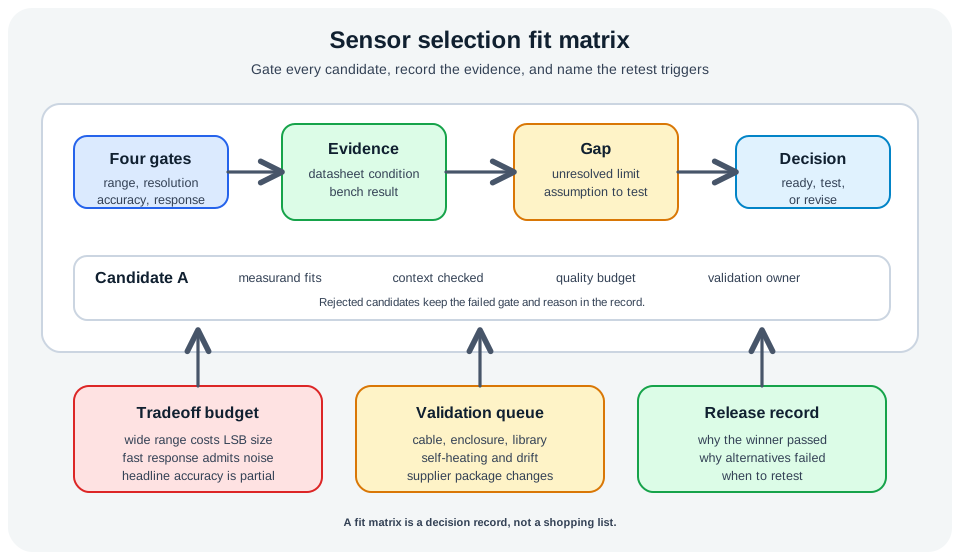
Sensor selection fit matrix tradeoff record showing range, resolution, accuracy, response evidence, unresolved gaps, validation actions, release status, and revalidation triggers.
Read the matrix from requirements to evidence, gaps, validation actions, release status, and retest triggers. A failed must-have gate remains failed before preference scoring.
Major section
Keep a Cheap Converter from Winning a Failed Gate
An ideal 8-bit converter provides 256 bins, so the nominal step is 165 divided by 256 = 0.6445 °C, rounded.
Against a required 0.5 °C step, the excess is about 0.1445 °C, or 28.9% of the allowed step.
A fast bare sensing element may respond more slowly once installed.
Sensor selection fit matrix tradeoff record showing range, resolution, accuracy, response evidence, unresolved gaps, validation actions, release status, and revalidation triggers.
Major section
Keep a Cheap Converter from Winning a Failed Gate (continued)
The higher-resolution candidate still needs evidence for the other gates; it cannot borrow an accuracy claim from its code count.
The scale may shift, reopening the error budget rather than merely changing a bill-of-materials item.
The selection decision should preserve the rejected option and the reason it failed, then assign validation to the remaining uncertainty.
This module's tradeoffs are useful only after hard gates pass.
Deck summary
Key takeaways
Range, resolution, accuracy, and response tradeoffs need separate evidence.
Keep required gates separate from preferences.
Record evidence, gaps, actions, and an owner.
Retest when the measurement chain changes.
Keep must-have gates separate from preferences. Record the test condition, result, remaining gap, and owner. Retest when the enclosure, reference, firmware mode, or supplier changes.
Retrieval practice
Recall check 1 of 4
Physics Phoebe says: answer from memory, then check your reasoning.
Q1A sensor has superb 0.001-unit resolution but its accuracy is only ±2 units, and your application needs ±0.5 units. Is it a good choice?
ANo. Resolution and accuracy are different axes.
BYes; averaging can reduce the error.
CYes; small changes remain visible.
DIt cannot be judged without knowing the price.
Show answer
Answer: A Each axis must pass on its own; excellent resolution does not rescue inadequate accuracy.
Retrieval practice
Recall check 2 of 4
Physics Phoebe says: answer from memory, then check your reasoning.
Q2A sensor candidate fails its response-time gate in a bench test, while another lacks a field drift test. What belongs in the fit matrix?
AKeep failed response evidence; mark untested drift with a validation owner.
BDelete the failed response row and mark untested field drift passed without an owner.
CMark field drift passed because the datasheet does not discuss it.
DRank sensors by price because the least expensive candidate is the strongest fit for the response task.
Show answer
Answer: A Correct: rejected evidence and unresolved assumptions must remain visible for the selection decision.
Retrieval practice
Recall check 3 of 4
Physics Phoebe says: answer from memory, then check your reasoning.
Q3Candidate C converts its full −40 to +125 °C sensor span with an 8-bit ADC; the fridge needs 0.5 °C steps over −20 to +10 °C. Why does Candidate C fail?
A8-bit ADCs are inaccurate because their code width cannot resolve the needed signal variations.
BThe ADC step is too coarse for the required 0.5 °C.
DThe temperature range does not include a refrigerator.
Show answer
Answer: B Candidate C spans 165 °C, so 165/256 = 0.6445 °C per step, above the 0.5 °C gate.
Retrieval practice
Recall check 4 of 4
Physics Phoebe says: answer from memory, then check your reasoning.
Q4To be safe, an engineer picks a pressure sensor with 10× the range actually needed, read by the same fixed-bit-depth ADC. What is the hidden cost?
ANo cost, because excess pressure range always improves safety.
BImproved accuracy from selecting the widest available range.
CCoarser pressure resolution per ADC step, by about tenfold.
DFaster pressure response solely because the range is larger.
Show answer
Answer: C Since LSB = range / 2^N, a 10x larger range makes each step about 10x coarser for the same ADC.
Print reference
Answers
Answer key.
A · Each axis must pass on its own; excellent resolution does not rescue inadequate accuracy.
A · Correct: rejected evidence and unresolved assumptions must remain visible for the selection decision.
B · Candidate C spans 165 °C, so 165/256 = 0.6445 °C per step, above the 0.5 °C gate.
C · Since LSB = range / 2^N, a 10x larger range makes each step about 10x coarser for the same ADC.
1 A: resolution differs from accuracy. 2 A: retain failures and unknowns. 3 B: 165 °C / 256 = 0.6445 °C per step, above the 0.5 °C gate. 4 C: tenfold range gives tenfold nominal step size.