Specialized Architectures · Study deck
Sensor Production: Framework and Review
A fleet rule passes a demo and then blocks healthy nodes after a noisy week.
Blueprint Bina is your guide for this deck.

After studying this chapter
Learning objectives
You will be able to:
- Explain: Concrete example: a cold-room temperature feed repeats the same value across several review windows while door-state and compressor-status records show activity that should normally change the local condition.
- Explain: The goal is to make review decisions traceable: what was observed, what state was assigned, what action was allowed, what evidence was missing, and what change would reopen the decision.
- Explain: Storing only labels is too thin, while solving every architecture concern is too broad; the useful middle ground is a short, repeatable record for bounded decisions from visible evidence.
Major section
Sensor Production Framework
That promise must cover data, rules, action, support, and the next change.
- A strict rule can block weak data, but it may also stop useful work for a small fault.
- A loose rule keeps work moving, yet it can pass a bad claim.
- A sensor production framework is the operating record that keeps sensor behavior decisions repeatable.
Major section
Sensor Production Framework (continued)
The goal is not to prove that every sensor is always correct.
- The production review must name the site rule, accountable owner, and evidence that draws each sensor boundary.
- A production framework is a promise that sensor behavior decisions will be made the same careful way after the prototype is gone.
- The record still needs a retest trigger.
Major section
Sensor Production Framework (continued)
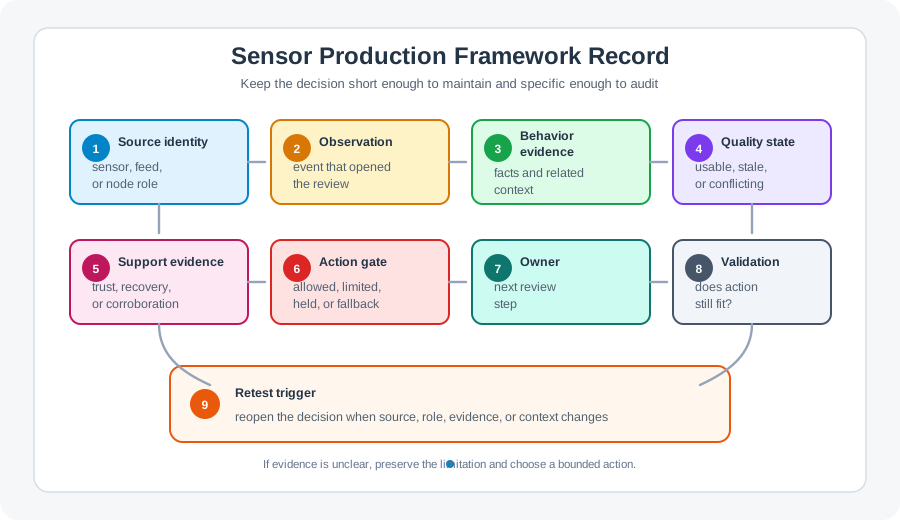
It links behavior evidence, quality state, trust, recovery, action gates, and retest rules so a later operator can understand the decision.
- Each framework element should answer what evidence enters, what decision comes out, who owns the action, and what change forces another review.
- It connects observations, behavior labels, quality states, trust or recovery evidence, allowed actions, ownership, validation, and retest triggers.
- Validation and retest triggers are part of the framework, not afterthoughts.
Major section
Sensor Production Framework (continued)
Sensor Behaviors Production and Review: production review gates and review records.
- The goal is to make review decisions traceable: what was observed, what state was assigned, what action was allowed, what evidence was missing, and what change would reopen the decision.
- A label describes current evidence rather than permanently branding a sensor, and each action gate is tied to quality state, trust or recovery support, and a review owner.
- Recovery review should preserve the before and after evidence.
Major section
Sensor Production Framework (continued)
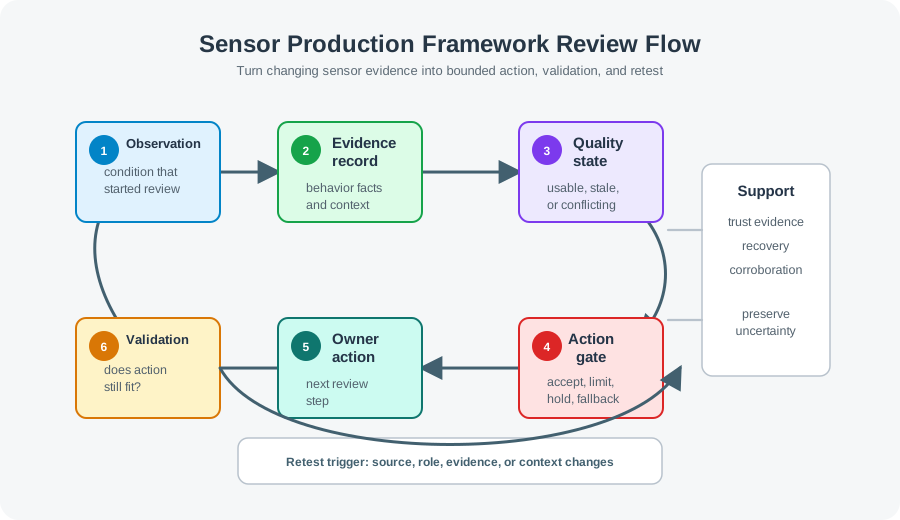
The production framework turns observations into gated actions and then keeps the decision open to validation and retest.
- When evidence is unclear, the safe state is usually lower confidence, limited action, recovery review, or retest.
- The record states which action is allowed, limited, or blocked, who owns the next step, and which validation or retest condition closes the loop.
- Ownership carries that response into validation, which checks whether it still fits the observed condition.
Major section
Sensor Production Framework (continued)
Storing only labels is too thin, while solving every architecture concern is too broad; the useful middle ground is a short, repeatable record for bounded decisions from visible evidence.
- The quality state then distinguishes usable, uncertain, stale, conflicting, and unavailable evidence before the action gate permits an action, fallback, recovery review, or hold.
- The final trigger reopens the decision when context, calibration evidence, role, or neighbouring observations change.
- The framework should state what evidence would resolve the question.
Major section
Sensor Production Framework (continued)
Identity and source: The record should identify the sensor, logical feed, or node role being reviewed.
- The identity should be stable enough to connect observations, quality state, and later retest evidence.
- Quality state: Quality state explains whether the evidence can support a decision.
- Useful states include acceptable, uncertain, stale, conflicting, unavailable, recovering, and rejected for this decision.
Major section
Sensor Production Framework (continued)
Ownership: Every non-final state needs an owner for the next action.
- Trust and recovery evidence: Trust evidence should be treated as review support, not as a magic score.
- Recovery evidence should show whether the condition was transient, recurring, or unresolved.
- Ownership can mean reviewing evidence, checking a calibration record, comparing related observations, or updating the retest rule.
Major section
Sensor Production Framework (continued)
Examples include accept for this decision, use with lower confidence, request corroboration, start recovery review, hold action, or retest before use.
- The framework is only useful when the record is short enough to maintain and specific enough to audit.
- Trust, recovery, or corroborating evidence supports—but does not replace—that state.
- The allowed action or fallback leads to an owner and validation result, and the final trigger states when review begins again.
Major section
Sensor Production Framework (continued)
Missing context, stale observations, and conflicting evidence must remain visible in this chain so the chosen action reflects uncertainty instead of hiding it inside a final label.
- The action should be limited to decisions that can tolerate that uncertainty.
- Request corroboration: Request corroboration when related sensors, logs, or state transitions can clarify a surprising observation.
- The framework should treat availability, freshness, and related evidence separately before allowing the value into the current decision.
Major section
Sensor Production Framework (continued)
Concrete example: a cold-room temperature feed repeats the same value across several review windows while door-state and compressor-status records show activity that should normally change the local condition.
- Observation: The value is reachable, but it has not changed when related evidence suggests it should.
- Evidence check: The reviewer records source identity, observation time, receive time, related observations, current role, quality state, and any recovery evidence.
- The value is not accepted solely because it is available.
Major section
Sensor Production Framework (continued)
Action gate: If the stale condition is unresolved, the source is marked lower confidence or unavailable for decisions that require current values.
- Retest trigger: Retest when the source resumes updates, the role changes, related evidence contradicts the feed again, the review owner changes the quality rule, or the decision context changes.
- Weak frameworks store labels without their observations, mix trust and recovery into one unclear approval, or accept a value because it is reachable rather than fit for the decision.
- This loop matters because an uncertain sensor may recover and an apparently healthy sensor may later lose the evidence supporting that state.
Deck summary
Key takeaways
That promise must cover data, rules, action, support, and the next change.
- The goal is not to prove that every sensor is always correct.
- It links behavior evidence, quality state, trust, recovery, action gates, and retest rules so a later operator can understand the decision.
- Sensor Behaviors Production and Review: production review gates and review records.
- The production framework turns observations into gated actions and then keeps the decision open to validation and retest.
Retrieval practice
Recall check 1 of 3
Blueprint Bina says: answer from memory, then check your reasoning.
Q1A sensor reading is plausible but older than the freshness limit for an automatic action. How should the production framework handle it?
Show answer
Answer: C The production framework separates observed value, quality state, and permitted action.
Retrieval practice
Recall check 2 of 3
Blueprint Bina says: answer from memory, then check your reasoning.
Q2A production framework labels a sensor as acceptable, but the record does not show the observation, quality state, validation result, or retest trigger. How should the production team use this acceptable label?
Show answer
Answer: A A sensor production framework is useful when labels remain connected to evidence, quality state, allowed action, validation, ownership, and retest triggers.
Retrieval practice
Recall check 3 of 3
Blueprint Bina says: answer from memory, then check your reasoning.
Q3A sensor rule begins blocking healthy nodes after noisy field data. Which production record supports safe recovery?
Show answer
Answer: D A production rule needs impact signals, a bounded rollback path, and evidence for revalidation.
Print reference
Answers
Answer key.
- C · The production framework separates observed value, quality state, and permitted action.
- A · A sensor production framework is useful when labels remain connected to evidence, quality state, allowed action, validation, ownership, and retest triggers.
- D · A production rule needs impact signals, a bounded rollback path, and evidence for revalidation.