Sensors & Measurement · Study deck
Sensor Power: Accuracy and Field Hardening
A lab prototype wakes on cue, but a cold field unit misses interrupts and reports stale values.
Physics Phoebe is your guide for this deck.

After studying this chapter
Learning objectives
You will be able to:
- Configure wake sources and data-ready timing before deep sleep.
- Test power estimates against accuracy, temperature, and field failures.
- Explain how self-heating and settling delay can make low-power readings inaccurate.
- Calculate when excitation current violates a temperature sensor's self-heating error budget.
Major section
Power Accuracy and Field Hardening
Firmware is the software stored inside a device.
- In the field, cable strain, weak battery power, moisture, and a slow network can turn one fault into a believable but wrong value.
- For each threat, name the expected sign, the limit for safe use, and the fallback.
- This review does not prove all future weather or ageing.
Major section
Power Accuracy and Field Hardening (continued)
A cold battery during retries may fail where either test alone passes.
- It defines the tested envelope.
- The deeper sections show how calibration, power design, filtering, enclosure choices, and maintenance evidence support that boundary.
- A field sensor has to be accurate after vibration, moisture, temperature swings, and low battery states.
- Accelerometer runs continuously (low power).
Major section
Power Accuracy and Field Hardening (continued)
Warm-up is both an energy event and a measurement-validity interval.
- The design starts by naming the threats and deciding which protection, calibration, and evidence checks keep the reading usable.
- But the excitation signal also falls to 83.3%, so the smaller thermal error can hide worsening resolution.
- GPS off unless accelerometer detects motion.
Major section
Power Accuracy and Field Hardening (continued)
If the number changes after only the sleep interval changes, investigate timing before recalibrating the sensor.
- Drooping from the chapter's 3.6 V fresh rail to 3.0 V gives $(3.0/3.6)^2=0.694$, so a 0.10 °C fresh-cell rise becomes 0.0694 °C.
- A practical power plan therefore starts with a measurement-quality budget, not just a battery-life target.
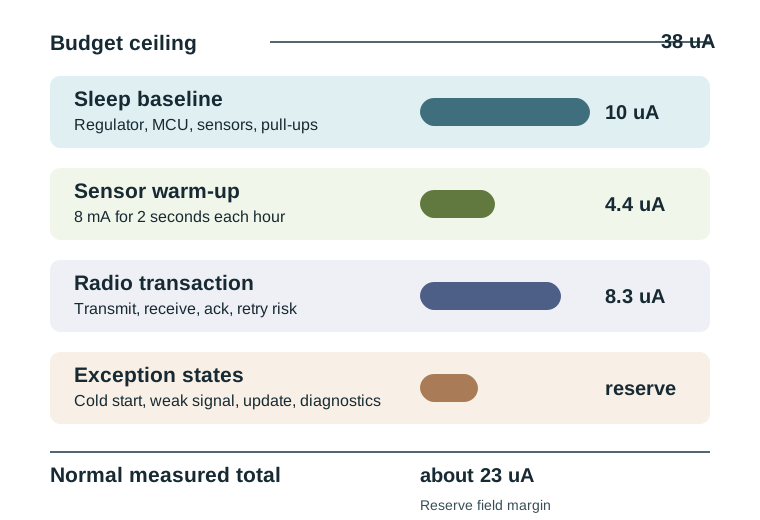
- The ledger view also changes how failures are budgeted.
Major section
Power Accuracy and Field Hardening (continued)
Wireless transmission (Wi-Fi, LoRa, BLE advertising) is often 10–1000x more power-hungry than the microcontroller.
- The second is warm-up and settling: a sensor that was just powered on after sleep has not yet stabilised, so an eager reading taken too soon is wrong.
- When changing a power setting changes the measured value, the measurement chain is part of the power design.
- Factor this into duty-cycle calculations or keep critical sensors powered continuously.
Major section
Power Accuracy and Field Hardening (continued)
If the error budget allows only 0.25 °C of self-heating and the dissipation constant is 2 mW/°C, the excitation budget is 0.5 mW.
- A convenient 1 mA test current would dissipate 10 mW and create about 5 °C of self-heating in the same condition.
- The goal is not the lowest instantaneous current; it is a repeatable energy packet whose thermal error, ADC noise, and settling time are all known.
- Optimising energy while ignoring settling gives a node that lasts for years and reports numbers that were never quite right.
Major section
Power Accuracy and Field Hardening (continued)
A node that normally sleeps for 99% of the hour may still need a reserve for cold starts, low-battery retries, cloud outages, or a stuck sensor that forces extra reads.
- If the normal cycle already consumes the whole budget, exception paths drain the battery first and accuracy degrades next as firmware starts cutting settle time to recover.
- Some sensors require a warm-up or stabilisation period after power-on before they produce accurate readings.
- Lithium cells lose capacity at low temperatures; alkaline cells have a steeper voltage drop curve.
Deck summary
Key takeaways
Firmware is the software stored inside a device.
- A cold battery during retries may fail where either test alone passes.
- Warm-up is both an energy event and a measurement-validity interval.
- If the number changes after only the sleep interval changes, investigate timing before recalibrating the sensor.
- Wireless transmission (Wi-Fi, LoRa, BLE advertising) is often 10–1000x more power-hungry than the microcontroller.
Retrieval practice
Recall check 1 of 4

Physics Phoebe says: answer from memory, then check your reasoning.
Q1What is 'self-heating' in a resistive temperature sensor?
Show answer
Answer: C The measurement current is also a heat source, so it adds a systematic upward error.
Retrieval practice
Recall check 2 of 4

Physics Phoebe says: answer from memory, then check your reasoning.
Q2A sensor shows 0.1 °C of self-heating error at a given sense current. If you triple that current, roughly what self-heating error should you expect?
Show answer
Answer: A P = I^2R, so tripling current multiplies dissipation and self-heating error by nine.
Retrieval practice
Recall check 3 of 4

Physics Phoebe says: answer from memory, then check your reasoning.
Q3To save power, a node powers its sensor, immediately converts, and sleeps. Readings are erratic and biased. What is the most likely cause?
Show answer
Answer: D Aggressive duty-cycling without a settling delay samples an unstabilised sensor; give it enough time to settle.
Retrieval practice
Recall check 4 of 4

Physics Phoebe says: answer from memory, then check your reasoning.
Q4What happens if you call esp_deep_sleep_start() on an ESP32 without configuring any wake source?
Show answer
Answer: B ESP32 deep sleep disables the CPU and peripherals.
Print reference
Answers
Answer key.
- C · The measurement current is also a heat source, so it adds a systematic upward error.
- A · P = I^2R, so tripling current multiplies dissipation and self-heating error by nine.
- D · Aggressive duty-cycling without a settling delay samples an unstabilised sensor; give it enough time to settle.
- B · ESP32 deep sleep disables the CPU and peripherals.