Sensors & Measurement · Study deck
Low-Power Sensors: Duty Cycles and Fusion
A node sleeps for most of the hour, then burns its budget during radio joins and sensor fusion.
Physics Phoebe is your guide for this deck.

After studying this chapter
Learning objectives
You will be able to:
- Explain: The Mistake: Reading sensor data registers immediately after triggering a measurement, before the sensor's internal ADC has completed conversion, resulting in stale data from the previous measurement or invalid values.
- Explain: the battery had a big problem. "I only have so much energy," she said. "If everyone keeps talking all the time, I will run out in just a few months!".
- Explain: Key Insight: For battery-powered outdoor IoT with infrequent small-payload transmissions, LoRaWAN's lower TX current and vastly longer range make it the clear winner.
Major section
Transmission Buffering Check
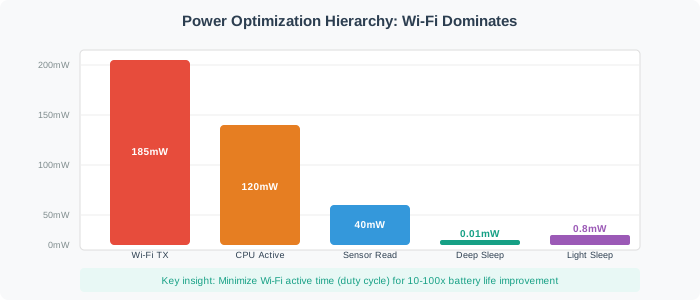
The hierarchy keeps radio use, awake time, and peripheral choices in proportion.
- The order connects engineering effort to likely energy return, preventing small microamp savings from distracting from costly radio or wake-time behaviour.
Major section
Read Registers After Conversion
The Mistake: Reading sensor data registers immediately after triggering a measurement, before the sensor's internal ADC has completed conversion, resulting in stale data from the previous measurement or invalid values.
- The datasheet specifies conversion time, but example code often uses fixed delays or omits waiting entirely.
- At 400kHz I2C, you can read registers in ~50us, but BMP280 needs 44 ms in ultra-high-resolution mode.
- The behavior to remember is: trigger measurement, wait until conversion is complete, then read the result.
Major section
For Kids: Meet the Sensor Squad!
the battery had a big problem. "I only have so much energy," she said. "If everyone keeps talking all the time, I will run out in just a few months!".
- "Exactly!" said Max. "The Wi-Fi radio uses the MOST energy -- way more than Sammy reading the temperature.
- Bella was relieved. "And between readings, everyone goes to DEEP SLEEP.
- "But ALWAYS set an alarm before sleeping," Max warned. "If you sleep without an alarm, you sleep FOREVER and someone has to unplug you and plug you back in!".
Major section
Wi-Fi vs LoRaWAN Power
Scenario: You are deploying 50 environmental sensors across a 5 km² agricultural area.
- We use 120 mA as a realistic value for long-range agricultural deployments.
- The advantage grows further with transmission buffering, since LoRaWAN's lower per-TX energy cost compounds the savings.
- Key Insight: For battery-powered outdoor IoT with infrequent small-payload transmissions, LoRaWAN's lower TX current and vastly longer range make it the clear winner.
Deck summary
Key takeaways
The hierarchy keeps radio use, awake time, and peripheral choices in proportion.
- The Mistake: Reading sensor data registers immediately after triggering a measurement, before the sensor's internal ADC has completed conversion, resulting in stale data from the previous measurement or invalid values.
- the battery had a big problem. "I only have so much energy," she said. "If everyone keeps talking all the time, I will run out in just a few months!".
- Scenario: You are deploying 50 environmental sensors across a 5 km² agricultural area.
Retrieval practice
Recall check 1 of 5

Physics Phoebe says: answer from memory, then check your reasoning.
Q1Your sensor node transmits every 15 minutes via Wi-Fi. Which strategy extends battery life most?
Show answer
Answer: B Wi-Fi transmission dominates the power budget at 80%+ of total energy.
Retrieval practice
Recall check 2 of 5

Physics Phoebe says: answer from memory, then check your reasoning.
Q2Per this chapter's Complementary vs Kalman Filter guidance, which scenario is explicitly listed as a reason to choose the Complementary Filter over the Kalman Filter?
Show answer
Answer: A see answers page
Retrieval practice
Recall check 3 of 5

Physics Phoebe says: answer from memory, then check your reasoning.
Q3Per this chapter's Smart vs Raw Sensor Processing comparison, how do algorithm updates differ between the two approaches?
Show answer
Answer: A The chapter's Smart vs Raw comparison table lists 'Algorithm updates: Firmware upgrade (rare)' for Smart Sensors and 'OTA software update' for Raw Sensors + MCU, reflecting that raw-sensor fusion logic runs in your own updatable firmware.
Retrieval practice
Recall check 4 of 5

Physics Phoebe says: answer from memory, then check your reasoning.
Q4Per this chapter's 'Read Registers After Conversion' pitfall, why does reading a BMP280 immediately after calling takeForcedMeasurement() in ultra-high-resolution mode return the wrong value?
Show answer
Answer: A see answers page
Retrieval practice
Recall check 5 of 5

Physics Phoebe says: answer from memory, then check your reasoning.
Q5Place each power-control decision where it lives so you can trace why a sensor node meets its energy budget instead of merely hoping the battery lasts.
Show answer
Answer: A Place each power-control decision where it lives so you can trace why a sensor node meets its energy budget instead of merely hoping the battery lasts.
Print reference
Answers 1 of 3
Answer key.
- B · Wi-Fi transmission dominates the power budget at 80%+ of total energy.
- A · The chapter's decision guidance: Complementary Filter fits constrained MCUs, critical battery life, quick prototyping, 2-3 sensors, and modest accuracy needs; Kalman Filter fits paramount accuracy, varying sensor reliability, state prediction, tracking moving targets, and 5+ sensor fusion with adequate compute.
Print reference
Answers 2 of 3
Answer key.
- A · The chapter's Smart vs Raw comparison table lists 'Algorithm updates: Firmware upgrade (rare)' for Smart Sensors and 'OTA software update' for Raw Sensors + MCU, reflecting that raw-sensor fusion logic runs in your own updatable firmware.
Print reference
Answers 3 of 3
Answer key.
- A · The chapter's fix is to wait for the specified conversion time or poll the data-ready flag: BMP280 standard mode is 8ms, ultra-high-resolution mode is 44ms, while an I2C register read itself takes only ~50us at 400kHz -- reading before conversion completes returns the prior measurement, not the new one.
- A · Place each power-control decision where it lives so you can trace why a sensor node meets its energy budget instead of merely hoping the battery lasts.