IoT Fundamentals · Study deck

Sending Readings Over the Link

Picture a freezer sensor sending a warning through a wall to a staff screen.

Physics Phoebe is your guide for this deck.

sensorpipelinetransmission
Physics Phoebe, the module guide, in a scene from this chapter.
iotclass.org

After studying this chapter

Learning objectives

You will be able to:

  • choose a transmission link from range, cadence, payload, power, ownership, and reliability requirements
  • account for wake, setup, acknowledgement, retry, handoff, and sleep as one transaction
  • compare device-side and receiver-side evidence for delivery and failure behavior
  • design bounded buffering, backoff, expiry, and duplicate handling for weak connectivity
iotclass.org

Major section

In 60 Seconds

A gateway means a device or service that joins two message paths.

  • A radio burst is not the result; the result is a fresh, correctly labelled reading at the right receiver.
  • The first design question is which evidence survives the whole trip.
  • A payload means the useful reading or command carried inside a message.
iotclass.org

Major section

Start With the Story

You will choose a link, estimate the whole transaction cost, and check whether readings actually reach the receiver.

  • The mathematical gist.: Radio-on energy is $E=P\,t=P\times\mathrm{bits}/R$.

Numbers to remember

0.0235 Whover five years it is 0.0235 Wh
iotclass.org

Major section

Transmission Is a Transaction, Not a Burst
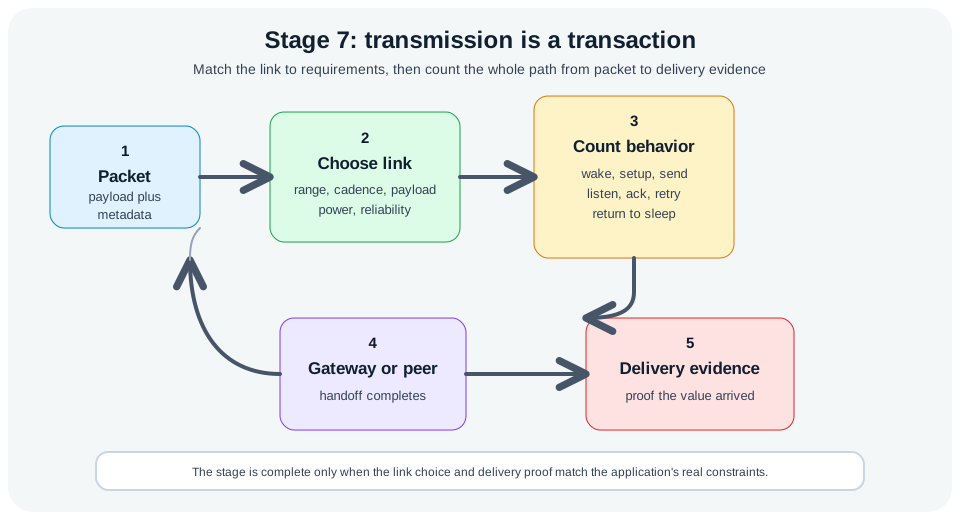
The useful question is not "which radio is fastest or longest range." It is whether the link can meet the application's range, update interval, latency, power source, reliability, coverage, and operations needs.

  • The important idea is that sending a message is a whole transaction, not a single over-the-air burst.
Stage seven: start from the assembled packet, match the link to range, cadence, payload, power, and reliability, then count the whole transaction through gateway or peer handoff to delivery evidence.
iotclass.org

Major section

Transmission Is a Transaction, Not a Burst (continued)
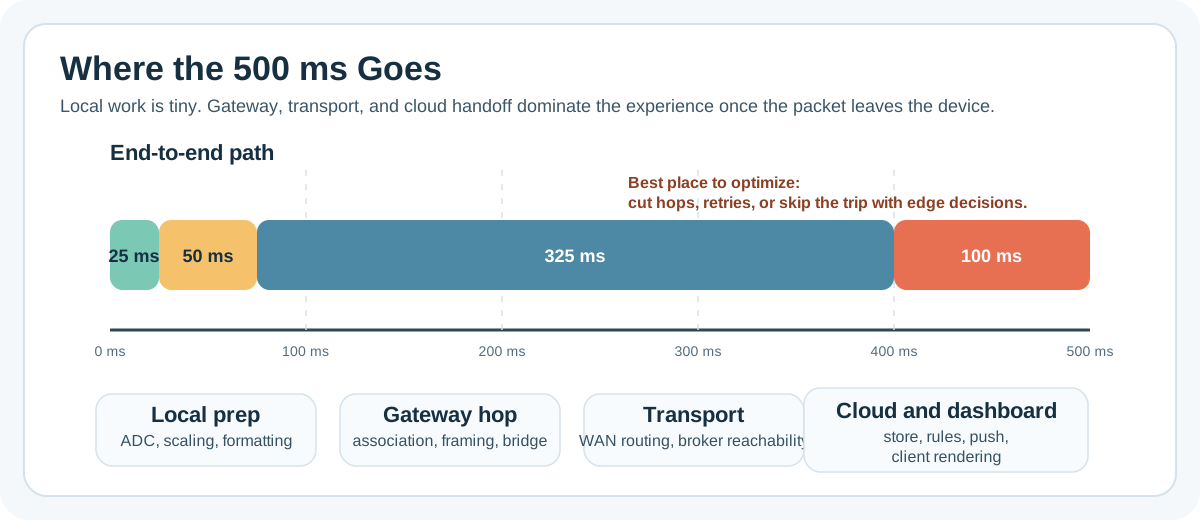
A device may wake, set up a session, transmit, listen for an acknowledgement, retry, hand off through a gateway, and only then sleep.

  • The best link is the one whose real transaction behavior matches the value of the data and the constraints of the deployment.
  • A radio works the same way: airtime is one line item in a longer transaction.
  • Transmission decides whether it can move and what proves it arrived.
iotclass.org

Major section

Transmission Is a Transaction, Not a Burst (continued)

The postage on the box is only part of the cost; the trip to the depot, the wait in line, the handoffs, and the proof-of-delivery slip are the rest.

  • For example, a greenhouse soil sensor may send a 24-byte reading every 15 minutes and a frost alarm within 30 seconds.
  • A wall-powered Wi-Fi gateway can afford association and broker handoff differently from a battery probe using LoRaWAN or LTE-M.
  • The transmission stage asks which complete path can deliver the value while preserving battery, freshness, and recoverability.
  • If this gives you the model, you can stop here.
iotclass.org

Major section

Transmission Is a Transaction, Not a Burst (continued)

The One-Minute View Start from the packet The payload already has meaning and metadata.

  • Beginner Examples A slow status update does not need the same link behavior as a low-latency control message; the choice starts from value and timing.
  • A packet can fit a link's payload limit yet still drain the battery if retries keep the radio awake.
  • A deployment in difficult terrain needs coverage evidence and a fallback rather than a data-sheet range number.
iotclass.org

Major section

Apply It: Choose the Link, Then Cost the Transaction
Wireless and wired options make different trade-offs.

  • A useful first pass is a three-column comparison: application need, link behavior, and operational owner.
  • For a wearable, the need may be short-range pairing with a phone; the owner is the user-facing app path.
  • Often explains energy or latency surprises.

Why it matters

For a freezer monitor, the need may be immediate alarm delivery and frequent health checks; the link behavior can tolerate Wi-Fi association because mains power is available; the owner is the building network team.

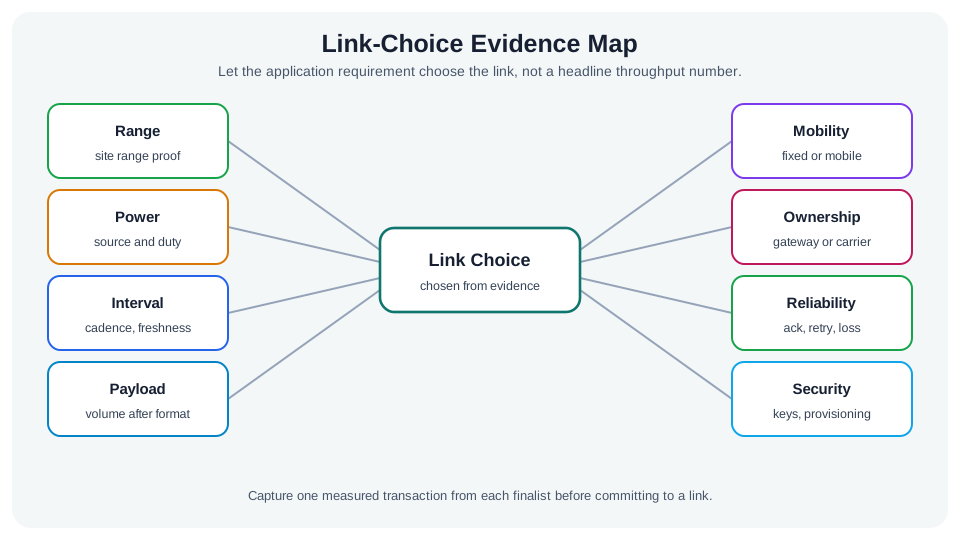
Link choice is an evidence map: range, power, cadence, payload, mobility, ownership, and reliability.
iotclass.org

Major section

Apply It: Choose the Link, Then Cost the Transaction (continued)

That comparison keeps the link decision tied to the deployed system rather than to a headline throughput number.

  • The comparison becomes concrete when every candidate is judged by the same message and failure condition.
  • Its: Link-Choice Evidence Map and chosen from evidence markers reveal where Link choice is an evidence map: range, power, cadence, payload, mobility, ownership, and reliability enters the running decision.
  • Separates device optimization from infrastructure delay.
iotclass.org

Major section

Apply It: Choose the Link, Then Cost the Transaction (continued)

These choices are not interchangeable; each one follows from range, ownership, freshness, and operating evidence.

  • The boundary joining: Link-Choice Evidence Map and chosen from evidence organises Link choice is an evidence map: range, power, cadence, payload, mobility, ownership, and reliability.
  • That makes: Link Choice a checkable part of Link Choice Starts With Requirements.
  • For slow-changing measurements, a smarter send rule often beats a denser encoding.
iotclass.org

Major section

Apply It: Choose the Link, Then Cost the Transaction (continued)

Local, high throughput Use when the device has power, infrastructure is near, and the payload or update rate is larger than constrained links should carry.

  • Short range, personal area Use when a phone, wearable, gateway, or nearby controller is part of the system and updates are small and frequent.
  • Long range, sparse telemetry Use when coverage distance matters more than throughput and the system tolerates small payloads, duty cycling, and occasional delay.
  • Operator or public network Use when owning gateways is impractical, but record coverage, service dependency, provisioning, data plan, and failure-mode assumptions.
iotclass.org

Major section

Apply It: Choose the Link, Then Cost the Transaction (continued)

Suppressing an unneeded routine message removes the whole transaction: wake, channel access, transmit, listen, retry exposure, and downstream handling.

  • A wall-powered gateway sensor, a phone-tethered wearable, a mobile asset tracker, and a remote soil probe can all report "temperature," yet their transmission requirements are entirely different systems.
  • A wall-powered freezer monitor beside an access point might use Wi-Fi and MQTT because the site already owns the network, maintenance can troubleshoot the gateway, and alarm latency matters more than sleep current.
  • If you can pick a link and budget its transaction, you can stop here.
iotclass.org

Major section

Under the Hood: Resilience and Delivery Evidence
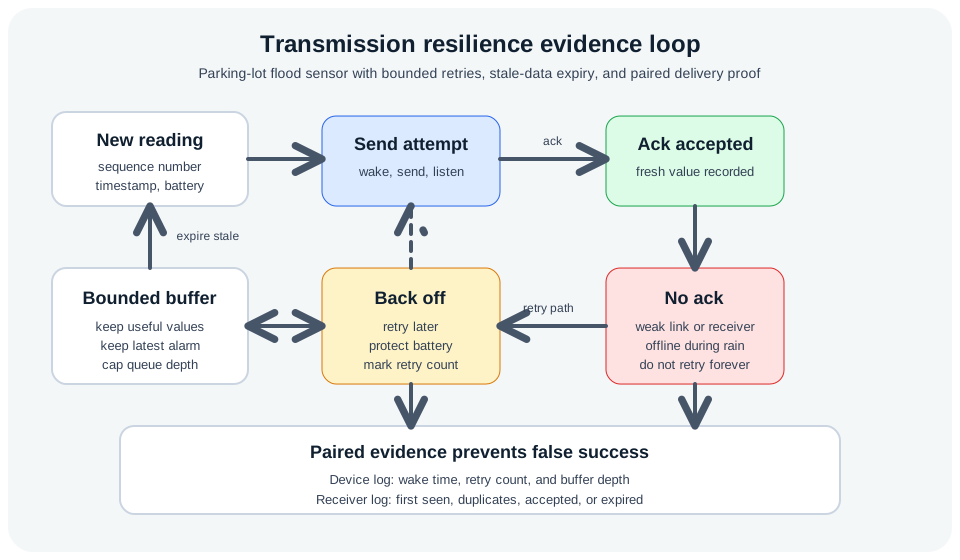
Field connectivity is imperfect.

  • A complete transmission design states what the system does when links are weak, receivers are down, packets arrive twice, or stale data returns after a gap.
  • Resilience is part of the design, not an afterthought.
  • The device should not retry continuously until the battery is exhausted.

Why it matters

That behavior matters more than shaving a few bytes from a packet, because the field failure is a delivery semantics problem.

A resilience evidence loop: bound the buffer, send with acknowledgement, back off after failed delivery, expire stale data, and compare device logs with receiver logs.
iotclass.org

Major section

Under the Hood: Resilience and Delivery Evidence (continued)

When the gateway returns, the receiver can detect gaps, ignore duplicates, and distinguish a current alarm from stale backlog.

  • The evidence should come from both sides of the path.
  • Acceptance ends the attempt; missing acknowledgement leads to backoff, while stale readings expire.
  • Buffer Keep unsent values only while they remain useful.
iotclass.org

Major section

Under the Hood: Resilience and Delivery Evidence (continued)

That paired evidence also defines the recovery contract: how many values may queue, how old an alarm may be, when a retry stops, and which component reports the gap to the operator.

  • A stale value must not masquerade as a current measurement.
  • Continuous retries can be worse than a controlled data gap.
  • Common Pitfalls Treating coverage as yes-or-no.: Real sites have dead zones, moving obstructions, antenna-orientation issues, and gateways under maintenance.
iotclass.org

Major section

Under the Hood: Resilience and Delivery Evidence (continued)

Counting only transmit airtime.: Wake time, session setup, listen windows, acknowledgements, retries, and backhaul delays can dominate the result.

  • At this depth, transmission is reviewed from the field backward: what must arrive, how fresh it must be, what happens when the link fails, and what evidence proves the system behaved correctly.
  • The best optimization is usually fewer useful packets, then clear contracts, then the right link.
  • That behavior matters more than shaving a few bytes from a packet, because the field failure is a delivery semantics problem.
iotclass.org

Major section

Summary

Transmission is a transaction, not only an over-the-air burst.

  • Energy and latency budgets need categories so device behavior and infrastructure delay are not confused.
  • Resilience is part of the design: buffering, retry, backoff, expiry, duplicate detection, and delivery evidence should be deliberate.
  • The best optimization is often fewer useful packets, followed by clear payload contracts and an appropriate link.
iotclass.org

Deck summary

Key takeaways

A gateway means a device or service that joins two message paths.

  • You will choose a link, estimate the whole transaction cost, and check whether readings actually reach the receiver.
  • The useful question is not "which radio is fastest or longest range." It is whether the link can meet the application's range, update interval, latency, power source, reliability, coverage, and operations needs.
  • A device may wake, set up a session, transmit, listen for an acknowledgement, retry, hand off through a gateway, and only then sleep.
  • The One-Minute View Start from the packet The payload already has meaning and metadata.
iotclass.org

Retrieval practice

Recall check 1 of 3

Physics Phoebe says: answer from memory, then check your reasoning.

Q1A battery-powered outdoor node sends small readings once per hour. What should guide the transmission choice?

AChoose the highest-throughput protocol regardless of energy use
BMatch range, payload size, cadence, power budget, and reliability.
CSend each reading as a large uncompressed text report
DSelect the protocol before defining range or update rate
Show answer

Answer: B Transmission decisions follow from the measurement pattern, power budget, and deployment constraints, not from raw speed.

iotclass.org

Retrieval practice

Recall check 2 of 3

Physics Phoebe says: answer from memory, then check your reasoning.

Q2A node's battery drains far faster than its tiny payload would suggest. Which review is most likely to explain it?

ACount only payload bytes and ignore session setup, listening, and retries
BRename payload fields before measuring radio awake time or retry behavior
CMeasure wake time, channel access, listen windows, acknowledgements, and retries
DTune the cloud dashboard refresh before reviewing the node transaction
Show answer

Answer: C The radio can spend more energy waiting, listening, and retrying than sending, so the whole transaction must be measured.

iotclass.org

Retrieval practice

Recall check 3 of 3

Physics Phoebe says: answer from memory, then check your reasoning.

Q3A field sensor starts losing gateway coverage for hours at a time. What is most important to fix before tuning payload bytes?

ASwitching every value to a shorter field name
BRaising the sample rate so more messages eventually get through
CBuffering, sequence numbers, stale-data expiry.
DRemoving timestamps so packets are smaller
Show answer

Answer: C Coverage gaps are a delivery-behavior problem; queued data, stale data, duplicates, controlled retry/backoff, and retry energy need a plan before byte tuning matters.

iotclass.org

Print reference

Answers

Answer key.

  1. B · Transmission decisions follow from the measurement pattern, power budget, and deployment constraints, not from raw speed.
  2. C · The radio can spend more energy waiting, listening, and retrying than sending, so the whole transaction must be measured.
  3. C · Coverage gaps are a delivery-behavior problem; queued data, stale data, duplicates, controlled retry/backoff, and retry energy need a plan before byte tuning matters.
iotclass.org