IoT Fundamentals · Study deck

Processing Readings Into Packets

Picture a vibration sensor that turns many samples into one warning value.

Physics Phoebe is your guide for this deck.

sensorpipelineprocessing
Physics Phoebe, the module guide, in a scene from this chapter.
iotclass.org

After studying this chapter

Learning objectives

You will be able to:

  • Explain: A good packet budget therefore records the useful application bytes, the wrapper bytes, the number of packets per useful event, and the receive or acknowledgement behavior that happens around the transmission.
  • Explain: If a retry arrives after the first copy was accepted, the application should have enough identity, sequence, or sample-time information to avoid counting the same physical event twice.
  • Explain: The practical rule: if the system sends the same routine value every few seconds, reducing packet count usually beats shaving a few bytes.
  • Explain: The first check runs one known trace through every middle step.
iotclass.org

Major section

In 60 Seconds · Start With the Story

The first check runs one known trace through every middle step.

  • An analog-to-digital converter is a circuit that turns a measured voltage into a number; ADC is its short name.
  • Firmware means the software stored on a device.
  • A payload means the useful reading or command carried inside a message.

Why it matters

Optimize the middle pipeline in that order: process the value correctly, encode it clearly, then reduce traffic and bytes where the link cost makes that worth doing.

iotclass.org

Major section

A Digital Sample Is Not Yet Evidence · Apply It: Process the Value, Then Choose the Contract
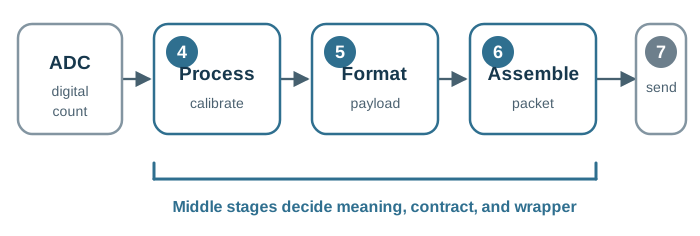
Stages four through six decide what that sample means, how it is encoded, and how it is wrapped for delivery.

  • A raw converter count is not yet something a receiver can trust; it becomes evidence only after processing, formatting, and packet assembly.

Key terms

Stages four through six
Stages four through six are that labeling and packaging step.

Why it matters

Keeping those decisions separate makes code review easier because a battery-saving change to the send rule should not silently change the calibration or hide an out-of-range sensor condition.

Stages four to six: processing decides meaning, formatting decides the contract, and assembly decides the wrapper.
iotclass.org

Major section

Under the Hood: Packet Assembly and the Whole Transaction
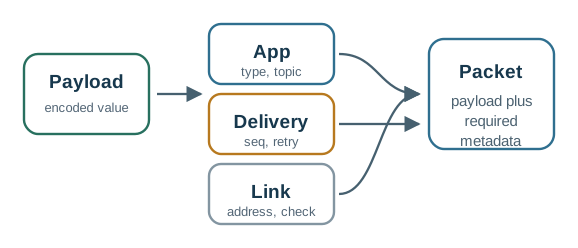
Packet assembly wraps the payload with the metadata the chosen path needs.

  • Headers are not automatically waste: they carry addressing, type, length, sequence, reliability, integrity, and security context.
  • The design question is whether each wrapper is needed at that boundary.
  • MQTT commonly uses a topic and message metadata above TCP/IP.

Key terms

Sequence numbers and timestamps
Sequence numbers and timestamps are not just bookkeeping.
Otherwise they
Otherwise they are small but ambiguous.
Packet assembly: a payload wrapped with application, delivery, and protection metadata.
iotclass.org

Major section

Under the Hood: Packet Assembly and the Whole Transaction (continued)
CoAP commonly uses a method, path, message ID, token, and UDP/IP headers.

  • BLE GATT uses services, characteristics, attributes, and link-layer behavior.
  • LoRaWAN separates the application payload from MAC and network-session metadata.
  • Sequence numbers and timestamps are not just bookkeeping.
  • Payload Size Is Not the Whole Transaction.
iotclass.org

Major section

Under the Hood: Packet Assembly and the Whole Transaction (continued)

Battery issue, missed event, duplicate storm, or new latency need.

  • A sequence number helps a receiver detect a lost or duplicated packet even when the payload value looks normal.
  • Packet assembly should also be idempotent from the receiver's point of view.
  • Fields, units, version, byte order, examples, and decoder tests.
iotclass.org

Major section

Under the Hood: Packet Assembly and the Whole Transaction (continued)

Byte count still matters, but it is only one part of the cost model.

  • If a retry arrives after the first copy was accepted, the application should have enough identity, sequence, or sample-time information to avoid counting the same physical event twice.
  • The pair turns Packet assembly: a payload wrapped with application, delivery, and protection metadata into something the team can verify.
  • Protocol change, security review, or observed delivery failure.
iotclass.org

Major section

Under the Hood: Packet Assembly and the Whole Transaction (continued)

If it sends rare but latency-sensitive events, preserve clear identifiers, timestamps, and reliability metadata even when that adds bytes.

  • Application metadata Topic, resource path, message type, schema version, device ID, and content type tell the receiver what the payload means.
  • Protection metadata Integrity checks, authentication, encryption, and replay protection depend on the threat model and the protocol boundary.
  • Security metadata should be reviewed at the same boundary as the transport decision.
iotclass.org

Major section

Under the Hood: Packet Assembly and the Whole Transaction (continued)

Otherwise they are small but ambiguous.

  • The practical rule: if the system sends the same routine value every few seconds, reducing packet count usually beats shaving a few bytes.
  • A shorter payload can be a bad trade if it removes the schema version or status flags needed to debug the system later.
  • A longer payload can be acceptable if messages are rare and the added fields prevent unsafe ambiguity.
iotclass.org

Major section

Under the Hood: Packet Assembly and the Whole Transaction (continued)

A good packet budget therefore records the useful application bytes, the wrapper bytes, the number of packets per useful event, and the receive or acknowledgement behavior that happens around the transmission.

  • Removing them to save bytes is only defensible when the threat model and deployment boundary make that safe.
  • Common Pitfalls Shipping raw counts without a contract.: They are valid only when receivers know reference, bit depth, scale, offset, unit, and calibration.
  • Treating every header as waste.: Remove unnecessary wrappers, but keep the addressing, ordering, integrity, and security metadata the real failure modes demand.
iotclass.org

Major section

Summary · Key Takeaway

Packet assembly adds the addressing, ordering, integrity, and security context the chosen path needs.

  • A gateway can keep constrained links compact while giving cloud systems readable, inspectable records.
  • Overhead should be measured across the whole transaction, not just the payload bytes.
  • The best middle-pipeline design is the smallest reviewable record that preserves meaning, supports maintenance, and avoids unnecessary transmissions.
iotclass.org

Deck summary

Key takeaways

The first check runs one known trace through every middle step.

  • Stages four through six decide what that sample means, how it is encoded, and how it is wrapped for delivery.
  • Packet assembly wraps the payload with the metadata the chosen path needs.
  • CoAP commonly uses a method, path, message ID, token, and UDP/IP headers.
  • Battery issue, missed event, duplicate storm, or new latency need.
iotclass.org

Retrieval practice

Recall check 1 of 3

Physics Phoebe says: answer from memory, then check your reasoning.

Q1Why is shipping a bare ADC count usually a weak interface?

AThe receiver may not know the calibration, units, scale, range.
BADC counts are always too large to transmit efficiently
CCounts cannot be encoded in any payload format
DRaw counts always violate the network protocol
Show answer

Answer: A A raw count is only meaningful when calibration, units, scale, range, and measurement conditions travel with it or are part of a shared contract.

iotclass.org

Retrieval practice

Recall check 2 of 3

Physics Phoebe says: answer from memory, then check your reasoning.

Q2A gateway receives compact device-side payloads, decodes them, and forwards data to a cloud API where engineers often inspect logs. Which formatting plan is most reviewable?

AUse a compact, documented device-side format, then re-encode to a readable cloud-side contract at the gateway
BForward the device-side fixed binary payload to the cloud and keep its layout in the gateway decoder code
CTransmit raw ADC counts everywhere because they are the smallest representation
DUse readable JSON on both links so device captures and cloud logs share one inspection workflow
Show answer

Answer: A The gateway is the translation boundary: keep the constrained hop compact, expose a readable contract where humans inspect data.

iotclass.org

Retrieval practice

Recall check 3 of 3

Physics Phoebe says: answer from memory, then check your reasoning.

Q3A device sends the same slow-changing temperature every few seconds and its battery is draining fast. Where should optimization start?

AReduce how often a packet is created
BShorten every field name in the payload
CIncrease the sample rate so values are more accurate
DSwitch to a larger, more readable text format
Show answer

Answer: A Wake, channel access, transmit, listen, and retry cost are paid per transaction, so sending fewer routine packets saves the most energy.

iotclass.org

Print reference

Answers

Answer key.

  1. A · A raw count is only meaningful when calibration, units, scale, range, and measurement conditions travel with it or are part of a shared contract.
  2. A · The gateway is the translation boundary: keep the constrained hop compact, expose a readable contract where humans inspect data.
  3. A · Wake, channel access, transmit, listen, and retry cost are paid per transaction, so sending fewer routine packets saves the most energy.
iotclass.org