IoT Fundamentals · Study deck

Turning Signals Into Readings

Picture a vaccine box with a temperature probe near its outer wall.

Physics Phoebe is your guide for this deck.

sensorpipeline
Physics Phoebe, the module guide, in a scene from this chapter.
iotclass.org

After studying this chapter

Learning objectives

You will be able to:

  • Explain: The important idea is not "add more bits" or "sample faster." The important idea is that the measurement becomes trustworthy only when the sensor, the analog interface, and the digitizer are designed as one chain.
  • Explain: The practical method is the same whether you are designing a new channel or debugging a wrong cloud value: move along the pipeline from left to right, and let each stage explain the next.
  • Explain: If the divider then uses only a narrow part of the ADC range, the graph looks stable but hides poor evidence.
iotclass.org

Major section

In 60 Seconds

The screen shows a steady value, but the medicine sits deeper inside.

  • The design team must prove that the number starts with the right physical event before polish, storage, or a chart makes it look convincing.
  • At each step, keep source, time, unit, range, expected error, version, and owner.
  • A remote chart can store trends, but it must not be the only path to a safe response.
  • This opening does not size every part or prove final accuracy.
iotclass.org

Major section

A Measurement Is Only as Good as Its Pipeline
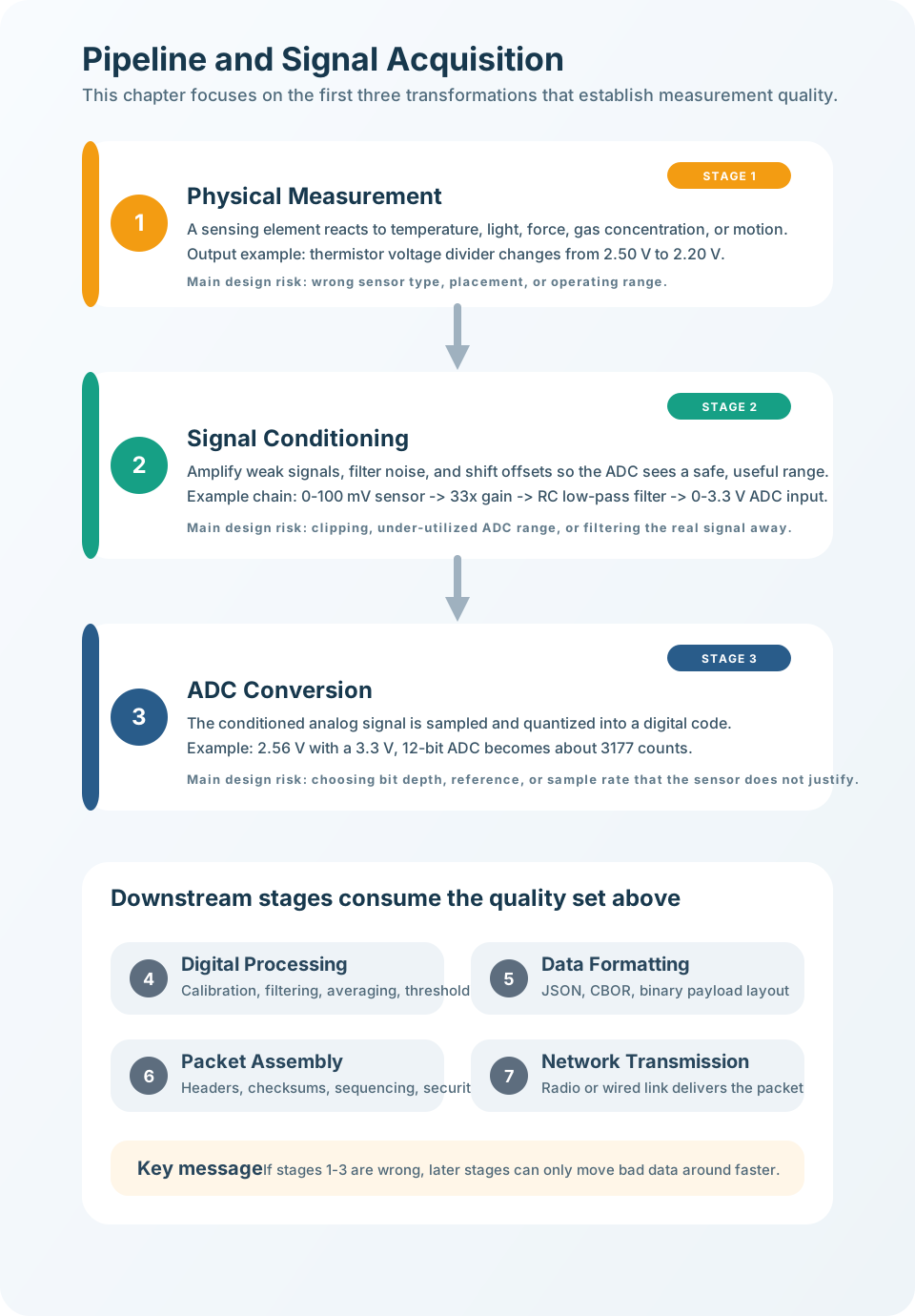
A sensor system is a pipeline.

  • The full sensor-to-network path has seven stages, but the first three, physical measurement, signal conditioning, and ADC conversion, decide what information is even available to the rest of the system.
  • The fix starts with placement and range fit, not with the dashboard.

Why it matters

Beginner Examples A slow room-temperature sensor can use a modest sample rate and simple validation because the condition changes gradually.

The seven-stage pipeline. The first three acquisition stages set the ceiling on measurement quality.
iotclass.org

Major section

A Measurement Is Only as Good as Its Pipeline (continued)
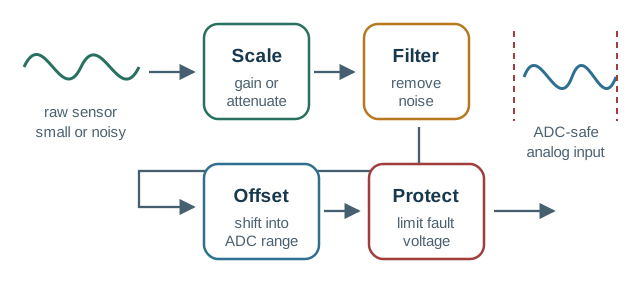
The important idea is not "add more bits" or "sample faster." The important idea is that the measurement becomes trustworthy only when the sensor, the analog interface, and the digitizer are designed as one chain.

  • For example, a cold-chain logger can publish perfectly formatted messages while still measuring the wrong thing.
  • If its thermistor is taped to the outside foam wall instead of near the payload, it may track room air after each door opening more than vaccine temperature.
  • If this gives you the mental model, you can stop here.
iotclass.org

Major section

A Measurement Is Only as Good as Its Pipeline (continued)

If the divider then uses only a narrow part of the ADC range, the graph looks stable but hides poor evidence.

  • Signal conditioning The analog interface scales, filters, offsets, and protects the signal so it is safe and useful for the converter.
  • A temperature sensor mounted next to a warm regulator may give stable, repeatable, and completely misleading data; the fault is placement, not software.
  • A tiny millivolt signal wired straight to a wide ADC range barely moves the count; it needs conditioning before the count means anything.
iotclass.org

Major section

Apply It: Build and Debug the Acquisition Chain
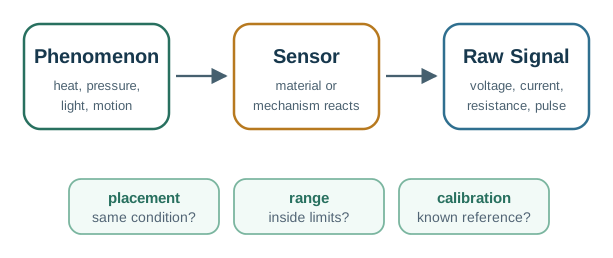
The practical method is the same whether you are designing a new channel or debugging a wrong cloud value: move along the pipeline from left to right, and let each stage explain the next.

  • If it matches the real condition, placement and the sensing element are probably fine.

Key terms

If it
If it is clipped, noisy, or outside the converter range, fix the analog interface before touching code.

Why it matters

On the 32 degrees C room sensor, this order prevents a common waste of effort.

Physical measurement: a phenomenon becomes a raw electrical signal whose quality depends on placement.
iotclass.org

Major section

Apply It: Build and Debug the Acquisition Chain (continued)

Walkthrough: Debug a Reading by Stage A room sensor reports 32 degrees C while nearby sensors report about 22 degrees C.

  • If it is clipped, noisy, or outside the converter range, fix the analog interface before touching code.
  • A sagging reference makes a correct input look wrong.
  • Those hand-offs make Physical measurement: a phenomenon becomes a raw electrical signal whose quality depends on placement actionable within: Walkthrough: Debug a Reading by Stage.
iotclass.org

Major section

Apply It: Build and Debug the Acquisition Chain (continued)

Offset and protect Shift bipolar signals into a unipolar range, buffer weak sources, and protect the pin from fault voltages.

  • If a meter shows the raw sensing node already sits near the expected voltage for 22 degrees C, the fault may be a gain, reference, or conversion problem.
  • Conditioning the Signal Raw sensor outputs rarely fit the ADC perfectly.
  • The range-fit relationship is V_ADC = V_sensor x Gain + Offset.
iotclass.org

Major section

Apply It: Build and Debug the Acquisition Chain (continued)

If you can build and debug a channel stage by stage, you can stop here.

  • If the raw node itself reads hot, the likely causes move upstream: self-heating, a bad location near a regulator, sunlight on the enclosure, or poor thermal contact with the air being measured.
  • A gain near 33 stretches the 100 mV span across most of the 3.3 V input, so the converter codes carry real detail instead of crowding into a few values near zero.
  • On the 32 degrees C room sensor, this order prevents a common waste of effort.
iotclass.org

Major section

Under the Hood: Conversion Math and Failure Modes
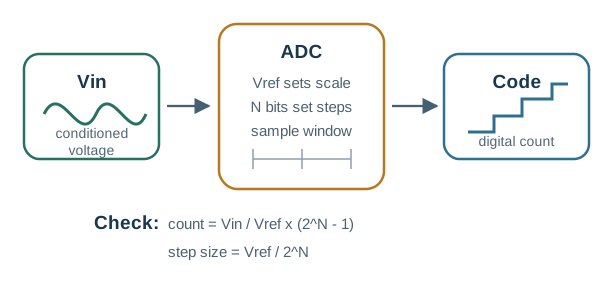
The deeper layer explains why each acquisition stage has its own gate.

  • The ADC count is only meaningful when the reference, bit depth, and sample timing are known.
  • A 12-bit, 3.3 V ADC has a step of about 0.806 mV.
  • That number is the amplitude grain, not the sensor's accuracy.

Numbers to remember

3.3 V3.3 V ADC has a step of about 0.806 mV .
0.806 mV3.3 V ADC has a step of about 0.806 mV .
ADC conversion: a conditioned voltage and reference produce a quantized count at a chosen sample time.
iotclass.org

Major section

Under the Hood: Conversion Math and Failure Modes (continued)

Real measurement quality also depends on analog noise, reference stability, calibration, linearity, and the sensor itself.

  • The middle panel shows how reference voltage, bit depth, and sample timing govern conversion; the formulas below connect voltage to counts.
  • Ample headroom for many designs where the sensor is the real limit.
  • If the sensor itself is only reliable to about 0.5 degrees C, a 12-bit converter already has plenty of quantization headroom.
iotclass.org

Deck summary

Key takeaways

The screen shows a steady value, but the medicine sits deeper inside.

  • A sensor system is a pipeline.
  • The important idea is not "add more bits" or "sample faster." The important idea is that the measurement becomes trustworthy only when the sensor, the analog interface, and the digitizer are designed as one chain.
  • If the divider then uses only a narrow part of the ADC range, the graph looks stable but hides poor evidence.
  • Walkthrough: Debug a Reading by Stage A room sensor reports 32 degrees C while nearby sensors report about 22 degrees C.
iotclass.org

Retrieval practice

Recall check 1 of 3

Physics Phoebe says: answer from memory, then check your reasoning.

Q1Why is it useful to describe a sensor system as a pipeline?

AIt proves a digitized value is reliable even when placement or conditioning is poor
BIt removes later network and cloud checks once the ADC produces a count
CIt links measurement, conditioning, conversion, and interpretation so quality loss is traceable
DIt means every IoT product can reuse identical sensors, ADCs, firmware, and payloads
Show answer

Answer: C Pipeline thinking keeps measurement, conditioning, conversion, and interpretation connected so you can find where quality is lost.

iotclass.org

Retrieval practice

Recall check 2 of 3

Physics Phoebe says: answer from memory, then check your reasoning.

Q2A pressure sensor produces a small but valid 0 to 20 mV signal connected directly to a 0 to 3.3 V, 12-bit ADC. The counts jump around and barely change with pressure. What should the team check first?

AAdd signal conditioning so the sensor range uses more of the ADC input span
BChange the cloud payload format from JSON to binary
CIncrease the sample rate until the pressure signal appears
DAssume the sensor is broken because the ADC is 12-bit
Show answer

Answer: A A 20 mV signal uses under 1 percent of a 3.3 V range. Gain, filtering, and careful analog layout come before any later pipeline stage.

iotclass.org

Retrieval practice

Recall check 3 of 3

Physics Phoebe says: answer from memory, then check your reasoning.

Q3A team upgrades a channel from a 12-bit to a 16-bit ADC, but the sensor itself is only accurate to about 0.5 degrees C. What is the most likely result?

AMeasurement accuracy improves to the ADC step size because sensor error is overwritten
BAliasing disappears because extra amplitude levels replace anti-alias filtering
CSample timing becomes faster automatically because higher bit depth raises the clock
DLittle real improvement because sensor accuracy, noise, and calibration remain the limiting factors
Show answer

Answer: D The 12-bit step was already far below the sensor's 0.5 C accuracy, so extra bits mostly record noise and reference drift.

iotclass.org

Print reference

Answers

Answer key.

  1. C · Pipeline thinking keeps measurement, conditioning, conversion, and interpretation connected so you can find where quality is lost.
  2. A · A 20 mV signal uses under 1 percent of a 3.3 V range. Gain, filtering, and careful analog layout come before any later pipeline stage.
  3. D · The 12-bit step was already far below the sensor's 0.5 C accuracy, so extra bits mostly record noise and reference drift.
iotclass.org