Sensors & Measurement · Study deck

IMU and Barometric Calibration

Picture a delivery cart that must detect a turn and a change of floor.

Physics Phoebe is your guide for this deck.

sensormotionbarometric
iotclass.org

After studying this chapter

Learning objectives

You will be able to:

  • Explain how a MEMS capacitive accelerometer turns proof-mass deflection into acceleration readings.
  • Convert analog and digital IMU readings into physical units while preserving full-scale and offset evidence.
  • Diagnose why accelerometers confuse gravity, tilt, vibration, and horizontal acceleration without fusion.
  • Use BMP280 pressure changes as relative altitude evidence while accounting for weather drift and baseline freshness.
iotclass.org

Major section

Start With the Measurement Story

Its motion sensor reports gravity as well as movement.

  • A changing number is not yet proof of a real move.
  • If the reference is old or the sensors disagree, lower confidence instead of forcing an answer.
  • One indoor check cannot promise accuracy on every vehicle or day.

Key terms

IMU and barometric readings
IMU and barometric readings are useful only after bias, drift, alignment, and altitude assumptions are visible.

Numbers to remember

8.43 kmthe scale height is 8.43 km
8.32 cmone pascal is worth 8.32 cm near 101,325 Pa.
iotclass.org

Major section

Start With the Measurement Story (continued)

The deeper sections explain gravity, drift, alignment, pressure, and combined sensing so each correction has a reference, a limit, and a new-test trigger.

  • IMU and barometric readings are useful only after bias, drift, alignment, and altitude assumptions are visible.
  • The first story is the reference condition, then the correction, then evidence that motion or pressure changes are real.
  • With the chapter's sea-level constants, the scale height is 8.43 km and one pascal is worth 8.32 cm near 101,325 Pa.
iotclass.org

Major section

Deflection to Volts

The central MEMS package contains all three axes; the labeled X, Y, and Z outputs are the signals a calibration rig must map from volts back to acceleration.

  • The package converts proof-mass deflection into three analogue outputs; the breakout only makes those supply and signal pins accessible.
A red ADXL335 three-axis analog accelerometer breakout board with its sensor chip and labeled connection pads visible
iotclass.org

Major section

Gravity, Brownian Noise, Bandwidth

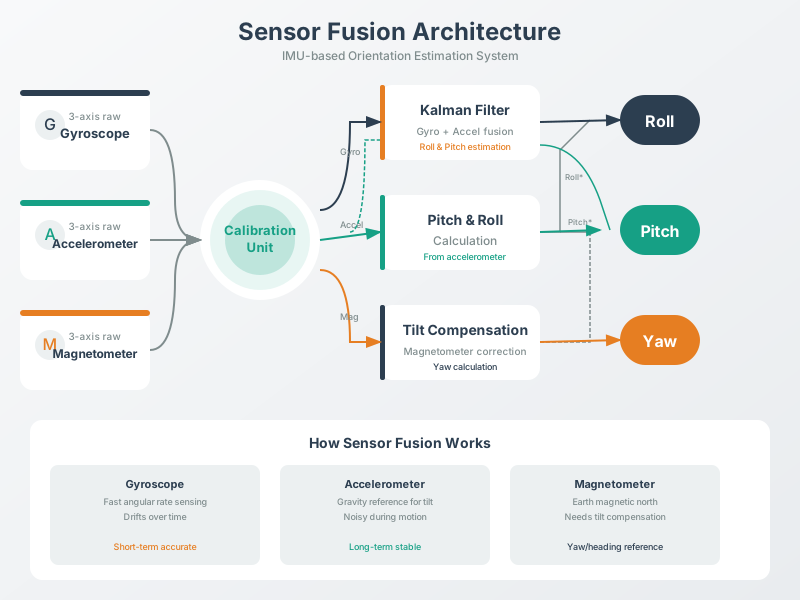
The accelerometer gives a gravity guide but is noisy in motion.

  • Their joint path can estimate roll and pitch.
  • The magnetic input needs tilt correction before it can help with yaw.
  • This split also explains why pressure needs its own check.
  • It should not be mixed into pose without evidence about height and weather.
IMU sensor fusion architecture combining gyroscope, accelerometer, and magnetometer inputs with calibration to estimate roll, pitch, and yaw.
iotclass.org

Deck summary

Key takeaways

Its motion sensor reports gravity as well as movement.

  • The deeper sections explain gravity, drift, alignment, pressure, and combined sensing so each correction has a reference, a limit, and a new-test trigger.
  • The central MEMS package contains all three axes; the labeled X, Y, and Z outputs are the signals a calibration rig must map from volts back to acceleration.
  • The accelerometer gives a gravity guide but is noisy in motion.
iotclass.org

Retrieval practice

Recall check 1 of 3

Physics Phoebe says: answer from memory, then check your reasoning.

Q1What physically moves inside a MEMS capacitive accelerometer when the device accelerates?

AA spinning disc changes speed in proportion to acceleration.
BA microscopic proof mass on silicon springs deflects.
CA crystal generates a steady voltage proportional to constant acceleration.
DNothing moves; the chip measures temperature changes instead.
Show answer

Answer: B Inertia deflects the proof mass, and the resulting capacitance change is the readout.

iotclass.org

Retrieval practice

Recall check 2 of 3

Physics Phoebe says: answer from memory, then check your reasoning.

Q2An ADXL335 outputs 300 mV/g with 0 g at 1.5 V. Its axis reads 1.20 V while stationary. What is happening?

AIt needs a zero-offset correction to 1.5 V, since the device is not translating.
BIt reads +1 g, using the magnitude of the 1.20 V deviation from 1.5 V.
CThe axis senses about -1 g: (1.20 - 1.50) / 0.300 = -1.0 g.
DIt suggests supply drift, so restore the zero-g level before interpreting the 1.20 V reading.
Show answer

Answer: C The 0.30 V offset below the 1.5 V zero-g level corresponds to -1 g, i.e. gravity along that axis. (Also: consistent with that axis pointing straight down so gravity acts along it.).

iotclass.org

Retrieval practice

Recall check 3 of 3

Physics Phoebe says: answer from memory, then check your reasoning.

Q3Why can a single MEMS accelerometer not distinguish a slow tilt from a genuine horizontal acceleration?

AIt measures gravity and linear acceleration as one force.
BThe accelerometer cannot sense gravity at all, so tilt is invisible to it.
CTilt and acceleration occur at different temperatures, which the sensor cannot read.
DQuantization noise erases the difference between them.
Show answer

Answer: A Gravity reoriented by tilt and genuine linear acceleration both contribute to the same measured specific force, so separating them requires extra information such as fusion with a gyroscope.

iotclass.org

Print reference

Answers

Answer key.

  1. B · Inertia deflects the proof mass, and the resulting capacitance change is the readout.
  2. C · The 0.30 V offset below the 1.5 V zero-g level corresponds to -1 g, i.e. gravity along that axis. (Also: consistent with that axis pointing straight down so gravity acts along it.).
  3. A · Gravity reoriented by tilt and genuine linear acceleration both contribute to the same measured specific force, so separating them requires extra information such as fusion with a gyroscope.
iotclass.org