Sensors & Measurement · Study deck

Light and Proximity Readout Physics

Imagine a lamp that should turn on when a hand moves nearby.

Physics Phoebe is your guide for this deck.

sensorproximitylight
iotclass.org

After studying this chapter

Learning objectives

You will be able to:

  • Separate light intensity, proximity, presence, touch, and distance as different measurement questions.
  • Explain how photodiodes, LDR voltage dividers, PIR modules, ultrasonic sensors, and capacitive sensors produce readings.
  • Compute ultrasonic distance from echo time and distinguish it from optical time-of-flight hardware.
  • Diagnose reflectance ambiguity, ambient-light interference, temperature drift, and photodiode noise limits.
iotclass.org

Major section

Start With the Measurement Story

The detector sees reflected light, not the hand itself.

  • An analog-to-digital converter is the circuit that turns the detector's changing voltage into a number a program can use.
  • A single clean desk test cannot prove reliable detection.
  • The threshold should follow the evidence and the allowed cost of each error.
iotclass.org

Major section

After Light and Proximity Labs

Those labs only become reliable when the reading is interpreted through the right physics.

  • The goal is to decide whether the sensor measures light level, reflected intensity, motion, field disturbance, or true distance before turning a number into an automation rule.
  • The comparison links each excitation method to the quantity the electronics really measure and the claim that quantity can support.
  • Every light and optical-proximity sensor rests on one idea: light carries energy, and certain semiconductors turn that energy into a measurable electrical signal.
iotclass.org

Major section

Transimpedance and ToF Readout

A photodiode's current is often tiny, so a transimpedance amplifier converts it to a usable voltage.

  • Keeping those three readout patterns separate prevents the common mistake of treating every light-related sensor as if it returned lux.
  • A lux threshold is more portable, but still depends on sensor placement, diffuser, and whether the application cares about human-perceived illumination or narrow-band light.
  • The practical pattern is to calibrate with the same geometry the device will use.
iotclass.org

Major section

Light, Reflectance, and Sound

Each optical and proximity method has a characteristic failure mode that separates a reliable reading from a misleading one.

  • The important engineering move is not memorising one "best" sensor; it is matching the failure mode to the environment.
  • A reflective IR sensor can be excellent inside a printer paper path and poor outdoors.
  • Ultrasonic ranging can be stable in a tank headspace and unreliable near soft fabric.
iotclass.org

Major section

Compare Two Returns at the Bench
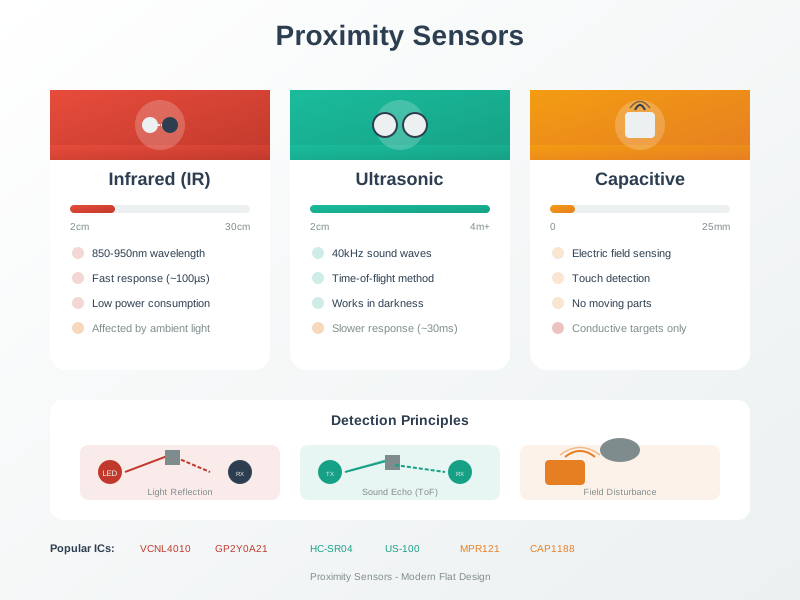
A black carton and a white carton stop at the same point in front of an infrared proximity head.

  • Dividing by two is essential because the timer includes both legs.
  • An ultrasonic echo taking 5.83 ms has travelled to the target and back.
Proximity sensing physics comparison showing what infrared reflection, ultrasonic time-of-flight and capacitive field disturbance actually measure and which presence, distance or near-field claims each can support.
iotclass.org

Deck summary

Key takeaways

The detector sees reflected light, not the hand itself.

  • Those labs only become reliable when the reading is interpreted through the right physics.
  • A photodiode's current is often tiny, so a transimpedance amplifier converts it to a usable voltage.
  • Each optical and proximity method has a characteristic failure mode that separates a reliable reading from a misleading one.
  • A black carton and a white carton stop at the same point in front of an infrared proximity head.
iotclass.org

Retrieval practice

Recall check 1 of 5

Physics Phoebe says: answer from memory, then check your reasoning.

Q1A team needs room brightness, recent person movement, finger touch, and measured distance. Which sensor evidence fits those distinct questions?

ALux for brightness, PIR motion events for recent movement, capacitance for touch, and echo time for distance
BUse lux alone to infer every event and distance
CUse a PIR pulse as a calibrated distance in metres
DUse capacitive touch counts to report room brightness
Show answer

Answer: A Correct: each readout answers a different physical question.

iotclass.org

Retrieval practice

Recall check 2 of 5

Physics Phoebe says: answer from memory, then check your reasoning.

Q2A photodiode responds to light by producing what electrical quantity?

AA resistance that rises with light, exactly like a photoresistor.
BA frequency proportional to colour temperature.
CA fixed voltage independent of light level.
DA current proportional to the incident light intensity (irradiance).
Show answer

Answer: D A photodiode is fundamentally a current source driven by light; a transimpedance amplifier can convert that current into a voltage.

Q3A team needs the brightness of a room, but has a motion detector. What should it conclude?

ATurn motion events into distance values.
BRaise the motion threshold to get lux.
CUse a light sensor that reports brightness.
DTreat motion events as brightness readings.
Show answer

Answer: C Brightness needs a light measurement and units.

iotclass.org

Retrieval practice

Recall check 3 of 5

Physics Phoebe says: answer from memory, then check your reasoning.

Q4An ultrasonic sensor reports an echo round-trip time of 10 ms at about 20 °C. What distance does this correspond to?

AAbout 1.7 m: distance = 343 m/s × 0.010 s / 2 = 1.715 m.
BAbout 3.4 m, using distance = speed × time without halving.
CAbout 3 million metres, using the speed of light.
DYou cannot compute distance from time.
Show answer

Answer: A Multiply the speed of sound by the time, then halve it for the one-way distance.

iotclass.org

Retrieval practice

Recall check 4 of 5

Physics Phoebe says: answer from memory, then check your reasoning.

Q5An IR reflective proximity sensor reports 'far' for a nearby black rubber pad and 'close' for a distant white wall. Why?

AReflected-intensity sensing depends on both distance and surface reflectivity.
BBlack surfaces are physically closer to IR sensors than white ones.
CThe sensor measures temperature, and black is warmer.
DWhite walls absorb IR while black rubber reflects it.
Show answer

Answer: A Intensity conflates distance with reflectivity; a poorly reflecting near target and a well reflecting far target can return misleading light levels.

iotclass.org

Retrieval practice

Recall check 5 of 5

Physics Phoebe says: answer from memory, then check your reasoning.

Q6A proximity alert threshold works on the bench but moves after installation. Which release record would make it reviewable?

AThreshold units, mounting geometry, readout chain, and calibration conditions
BOnly the final threshold number
COnly the sensor brand and app screenshot
DOnly a pass label from the bench
Show answer

Answer: A Correct: the threshold depends on what was measured, how it was mounted, and how it was calibrated.

iotclass.org

Print reference

Answers 1 of 2

Answer key.

  1. A · Correct: each readout answers a different physical question.
  2. D · A photodiode is fundamentally a current source driven by light; a transimpedance amplifier can convert that current into a voltage.
  3. C · Brightness needs a light measurement and units.
  4. A · Multiply the speed of sound by the time, then halve it for the one-way distance.
  5. A · Intensity conflates distance with reflectivity; a poorly reflecting near target and a well reflecting far target can return misleading light levels.
iotclass.org

Print reference

Answers 2 of 2

Answer key.

  1. A · Correct: the threshold depends on what was measured, how it was mounted, and how it was calibrated.
iotclass.org