Sensors & Measurement · Study deck

Sampling and Anti-Alias Limits

Picture a spinning fan that appears to slow down when its speed actually rises.

Physics Phoebe is your guide for this deck.

sensordataprocessing
Physics Phoebe, the module guide, in a scene from this chapter.
iotclass.org

After studying this chapter

Learning objectives

You will be able to:

  • Explain: The: Undersampled (Aliased) panel then uses an 80 Hz sample rate, whose 40 Hz Nyquist limit excludes the input; the samples reconstruct a false 30 Hz component from |80 − 50|.
  • Explain: Averaging $M$ independent readings reduces that noise to $q/\sqrt{12M}$, so $M=4$ buys a factor of 2, 6.02 dB, or one effective bit.
  • Explain: In the sampling trace, a healthy motor turns with a real 12 Hz vibration while its drive adds a 38 Hz electrical ripple.
  • Explain: The mathematical gist.: One ADC code step has RMS rounding noise $q/\sqrt{12}$.
iotclass.org

Major section

Start With the Measurement Story

The sensor is not seeing the motion often enough, so the samples create a false pattern.

  • Analog-to-digital converter means a circuit that turns a voltage into a number; it is often shortened to ADC.
  • Firmware means the software stored on the device.
  • Feed in a known tone below and above the planned limit.
iotclass.org

Major section

Phoebe's Field Notes: Why Four Samples Buys 2x, Not 4x

Averaging $M$ independent readings reduces that noise to $q/\sqrt{12M}$, so $M=4$ buys a factor of 2, 6.02 dB, or one effective bit.

  • The mathematical gist.: One ADC code step has RMS rounding noise $q/\sqrt{12}$.
iotclass.org

Major section

Predicting Frequency Aliases
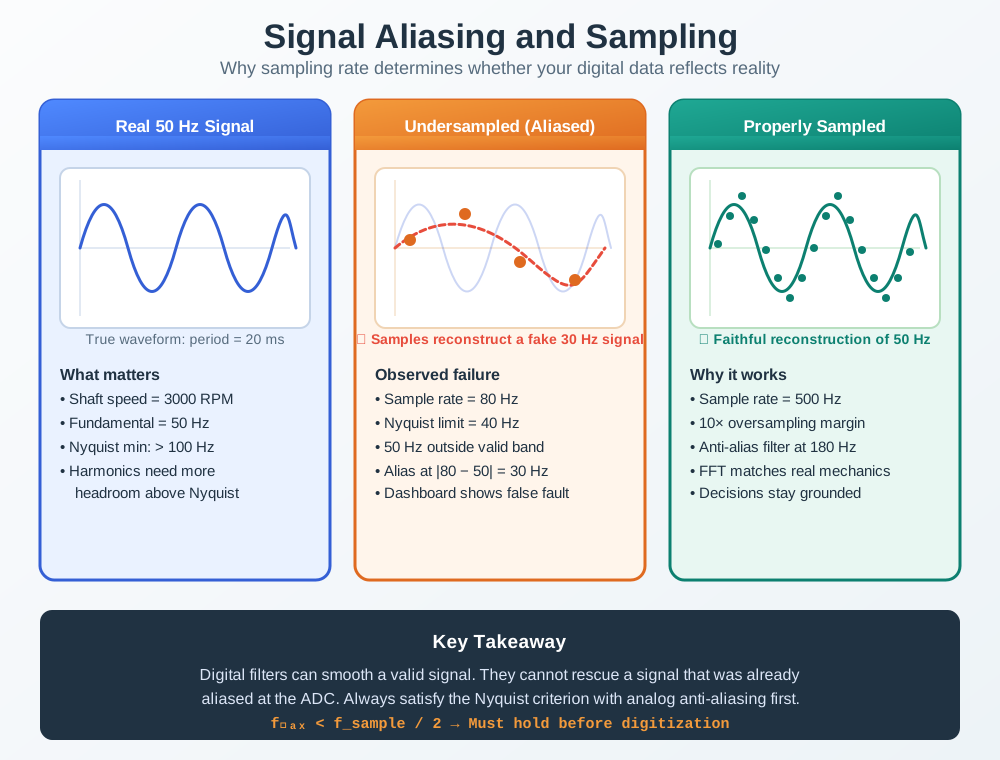
The 50 SPS logger cannot represent the machine vibration assumed in this example.

  • The: Undersampled (Aliased) panel then uses an 80 Hz sample rate, whose 40 Hz Nyquist limit excludes the input; the samples reconstruct a false 30 Hz component from |80 − 50|.

Numbers to remember

80 HzThe : Undersampled (Aliased) panel then uses an 80 Hz sample rate
40 Hzwhose 40 Hz Nyquist limit excludes the input
500 Hz500 Hz provides ten samples per cycle
Sampling a 50 Hz machine-vibration signal three ways: undersampling at 80 Hz aliases it to a false 30 Hz, while sampling at 500 Hz with an anti-alias filter reconstructs it faithfully.
iotclass.org

Major section

Rescue a Motor Trace Before the ADC

In the sampling trace, a healthy motor turns with a real 12 Hz vibration while its drive adds a 38 Hz electrical ripple.

  • At this anti-alias boundary, if a logger takes only 50 samples each second, both motions can land on the same plotted frequency.

Numbers to remember

12 Hza dashboard cannot tell which 12 Hz trace came from the shaft.
38 Hzso 38 Hz remains distinct.

Why it matters

The anti-alias filter sits before the ADC because filtering after sampling cannot unfold a frequency that already has the wrong identity.

Sampling a 50 Hz machine-vibration signal three ways: undersampling at 80 Hz aliases it to a false 30 Hz, while sampling at 500 Hz with an anti-alias filter reconstructs it faithfully.
iotclass.org

Major section

Rescue a Motor Trace Before the ADC (continued)

Once the ADC has confused them, a dashboard cannot tell which 12 Hz trace came from the shaft.

  • The ADC then takes spaced snapshots, and the digital analysis receives only those samples.
  • At 50 samples/s, Nyquist is 50/2=25 Hz.
  • If sample spacing wanders, the frequency axis also becomes uncertain.
iotclass.org

Major section

Rescue a Motor Trace Before the ADC (continued)

Raising the rate to 100 samples/s moves Nyquist to 50 Hz, so 38 Hz remains distinct.

  • A filter that strongly reduces input above 20 Hz offers another route when the 12 Hz motion is the only required result.
  • Without those two values, a 12 Hz peak cannot show whether the capture protected its frequency identity.
  • A timestamped capture can reveal dropped or late samples that a plain array of ADC values hides.
iotclass.org

Deck summary

Key takeaways

The sensor is not seeing the motion often enough, so the samples create a false pattern.

  • Averaging $M$ independent readings reduces that noise to $q/\sqrt{12M}$, so $M=4$ buys a factor of 2, 6.02 dB, or one effective bit.
  • The 50 SPS logger cannot represent the machine vibration assumed in this example.
  • In the sampling trace, a healthy motor turns with a real 12 Hz vibration while its drive adds a 38 Hz electrical ripple.
  • Once the ADC has confused them, a dashboard cannot tell which 12 Hz trace came from the shaft.
iotclass.org

Retrieval practice

Recall check 1 of 3

Physics Phoebe says: answer from memory, then check your reasoning.

Q1What does the Nyquist rule require to capture a signal without aliasing?

AThe sample rate must be more than twice the highest frequency present in the signal.
BThe sample rate must equal the highest frequency present.
CThe sample rate must be a whole-number multiple of the signal frequency.
DAny sample rate works as long as you average enough samples afterwards.
Show answer

Answer: A Below twice the highest frequency, fast components fold down and masquerade as slower ones.

iotclass.org

Retrieval practice

Recall check 2 of 3

Physics Phoebe says: answer from memory, then check your reasoning.

Q2You sample at 100 SPS and a 90 Hz interference tone is present. Where does it appear in the sampled data?

AAt 10 Hz: Nyquist is 50 Hz, 90 Hz is above it.
BAt 90 Hz, unchanged, because the ADC records whatever frequency is present.
CAt 45 Hz, half of the interference frequency.
DIt disappears entirely and has no effect.
Show answer

Answer: A The 90 Hz tone folds down to a phantom 10 Hz component because |90 - 100 x round(0.9)| = 10 Hz.

iotclass.org

Retrieval practice

Recall check 3 of 3

Physics Phoebe says: answer from memory, then check your reasoning.

Q3A team finds aliased interference in already-recorded sensor data and proposes a stronger digital low-pass filter to remove it. Why will this fail?

ADigital filters cannot attenuate any frequencies, only analog ones can.
BAfter sampling, the aliased component is indistinguishable from a genuine low-frequency signal.
CThe filter would work fine; the team simply chose the wrong cutoff.
DAliased components are always above the Nyquist frequency, where digital filters cannot reach.
Show answer

Answer: B Aliasing is irreversible once sampled; prevention has to happen in analog, before conversion.

iotclass.org

Print reference

Answers

Answer key.

  1. A · Below twice the highest frequency, fast components fold down and masquerade as slower ones.
  2. A · The 90 Hz tone folds down to a phantom 10 Hz component because |90 - 100 x round(0.9)| = 10 Hz.
  3. B · Aliasing is irreversible once sampled; prevention has to happen in analog, before conversion.
iotclass.org