Picture a water sensor whose resistance changes as a tray fills.
Voltage Vera is your guide for this deck.
sensorcircuitsresistive
After studying this chapter
Learning objectives
Follow resistance through voltage, reference, and sampling time.
Translate resistance changes into voltage and ADC codes.
Use a shared reference only within valid supply and acquisition limits.
Balance sensitivity, battery current, source impedance, and sample time.
A thermistor changes resistance with temperature; a light-dependent resistor changes with light. A force-sensitive resistor responds to force, and a potentiometer is adjustable. A divider turns these changes into voltage; an analogue-to-digital converter turns that voltage into a code. Choose sensor position and shared reference, then balance battery current against sampling time.
Major section
Start With the Measurement Story
The controller cannot read resistance by itself.
A pair of resistors turns the change into a voltage, and the input circuit turns that voltage into a number.
Each step can change the result.
A voltage divider means two resistors that share a supply voltage.
Firmware means software stored on the controller.
Major section
Start With the Measurement Story (continued)
An analog-to-digital converter means a circuit that turns a voltage into a number; it is called an ADC.
Resolution means the smallest change the number can show.
Loading means the input circuit changes the voltage it is trying to measure.
This runway does not choose the best resistor or prove the sensor is linear.
Major section
Divider Sensitivity and ADC Load
The divider calculation is incomplete until the ADC has acquired the node voltage.
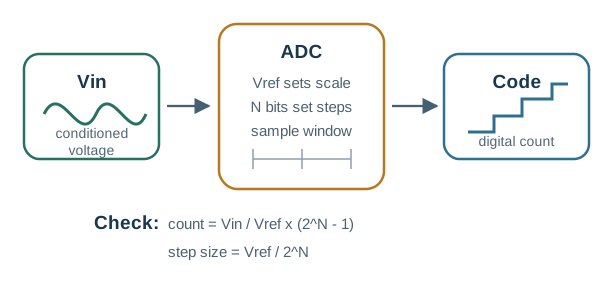
Inside the: ADC: Vref sets scale and: N bits set steps, but the third label—sample window—is the one threatened by a large Thevenin resistance: the sampling capacitor may not settle to Vin before conversion.
Sensor input voltage Vin feeding an ADC referenced to Vref, where bit depth and sample time determine the resulting digital count code.
Major section
Turn a Warm Thermistor Into a Code
In the resistive divider, a thermistor on a pipe changes resistance, but the ADC pin can only see voltage.
A 12-bit ADC then reports about 1.65/3.3×4095=2048.
The direction of that 683-code change is part of the circuit contract.
Sensor input voltage Vin feeding an ADC referenced to Vref, where bit depth and sample time determine the resulting digital count code.
Deck summary
Key takeaways
The controller cannot read resistance by itself.
An analog-to-digital converter means a circuit that turns a voltage into a number; it is called an ADC.
The divider calculation is incomplete until the ADC has acquired the node voltage.
In the resistive divider, a thermistor on a pipe changes resistance, but the ADC pin can only see voltage.
Retrieval practice
Recall check 1 of 3
Voltage Vera says: answer from memory, then check your reasoning.
Q1Why does a resistive sensor such as a thermistor or LDR usually need a voltage-divider circuit before it can be read by a microcontroller?
AResistance changes must become a voltage that the ADC can read.
BThe divider boosts output power so the ADC receives extra current.
CThe divider removes every noise source from the sensor signal.
DThe MCU reads resistance directly; the divider only decorates it.
Show answer
Answer: A The divider is the bridge from a resistance the ADC cannot read to a voltage it can.
Retrieval practice
Recall check 2 of 3
Voltage Vera says: answer from memory, then check your reasoning.
Q2A divider uses a fixed top resistor and a sensor bottom resistor, fed from the same 3.3 V rail that supplies the ADC reference. The 3.3 V rail sags to 3.1 V under load. What happens to the ADC code for a fixed sensor resistance?
AThe ADC code stays nearly constant because both signal and reference scale.
BThe code falls with supply because only divider output scales down.
CThe code doubles as the lower rail increases ADC resolution.
DSensor resistance automatically changes to cancel the rail sag.
Show answer
Answer: A The ideal code ratio stays the same for fixed resistance while the divider and ADC remain within their valid supply and acquisition limits.
Retrieval practice
Recall check 3 of 3
Voltage Vera says: answer from memory, then check your reasoning.
Q3A thermistor divider built with 220 kΩ legs to save battery current reads consistently lower than a bench multimeter across the same nodes. What is the most likely cause?
AADC input loading caused by the divider's high source impedance.
BThe thermistor becomes more accurate than the bench meter at 220 kΩ.
CLarge resistor values always raise the divider's supply voltage.
DRatiometric cancellation fails solely because the legs are large.
Show answer
Answer: A High-impedance dividers under-charge the S/H cap; lengthen the sample time, buffer the node, or lower the impedance.
Print reference
Answers
Answer key.
A · The divider is the bridge from a resistance the ADC cannot read to a voltage it can.
A · The ideal code ratio stays the same for fixed resistance while the divider and ADC remain within their valid supply and acquisition limits.
A · High-impedance dividers under-charge the S/H cap; lengthen the sample time, buffer the node, or lower the impedance.
1 A: the ideal code ratio stays the same for fixed resistance while supply and acquisition limits hold. 2 A: divider orientation determines whether voltage rises or falls. 3 A: about nine time constants, or five microseconds, are needed for the stated 12-bit settling target.