Sensors & Measurement · Study deck
Sensor Circuits: Conditioning and Filters
This first route shapes small sensor signals with amplification, filtering, protection, and calculated interfaces.
Voltage Vera is your guide for this deck.
After studying this chapter
Learning objectives
You will be able to:
- Design Signal Conditioning Chains: Construct complete pipelines from raw sensor output to ADC-ready signals
- Calculate Amplifier Gain: Derive required gain to utilize full ADC range for maximum resolution
- Implement Wheatstone Bridges: Configure bridge circuits for precision resistance measurements
- Evaluate Worked Examples: Trace step-by-step calculations for real thermistor and strain gauge interfaces
Major section
Start With the Measurement Story
Protect the Meaning of a Weak Signal: An analog-to-digital converter is a part that turns a voltage into a number.
- Its useful change is tiny, while motors, long wires, heat, and the power supply can add much larger unwanted changes.
- Switch nearby loads, change cable position, and apply a value just beyond the safe limit.
- A clean number is not proof if the chain hid a fault.
Major section
Start With the Measurement Story (continued)
One bench result cannot cover every part, temperature, or installation.
- The deeper sections explain bridges, amplifiers, filters, and conversion maths so each stage keeps a stated limit and test.
- A raw sensor output is rarely ready for a dashboard or control loop.
- The first design move is to identify what must be amplified, filtered, level-shifted, isolated, or protected before the reading can be trusted.
Major section
Key Concepts
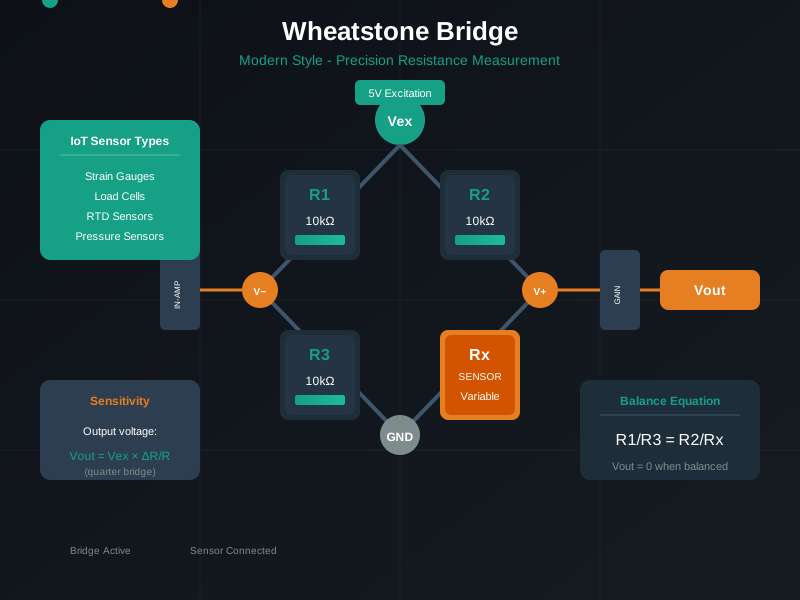
Wheatstone Bridge: Four resistors in a diamond configuration where one or more are sensing elements; the differential output voltage is proportional to the excitation voltage and the resistance imbalance.
- Using that excitation as the ADC reference can cancel excitation drift in the digital reading.
- Common-Mode Rejection Ratio (CMRR): The amplifier's ability to reject identical signals on both inputs while amplifying the difference; high CMRR (>80 dB) is critical for rejecting noise on long sensor cables.
- Anti-Aliasing Filter: An analog low-pass filter before the ADC that attenuates frequencies above half the sample rate enough to meet the application's alias-error limit.
Major section
Signal Conditioning Chain
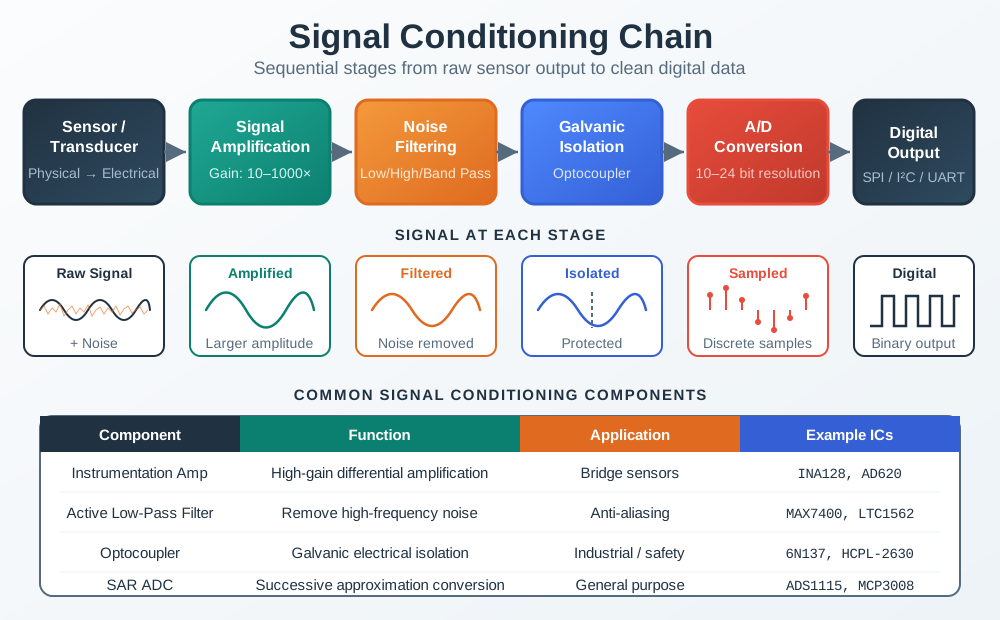
This four-stage pipeline is the foundation of all professional sensor interfaces.
- The mathematical gist: A 20.0 mV conditioned sensor span multiplied by the chapter's illustrative 150× gain uses 3.00 V of an ideal 3.3 V, 12-bit ADC.
Major section
Signal Processing Pipeline Overview
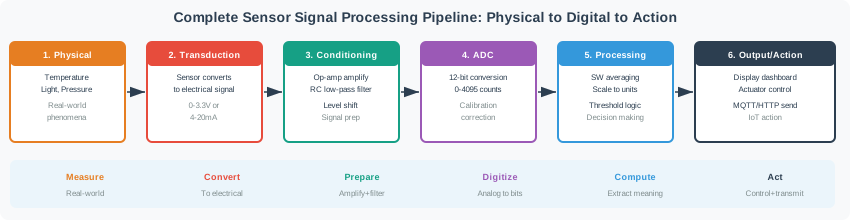
An error introduced before conversion can be labelled downstream but not reconstructed, which is why the bridge, thermistor, and gain circuits in this chapter belong inside an end-to-end chain.
- The stage map explains where work happens, but a practical design must also decide what to trade.
Major section
Wheatstone Bridge
The Wheatstone bridge is a precision measurement circuit used with strain gauges, load cells, and other resistive sensors requiring high accuracy.
- It detects small resistance changes by comparing two voltage dividers.
- The bridge makes the problem visible: a real physical change may only move the output by millivolts.
- Sensitivity: Small changes in Rx produce measurable differential voltage.
Major section
Wheatstone Bridge (continued)
Equal ratios, R1/R2 = R3/Rx, make those midpoint voltages equal and yield 0 V.
- A change in the sensing arm breaks that equality, linking mechanical or thermal change to a signed voltage.
- The amplifier then enlarges this small difference while rejecting voltage common to both nodes, which is why the bridge is useful before a limited-range ADC.
- The calculator's result is not yet a measurement resolution; it is the differential signal available to an instrumentation amplifier.
Major section
Signal Conditioning Chain
Without that offset removal, the displayed gain and resistor can clip the ADC; also check the selected amplifier's output headroom.
- Enter a practical resistor and inspect the calculated ideal capacitance alongside its nearest E12 value; the standard component changes the realised cutoff, so use that realised value for the sampling check.
Major section
HVAC Thermistor Conditioning
Scenario: You need to measure room temperature (15-35C) using an NTC thermistor in a conditioned bridge.
- Package pins and circuit limits remain part of the design even when the arithmetic is correct.
- The photographed component represents the amplifier class; the specified INA128 and its datasheet values govern the actual circuit below.

Major section
HVAC Thermistor Conditioning (continued)
Dividing the 3.3V ADC range by the 20mV sensor span requires gain 165.
- Design instrumentation amplifier: For the INA128, gain is G = 1 + 50 kΩ/R_G.
- A target gain of 150 needs R_G = 50,000 Ω/(150 − 1) = 335.6 Ω; use a 332 Ω standard resistor for nominal gain 151.6.
- A passive divider cannot subtract a 1.5V offset, and an INA128 needs supply and input/output headroom consistent with its data sheet.
Major section
Putting Numbers to It
With proper amplification, the nominal ADC code spacing is about 0.124°C/code instead of 20.14°C/code.
- You need to measure 0-500°C range with ESP32's 12-bit ADC (0-3.3V).
- Thermocouple example: 40 µV/°C over 0–500 °C gives 20 mV full scale.
- Code spacing is not accuracy.
Deck summary
Key takeaways
Protect the Meaning of a Weak Signal: An analog-to-digital converter is a part that turns a voltage into a number.
- One bench result cannot cover every part, temperature, or installation.
- Wheatstone Bridge: Four resistors in a diamond configuration where one or more are sensing elements; the differential output voltage is proportional to the excitation voltage and the resistance imbalance.
- This four-stage pipeline is the foundation of all professional sensor interfaces.
- An error introduced before conversion can be labelled downstream but not reconstructed, which is why the bridge, thermistor, and gain circuits in this chapter belong inside an end-to-end chain.
Retrieval practice
Recall check 1 of 2
Voltage Vera says: answer from memory, then check your reasoning.
Q1A strain gauge Wheatstone bridge is balanced at zero load with all four 350ohm resistors. Under maximum load, one gauge changes by 0.1% (to 350.35ohm). With 5V excitation, what differential output voltage do you expect?
Show answer
Answer: B One 0.1% change in a 350 ohm bridge arm gives about 1.25 mV differential output at 5 V excitation: 5 V × 0.35/(4 × 350) = 1.25 mV. This is bridge output, not field accuracy.
Retrieval practice
Recall check 2 of 2
Voltage Vera says: answer from memory, then check your reasoning.
Q2A pressure sensor outputs 0-50mV for 0-100 PSI range. You want to interface it with a 3.3V, 12-bit ADC. What amplifier gain provides the best resolution while staying within the ADC input range?
Show answer
Answer: B A nominal gain of 66 maps the 50 mV full-scale signal to an ideal 3.3 V range; this improves code use, not proven pressure accuracy or amplifier headroom.
Print reference
Answers
Answer key.
- B · One 0.1% change in a 350 ohm bridge arm gives about 1.25 mV differential output at 5 V excitation: 5 V × 0.35/(4 × 350) = 1.25 mV. This is bridge output, not field accuracy.
- B · A nominal gain of 66 maps the 50 mV full-scale signal to an ideal 3.3 V range; this improves code use, not proven pressure accuracy or amplifier headroom.