Sensors & Measurement · Study deck

Sensor Circuits: Bridges and Noise

A conditioned voltage is readable, but bridge sensors and long field wiring expose smaller errors.

Physics Phoebe is your guide for this deck.

sensorcircuitssignal
Physics Phoebe, the module guide, in a scene from this chapter.
iotclass.org

After studying this chapter

Learning objectives

You will be able to:

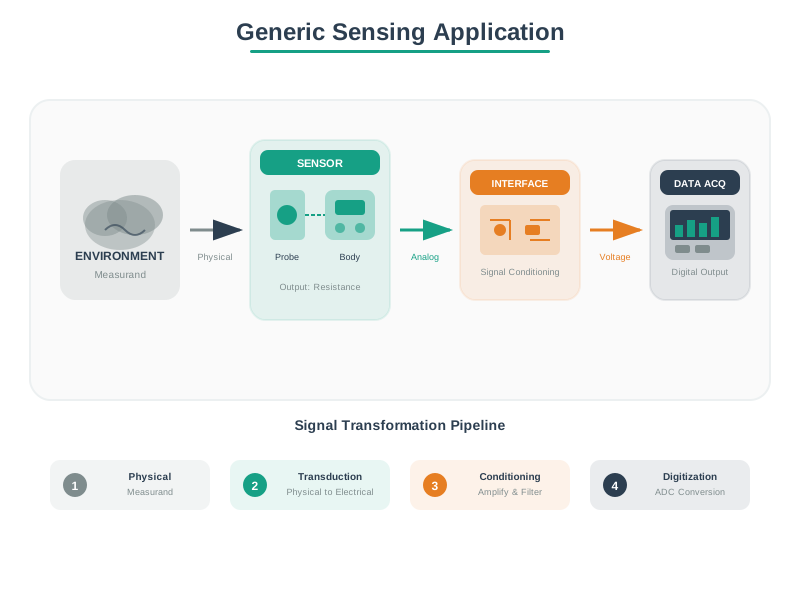
  • Explain: The sensing element first converts the phenomenon into an electrical quantity; conditioning makes that quantity compatible with conversion; data processing then scales, checks, or acts on the result.
  • Explain: Quick Test: To verify your anti-aliasing filter is working, inject a known high-frequency signal (e.g., 800 Hz sine wave) into your system.
  • Explain: Cost-Benefit: A $0.25 RC filter (two resistors, two capacitors) prevents false alarms that could cost thousands in unnecessary maintenance or missed real faults.
  • Explain: Scenario: A load cell for a beehive monitoring system uses a Wheatstone bridge with strain gauges.
iotclass.org

Major section

Load Cell Bridge Amplification

Scenario: A load cell for a beehive monitoring system uses a Wheatstone bridge with strain gauges.

  • You need to interface this with an Arduino Uno's 10-bit ADC.
  • That physical path explains why the HX711 calculation below sets electronic resolution but cannot remove mechanical installation error or drift.
A metal bar load cell removed from a digital weighing scale with its signal cable attached
iotclass.org

Major section

Signal Conditioning Circuit Detail
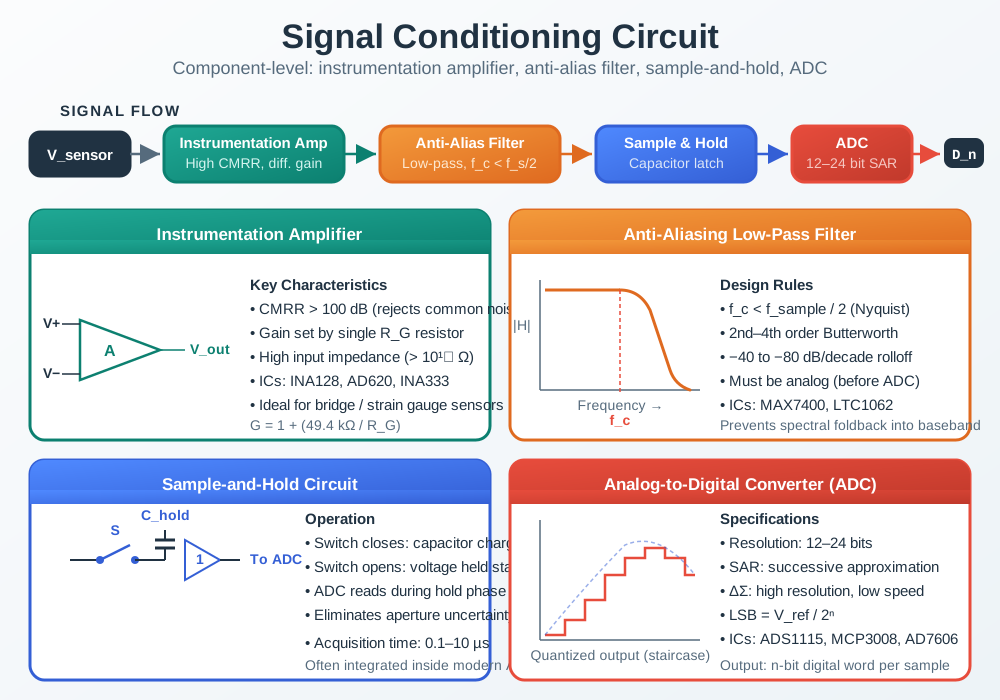
The order matters: a clipped amplifier output or overloaded ADC cannot be repaired by downstream processing.

  • The sensing element first converts the phenomenon into an electrical quantity; conditioning makes that quantity compatible with conversion; data processing then scales, checks, or acts on the result.
Signal conditioning circuit showing amplification, filtering, and level shifting stages.
iotclass.org

Major section

Noise Sources and Mitigation

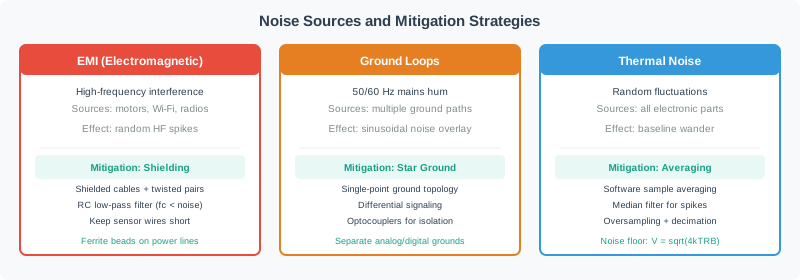
Understanding where noise enters the signal path helps design effective mitigation strategies.

  • Mitigation works best when it targets the coupling mechanism rather than merely smoothing every sample.
Noise diagnosis guide: EMI from motors and Wi-Fi adds high-frequency noise (mitigate with shielding). Ground loops cause 50/60Hz hum (use single-point ground). Thermal noise is always present (average samples). Combining hardware filtering with software averaging achieves clean readings even in noisy environments.
iotclass.org

Major section

Voltage Divider and Bridge Circuits
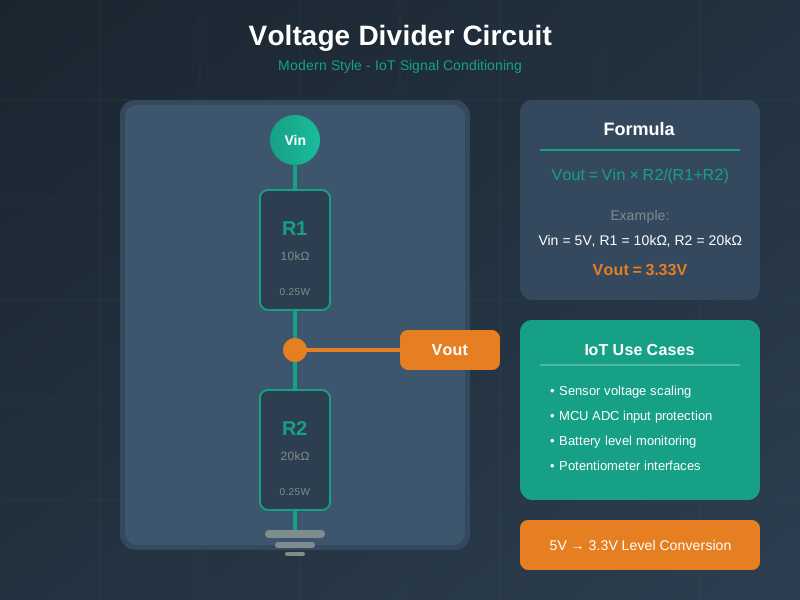
The Wheatstone bridge (covered above) and simple voltage dividers are the two fundamental resistive sensor interface circuits.

  • The voltage divider provides a simple output proportional to resistance ratio, while the bridge offers differential measurement with superior noise rejection.
A voltage divider scales a sensor voltage before ADC measurement.
iotclass.org

Major section

For Kids: Meet the Sensor Squad!

the microcontroller couldn't read it. "Sorry Sammy, my ADC needs at least a few hundred millivolts to see anything useful.

  • Temperature Terry was working in a factory, trying to measure the weight of honey jars on a conveyor belt.
  • But there was a problem.
  • Your signal is just lost in the noise.".

Key terms

When no weight
When no weight is on the scale, everything is balanced and the output is zero.
iotclass.org

Major section

For Kids: Meet the Sensor Squad! (continued)

"My strain gauge signal is only 1.25 millivolts!" Sammy cried. "That's like trying to hear a mouse whisper in a thunderstorm!".

  • When no weight is on the scale, everything is balanced and the output is zero.
  • But when a honey jar sits on it, the tiny change in the strain gauge tips the seesaw just a little bit!".
  • "Signal conditioning really is a superpower!" Sammy beamed.
iotclass.org

Major section

Anti-Alias Before ADC Sampling

If you see it aliased to a low frequency with significant amplitude, your filter is inadequate.

  • The system is supposed to detect bearing faults by analyzing vibration frequencies up to 400 Hz.
  • For 1 kHz sampling, the Nyquist frequency is 500 Hz.
  • Anti-aliasing is mandatory for any system that processes signals with unknown high-frequency content.

Numbers to remember

1 kHzFor 1 kHz sampling, the Nyquist frequency is 500 Hz.

Why it matters

Cost-Benefit: A $0.25 RC filter (two resistors, two capacitors) prevents false alarms that could cost thousands in unnecessary maintenance or missed real faults.

iotclass.org

Major section

Anti-Alias Before ADC Sampling (continued)

Any frequency components above 500 Hz in the input signal will "alias" — appear as false lower frequencies in the digitized data.

  • Quick Test: To verify your anti-aliasing filter is working, inject a known high-frequency signal (e.g., 800 Hz sine wave) into your system.
  • If it correctly shows up as highly attenuated (or doesn't appear at all) in your ADC data, your filter is working.
  • Cost-Benefit: A $0.25 RC filter (two resistors, two capacitors) prevents false alarms that could cost thousands in unnecessary maintenance or missed real faults.
iotclass.org

Deck summary

Key takeaways

Scenario: A load cell for a beehive monitoring system uses a Wheatstone bridge with strain gauges.

  • The order matters: a clipped amplifier output or overloaded ADC cannot be repaired by downstream processing.
  • Understanding where noise enters the signal path helps design effective mitigation strategies.
  • The Wheatstone bridge (covered above) and simple voltage dividers are the two fundamental resistive sensor interface circuits.
  • the microcontroller couldn't read it. "Sorry Sammy, my ADC needs at least a few hundred millivolts to see anything useful.
iotclass.org

Retrieval practice

Recall check 1 of 2

Physics Phoebe says: answer from memory, then check your reasoning.

Q1Your ESP32-based temperature logger shows periodic 50Hz noise spikes in ADC readings. The sensor is a thermocouple measuring slow changes (max 0.5Hz). Which combination of mitigations is most effective?

ASoftware averaging only (128-sample moving average)
BHardware RC low-pass filter (fc = 5Hz) plus star-ground topology
CIncrease ADC sampling rate to 10kHz to oversample the noise
DReplace the thermocouple with a digital I2C temperature sensor
Show answer

Answer: B Correct!

iotclass.org

Retrieval practice

Recall check 2 of 2

Physics Phoebe says: answer from memory, then check your reasoning.

Q2Place each conditioning function where it lives so you can place each conditioning function where it controls amplitude, interference, safety, or transfer accuracy before digitisation.

AAmplification
BFiltering
CIsolation
DLinearisation
Show answer

Answer: A Place each conditioning function where it lives so you can place each conditioning function where it controls amplitude, interference, safety, or transfer accuracy before digitisation.

Q3Complete the digital low-pass filter for noisy sensor data:

Aalpha = 0.1 # Smoothing factor (0-1)
Balpha = 10 # Smoothing factor
Calpha = -0.5 # Smoothing factor
Dalpha = 0 # Smoothing factor
Show answer

Answer: A An exponential moving average (EMA) filter uses alpha to blend new readings with previous output.

iotclass.org

Print reference

Answers

Answer key.

  1. B · Correct!
  2. A · Place each conditioning function where it lives so you can place each conditioning function where it controls amplitude, interference, safety, or transfer accuracy before digitisation.
  3. A · An exponential moving average (EMA) filter uses alpha to blend new readings with previous output.
iotclass.org