Specialized Architectures · Study deck

Mine Safety Case Study

Picture a worker underground when a gas reading crosses a danger limit.

Blueprint Bina is your guide for this deck.

mine-safetysensor-behaviorevidence-review
Blueprint Bina, the module guide, in a scene from this chapter.
iotclass.org

After studying this chapter

Learning objectives

You will be able to:

  • Explain: This order keeps a hazard signal distinct from a node-behaviour signal: an unusual reading may support hazard review while a missing or contradictory input separately supports behaviour review.
  • Explain: The useful architecture is the one that preserves enough evidence to explain the hazard claim, the response, the uncertainty, and the retest needed before normal operation resumes.
  • Explain: A classroom rule such as "two sensor types must agree" is useful for reasoning, but a real safety rule depends on the approved context and evidence record.
  • Explain: Mine-safety decisions often depend on several sensor types.
iotclass.org

Major section

Start With the Alarm No One Can Ignore

The safe action cannot wait for a distant service or a perfect map.

  • The worker needs a clear local warning and a known route to safety.
  • A broken sensor, low battery, blocked path, stale value, or unknown location must create its own visible state.
  • The simple path has limits.
iotclass.org

Major section

Start With the Alarm No One Can Ignore (continued)

A sensor cannot prove that every pocket of air is safe.

  • In a mine-safety setting, a sensor behavior decision is not abstract.
  • A missing reading, gas warning, ventilation change, or contradictory source can affect whether people keep working, evacuate, or inspect equipment.
  • The useful architecture is the one that preserves enough evidence to explain the hazard claim, the response, the uncertainty, and the retest needed before normal operation resumes.
iotclass.org

Major section

Minimum Viable Understanding · Case Boundary

A mine-safety sensor reading is useful only when its freshness, source, and validity are known.

  • Agreement between independent sensors can reduce reliance on one reading, but it does not remove the need to review node behaviour.
  • Missing evidence remains visible rather than being hidden by an old value.
  • This chapter applies that discipline as a review case study; it does not replace site-specific safety design or approval.

Why it matters

This case study uses an underground mine as the context because sensor behavior matters when decisions have high consequence.

iotclass.org

Major section

Evidence Flow · Sensor Behavior In A Mine-Safety Review
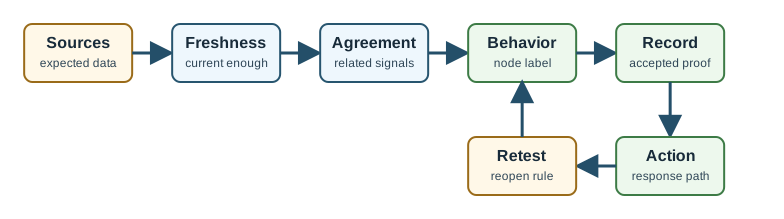
A reviewable safety-monitoring path connects local observations to a decision record.

  • This order keeps a hazard signal distinct from a node-behaviour signal: an unusual reading may support hazard review while a missing or contradictory input separately supports behaviour review.
  • Different node behaviors change how the evidence should be used.

Key terms

Expected messages
Expected messages are absent.

Why it matters

Misleading: The reading is active but unsafe for the current decision because it repeatedly contradicts related evidence or fails validity checks.

Mine-safety sensor behavior evidence flow from sensor sources through freshness, agreement, node behavior, decision record, response action, and retest trigger.
iotclass.org

Major section

Multi-Sensor Agreement · Review Record
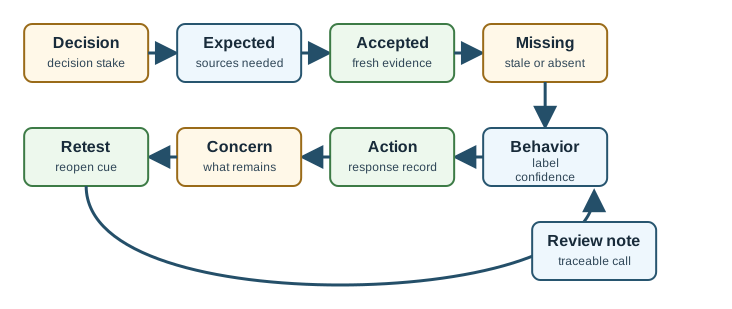
Mine-safety decisions often depend on several sensor types.

  • Agreement can make a decision stronger, but only if the agreement is reviewed carefully.
  • A classroom rule such as "two sensor types must agree" is useful for reasoning, but a real safety rule depends on the approved context and evidence record.
Mine-safety review record fields for decision, expected sources, accepted evidence, missing evidence, node behavior, action, residual concern, and retest trigger.
iotclass.org

Major section

Worked Review: Possible Hazard Signal · Worked Review: Conflicting Evidence

Scenario: a monitoring view receives an unusual reading from one section of a mine.

  • Related sources are expected before the system treats the event as confirmed.
  • The review should keep the possible hazard evidence and the missing-node evidence visible as separate facts.
  • Observation: One source reports an unusual condition.
iotclass.org

Major section

Sensor Behavior Apps Quiz · Summary

The quiz should not let one loaded word decide what the node meant to do.

  • A neat answer can still teach the wrong habit when the scene lacks context.
  • A vague answer can also leave the learner with no rule to reuse.
  • The review records and worked cases later in the chapter show the full test.

Why it matters

Evidence reading: The node is not silent because messages are present.

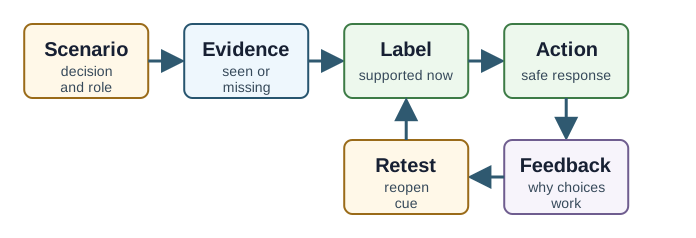
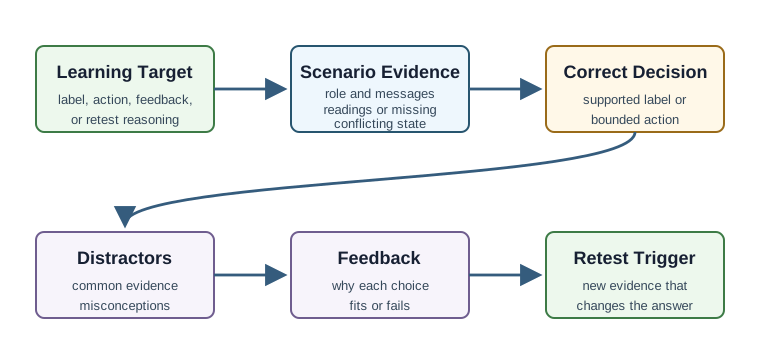
Sensor-behavior quiz evidence path from scenario context through observable evidence, supported label, bounded action, feedback, and retest trigger.
iotclass.org

Deck summary

Key takeaways

The safe action cannot wait for a distant service or a perfect map.

  • A sensor cannot prove that every pocket of air is safe.
  • A mine-safety sensor reading is useful only when its freshness, source, and validity are known.
  • A reviewable safety-monitoring path connects local observations to a decision record.
  • Mine-safety decisions often depend on several sensor types.
iotclass.org

Retrieval practice

Recall check 1 of 4

Blueprint Bina says: answer from memory, then check your reasoning.

Q1A fresh gas reading indicates a possible hazard and an independent airflow signal supports concern, while a third expected feed is stale. What should the monitoring record preserve?

AKeep the current signals, mark the stale feed missing, and record the site response and retest evidence.
BAverage the three feeds, including the stale value, so the combined number appears less alarming.
CIgnore the gas and airflow evidence until the stale expected feed reports at the same time.
DLabel the gas node malicious because an unusual reading proves the sensor is attacking the system.
Show answer

Answer: A Mine-safety review keeps current hazard evidence, stale or absent inputs, node-behavior uncertainty, the site response, and the condition for resuming or retesting as separate record fields.

iotclass.org

Retrieval practice

Recall check 2 of 4

Blueprint Bina says: answer from memory, then check your reasoning.

Q2A mine-safety monitoring view receives one unusual reading, one related reading that supports it, and one expected source that has not reported recently. What is the strongest review response?

AUse the current supporting evidence, mark the missing source unavailable, and record the retest trigger
BIgnore the missing source because two readings are enough in every mine-safety system
CDeclare the missing node permanently failed from this event alone
DTreat the unusual reading as false because one expected source is missing
Show answer

Answer: A Safety-monitoring review should keep accepted, missing, and residual evidence separate so the action remains traceable.

iotclass.org

Retrieval practice

Recall check 3 of 4

Blueprint Bina says: answer from memory, then check your reasoning.

Q3A quiz calls a node malicious after one missed message and gives no schedule, role, or related-node evidence. What is the best revision?

AAdd role, schedule, and corroborating evidence; use the conservative supported answer and explain what would change it.
BKeep the question because the word missed is enough for learners to recall the malicious label.
CKeep the prompt and add feedback limited to the statement 'malicious is correct.'
DInvent a universal missed-message threshold so the item produces a decisive label without further context.
Show answer

Answer: A A sensor-behavior quiz should expose observable evidence, use plausible misconception-based distractors, and make feedback explain why the supported label or action is bounded.

iotclass.org

Retrieval practice

Recall check 4 of 4

Blueprint Bina says: answer from memory, then check your reasoning.

Q4A quiz scenario says a node missed one expected message. It gives no related-node evidence, no schedule review, and no route-role evidence. Which answer is best supported first?

AClassify the node as silent or unknown and request the missing context before assigning a stronger cause
BClassify the node as malicious because any missed expected message is active disruption with no more context needed
CClassify the node as healthy because only one message was missed
DIgnore the missing message because quiz scenarios should avoid uncertainty
Show answer

Answer: A Assessment questions should reward evidence-bound labels.

iotclass.org

Print reference

Answers

Answer key.

  1. A · Mine-safety review keeps current hazard evidence, stale or absent inputs, node-behavior uncertainty, the site response, and the condition for resuming or retesting as separate record fields.
  2. A · Safety-monitoring review should keep accepted, missing, and residual evidence separate so the action remains traceable.
  3. A · A sensor-behavior quiz should expose observable evidence, use plausible misconception-based distractors, and make feedback explain why the supported label or action is bounded.
  4. A · Assessment questions should reward evidence-bound labels.
iotclass.org