Wireless and Optical Sensing for IoT · Study deck
Privacy and Consent for Wireless and Optical Sensing
Radio Remi is asked to count people in a shared study room.
Radio Remi is your guide for this deck.
After studying this chapter
Learning objectives
You will be able to:
- Identify people, inferences, and harms across a wireless or optical sensing flow.
- Apply purpose limitation, minimisation, notice, lawful-basis, retention, and access questions.
- Produce a downloadable decision record with an abstention and human-review path.
- Explain: Radio Remi is asked to count people in a shared study room.
Major section
Start With the Story
Radio Remi is asked to count people in a shared study room.
- The sensor stores no images, so the team first calls it anonymous.
- Remi asks who is observed, what decision will follow, and how someone can say no.
- The design changes from storing raw traces to keeping short local counts with a clear sign and a review route.
Major section
Start with a threat model
Include visitors, workers, neighbours, children, household members, and people behind walls or glass where the modality can reach.
- A coarse count can become a routine when timestamps persist; a breathing cue can become health-related inference when linked to a person.
- A room sketch should mark doors, walls, shared areas, and any path that reaches beyond the intended space.
- CSI amplitude, radar phase, lidar points, and packet timing are measurements.
Major section
Start with a threat model (continued)
The field of view is part of the threat model because people can be observed without touching the device.
- Presence, identity, sleep, health, performance, and suspicion are interpretations with different harm and evidence.
- The team should record which inference is prohibited as well as which one is needed.
- This boundary helps reviewers spot a later request that quietly changes the purpose.
Major section
Read the minimised data flow
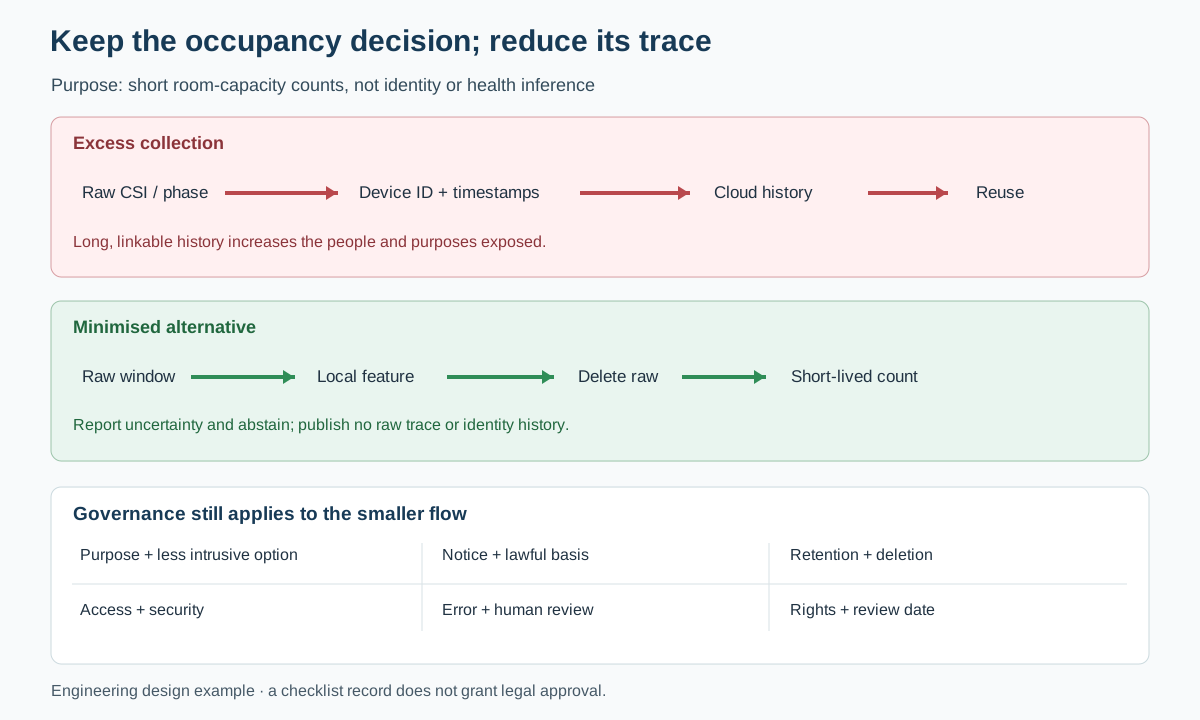
That path helps later reuse but makes it easier to link data to a person and raises the harm from a breach.
- The green lower lane keeps only the feature needed for a stated decision, deletes the raw window, and sends a short-lived count with uncertainty.
Major section
Minimise at the point of sensing
Process on the device where practical, separate operational output from diagnostic logs, and make high-detail debugging an explicit temporary mode.
- A retention test should prove that raw windows are actually deleted after the short processing interval.
- The test should include local caches, diagnostics, exports, backups, and service logs.
- If a doorway counter can manage room capacity, do not infer identity or health.
- The saved result should include uncertainty and the reason for any abstention.
Deck summary
Key takeaways
Radio Remi is asked to count people in a shared study room.
- Include visitors, workers, neighbours, children, household members, and people behind walls or glass where the modality can reach.
- The field of view is part of the threat model because people can be observed without touching the device.
- That path helps later reuse but makes it easier to link data to a person and raises the harm from a breach.
- Process on the device where practical, separate operational output from diagnostic logs, and make high-detail debugging an explicit temporary mode.
Retrieval practice
Recall check 1 of 2

Radio Remi says: answer from memory, then check your reasoning.
Q1Why can a radar presence record be personal data even without a name or image?
Show answer
Answer: A Context and repeated observations can make a person identifiable and support consequential inferences.
Retrieval practice
Recall check 2 of 2
Radio Remi says: answer from memory, then check your reasoning.
Q2Which change best demonstrates data minimisation for a room-capacity sensor?
Show answer
Answer: A Local feature extraction, prompt raw deletion, short retention, and visible uncertainty reduce data to what the purpose needs.
Print reference
Answers
Answer key.
- A · Context and repeated observations can make a person identifiable and support consequential inferences.
- A · Local feature extraction, prompt raw deletion, short retention, and visible uncertainty reduce data to what the purpose needs.