Specialized Architectures · Study deck

Sensing as a Service

Picture a farm team using a soil reading supplied by another company.

Blueprint Bina is your guide for this deck.

sensing-as-a-serviceshared-sensingdata-quality
Blueprint Bina, the module guide, in a scene from this chapter.
iotclass.org

After studying this chapter

Learning objectives

You will be able to:

  • Explain: Service records therefore preserve freshness, provenance, uncertainty, and retest triggers; when ownership, permission, or quality evidence is unclear, the consumer decision uses a lower-confidence or unavailable state.
  • Explain: A good review separates the physical sensor, the service interface, the consumer decision, and the evidence that proves the data is fresh, permitted, and fit for use.
  • Explain: Sensor Node Behaviors: Taxonomy explains why labels and decisions remain evidence-bound, and Sensor Node Behavior Classification supplies the confidence, action, and retest record pattern.
  • Explain: Sensing as a Service is a shared-data boundary, not merely a pricing model.
iotclass.org

Major section

Start With the Shared Sensor Record

The number is easy to download.

  • A reachable feed is not the same as a trustworthy fact.
  • Sensing as a service starts when one sensing system becomes useful to another team, application, or organization.
  • The service boundary should make access, quality, permission, liability, and retest evidence visible before the record is trusted.
iotclass.org

Major section

In 60 Seconds · First Step: Sensing as a Service Evidence

Sensing as a Service means a sensing capability is offered through a service boundary instead of being controlled only by the local device owner.

  • The key review question is not whether sharing sensor data is attractive.
  • The key question is whether the service record makes access, ownership, data quality, use limits, and retest conditions clear enough for a downstream decision.
  • A good review separates the physical sensor, the service interface, the consumer decision, and the evidence that proves the data is fresh, permitted, and fit for use.
iotclass.org

Major section

Minimum Viable Understanding · Boundary Scope

Sensing as a Service is a shared-data boundary, not merely a pricing model.

  • A consumer must know the sensor source, service interface, quality state, permission, and use limit before accepting a reading.
  • Availability alone is not evidence of fitness.
  • Service records therefore preserve freshness, provenance, uncertainty, and retest triggers; when ownership, permission, or quality evidence is unclear, the consumer decision uses a lower-confidence or unavailable state.

Key terms

If those questions
If those questions are not reviewable, the service may still exist, but it is not yet reliable evidence for a decision.
iotclass.org

Major section

Service Boundary

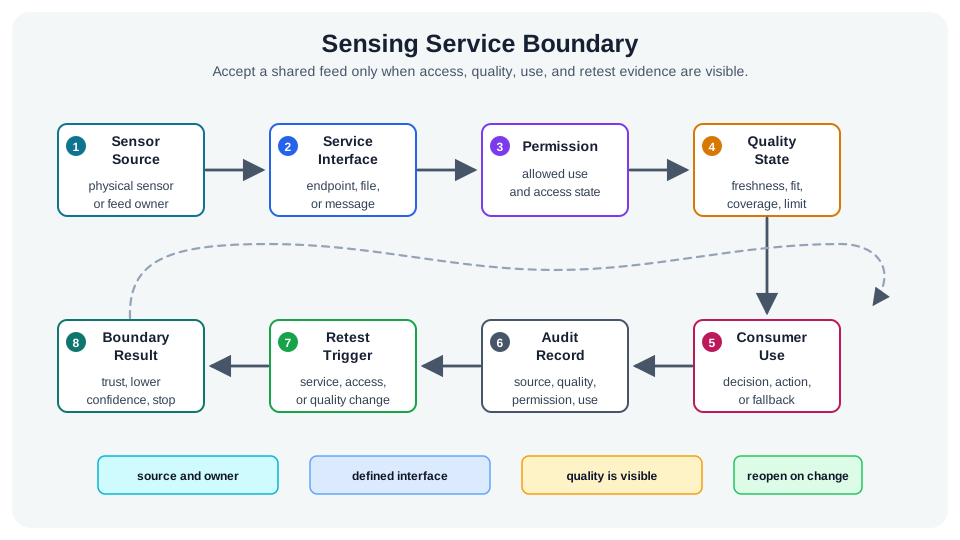
The service boundary separates a physical sensing source from the consumer decision that uses its data.

  • Permission then constrains who may use the record and for what purpose.
  • The audit record preserves those conditions, and the final retest trigger names the service, permission, source, or quality change that reopens acceptance.
Sensing-service boundary decision path from sensor source through service interface, permission, quality state, consumer use, audit record, retest trigger, and boundary result.
iotclass.org

Major section

Evidence Questions · Service Review Record
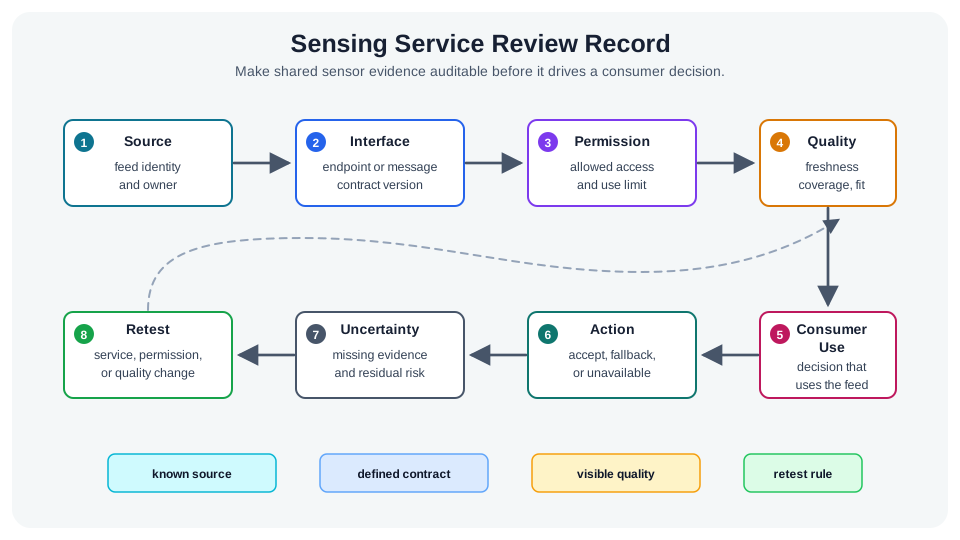
A sensing-service review should separate four questions.

  • If it only provides a value, the consumer may need a lower-confidence decision.
  • The review needs a retest trigger, not an assumption that the service stays stable.
  • The review record should be short enough to repeat and specific enough to audit.
Sensing-service review record from source and interface through permission, quality state, consumer use, action, uncertainty, and retest trigger.
iotclass.org

Major section

Fit Checks · Named Architecture: Sensor-Cloud

Measurement fit: The service should measure the condition that the consumer decision actually needs.

  • A nearby measurement, aggregate feed, or proxy source may be useful, but the record should state the limit.
  • Quality fit: Quality evidence should be visible.
  • When confidence, coverage, or validation status is missing, the consumer action should reflect that uncertainty.

Key terms

If access
If access is revoked, narrowed, or unclear, the review should not silently continue using the feed.
Sensor-cloud
Sensor-cloud is one published instantiation of the service boundary above.
iotclass.org

Major section

Named Architecture: Rentable IoT Infrastructure (S²aaS) · Worked Review: Shared Condition Feed

Which end of that spectrum a source sits on changes what ownership and permission evidence should look like.

  • The same model is used to rent nearby infrastructure rather than only publish sensed data.
  • Scenario: an application wants to use a shared condition feed instead of a directly owned sensor.
  • Observation: The service provides a current value and a source identifier.

Key terms

Related evidence
Related evidence is checked when the value is surprising or close to a decision threshold.
iotclass.org

Major section

Worked Review: Rented Infrastructure, Different Priorities

Reachability alone does not decide how much of the service either consumer should actually use.

  • Scenario: two consumers can reach the same rented infrastructure through their own devices, but their constraints for using it are different.
  • A budget traveler nearby has a tighter constraint: she needs her own phone battery to last until she is back at her hotel.
  • Action: Each device's use of the shared service is scoped to its own consumer decision.
iotclass.org

Major section

Specialized Architectures Route Map · Summary

A gateway is a node that joins one network to another.

  • A normal box-and-arrow map may show where its data goes.
  • It may not show why the node sleeps, what happens when it stays quiet, or who may reuse its data.
  • It may be power, movement, weak links, trust, repair, or shared use.

Key terms

Specialized architectures
Specialized architectures are useful when a standard sensor-to-gateway-to-cloud path does not explain the real design problem.

Why it matters

A shared feed should not be trusted just because it is reachable, and it should not be rejected just because it is shared.

iotclass.org

Major section

Key Takeaway · Concept Relationships

Sensing as a service only works when ownership, quality, privacy, access control, pricing, and lifecycle responsibilities are explicit.

  • Sensor Node Behaviors: Taxonomy explains why labels and decisions remain evidence-bound, and Sensor Node Behavior Classification supplies the confidence, action, and retest record pattern.
  • Sensor Applications Route Map connects that evidence to consumer decisions.
  • S2aaS Fundamentals then provides the broader service-model background outside this specialised-architecture review.
iotclass.org

Deck summary

Key takeaways

The number is easy to download.

  • Sensing as a Service means a sensing capability is offered through a service boundary instead of being controlled only by the local device owner.
  • Sensing as a Service is a shared-data boundary, not merely a pricing model.
  • The service boundary separates a physical sensing source from the consumer decision that uses its data.
  • A sensing-service review should separate four questions.
iotclass.org

Retrieval practice

Recall check 1 of 4

Blueprint Bina says: answer from memory, then check your reasoning.

Q1A shared temperature feed is reachable, but the consumer cannot see its source identity, freshness, quality state, or permission for the intended use. How should the service record be treated?

ATreat it as unavailable or lower-confidence for that decision until provenance, freshness, quality, permission, and use limits are visible.
BAccept it because a successful API response proves the measurement is current and calibrated.
CAccept it once the sensor owner confirms the hardware is theirs, using that confirmation as the feed's permission record.
DAverage the feed with another source, because aggregation repairs missing provenance and permission evidence.
Show answer

Answer: A Sensing as a Service separates feed access from fitness for use.

iotclass.org

Retrieval practice

Recall check 2 of 4

Blueprint Bina says: answer from memory, then check your reasoning.

Q2A shared sensing feed is reachable, but the record does not show observation time, permission state, or quality status. What is the safest review action?

AMark the feed lower-confidence or unavailable for the decision until those evidence fields are checked
BAccept the value because any service interface is more reliable than a local sensor
CAssume ownership permission is valid because the data was visible
DPermanently reject all shared sensing services
Show answer

Answer: A Sensing-service review should separate reachability, permission, quality, consumer use, and retest evidence before data is trusted.

iotclass.org

Retrieval practice

Recall check 3 of 4

Blueprint Bina says: answer from memory, then check your reasoning.

Q3A battery-powered air-quality node wakes on schedule, but its readings now contradict nearby sources. Which module route should the team follow first?

AUse the node-behavior route to compare the node's expected role, readings, and corroborating evidence before choosing a label or response.
BUse the duty-cycling route because battery-powered-node problems are usually caused by too much sleep.
CUse the sensing-service route to inspect the consumer's access agreement before comparing the conflicting readings with nearby sources.
DJump to the production quiz because an assessment can determine which physical sensor is faulty.
Show answer

Answer: A The route map starts from the unresolved constraint.

iotclass.org

Retrieval practice

Recall check 4 of 4

Blueprint Bina says: answer from memory, then check your reasoning.

Q4A team has a battery-powered air-quality node that wakes on schedule, but its readings now contradict nearby sources. Which route should they use first in this module?

AUse the node behavior route because the first question is what the current evidence supports about the node's readings
BUse the duty-cycling route because every battery-powered node issue starts with sleep scheduling
CUse the sensing-service route because any shared sensor value should be treated as a service boundary problem
DSkip the route map and assign a malicious label because contradictory readings prove intent
Show answer

Answer: A Route choice should follow the decision evidence.

iotclass.org

Print reference

Answers

Answer key.

  1. A · Sensing as a Service separates feed access from fitness for use.
  2. A · Sensing-service review should separate reachability, permission, quality, consumer use, and retest evidence before data is trusted.
  3. A · The route map starts from the unresolved constraint.
  4. A · Route choice should follow the decision evidence.
iotclass.org