Connected Product and Service Design · Study deck
Ecosystem Integration: Semantic Mapping Risks
Conflict handling should be explicit.
UX Uma is your guide for this deck.
After studying this chapter
Learning objectives
You will be able to:
- Test semantic mapping product risk with a concrete scenario and pass criteria.
- Validate worked review: multi-platform home with a concrete scenario and pass criteria.
- Explain: Most ecosystem failures are semantic, not radio failures.
- Explain: Two controllers may rename a device, move it between rooms, edit a scene, rotate a credential, or send competing actuator commands.
Major section
Semantic Mapping Product Risk
Most ecosystem failures are semantic, not radio failures.
- Each translation can lose range, unit, precision, update cadence, permission context, or error detail.
- Matter fabrics, bridge identities, hub inventories, cloud device shadows, OAuth grants, webhook subscriptions, MQTT retained messages, event queues, and support logs may all hold a version of the same device relationship.
- Conflict handling should be explicit.
Major section
Semantic Mapping Product Risk (continued)
Two controllers may rename a device, move it between rooms, edit a scene, rotate a credential, or send competing actuator commands.
- Without clear authority, users see duplicate rooms, stale scenes, ghost devices, or commands that appear successful but never reach the physical device.
- The data model should separate identity, capability, authority, and observed state.
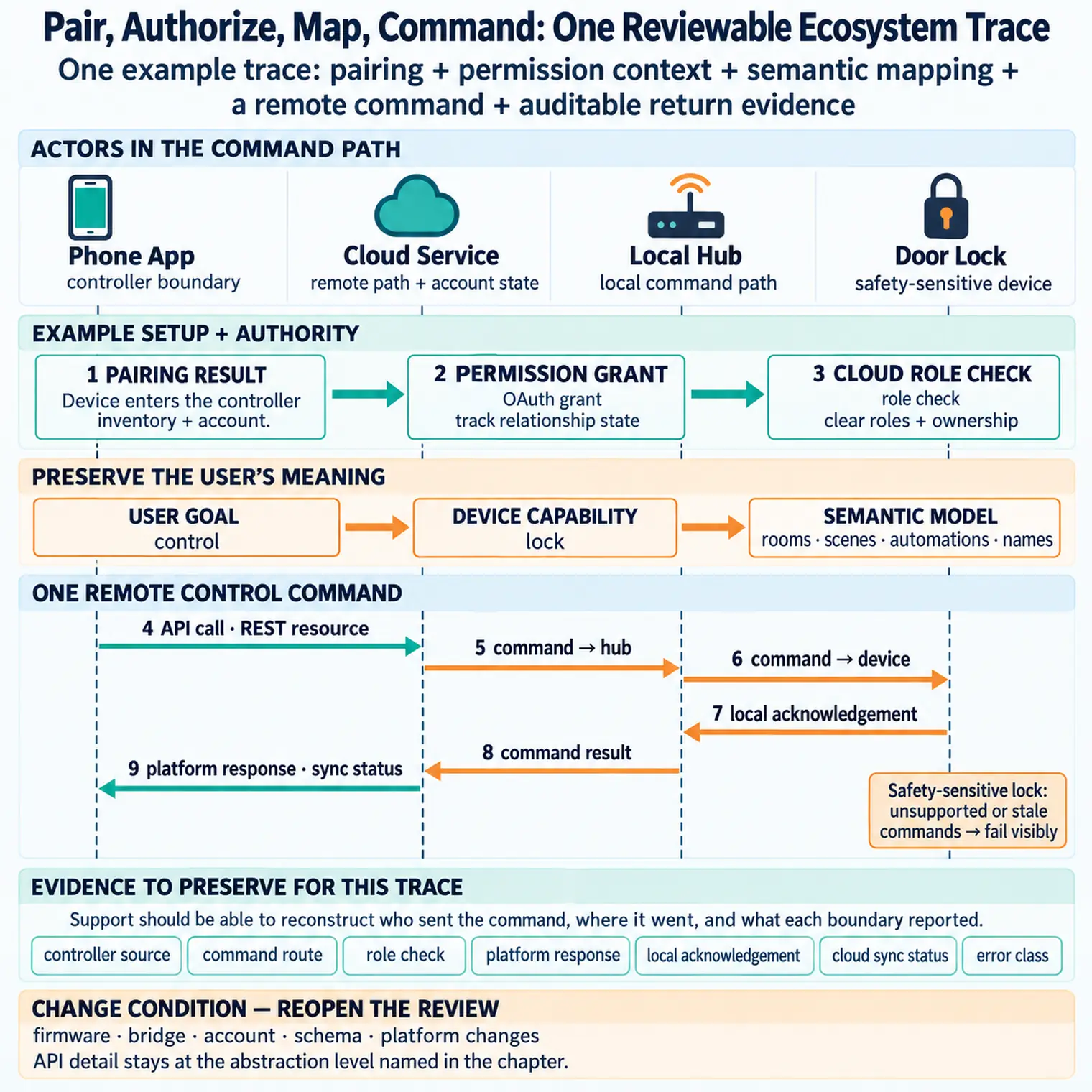
- For safety-sensitive devices such as locks, valves, alarms, and medical accessories, unsupported or stale commands should fail visibly rather than silently degrading.
Major section
Ecosystem Review Map
Room, zone, scene, and automation semantics must preserve the user's intended meaning rather than merely transport protocol fields.
- Permission and ownership then constrain who can control, share, or support the device across local and cloud paths.
- The evidence branch records setup, observed behaviour, failure message, and responsible service.
- User goal: control, monitor, automate, share, troubleshoot, update, migrate, or retire.
- Permission and ownership: owner, resident, installer, operator, guest, support, and service account.
Major section
Capability Mapping
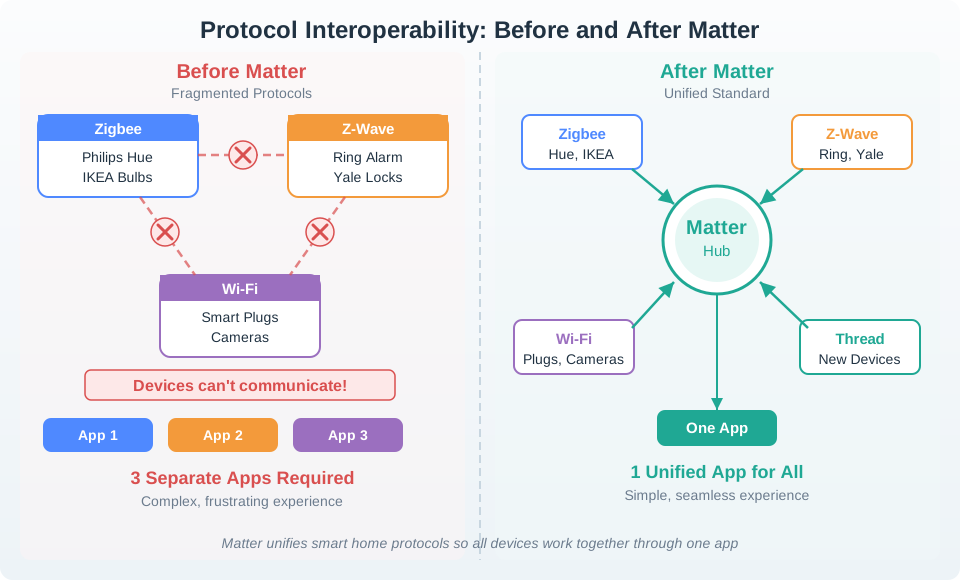
Interoperability depends on mapping device capabilities into a shared model.
- A light may expose on/off, brightness, color temperature, scenes, firmware update, power state, and health.
- A different controller may understand only some of those capabilities.
- Wi-Fi and Thread devices can join through native support, while legacy Zigbee or Z-Wave products still depend on a compatible bridge.
Major section
Rooms, Groups, Scenes, And Automations
Rooms and scenes are not cosmetic.
- Bad names, hidden dependencies, and inconsistent state create distrust even when the underlying protocol is working.
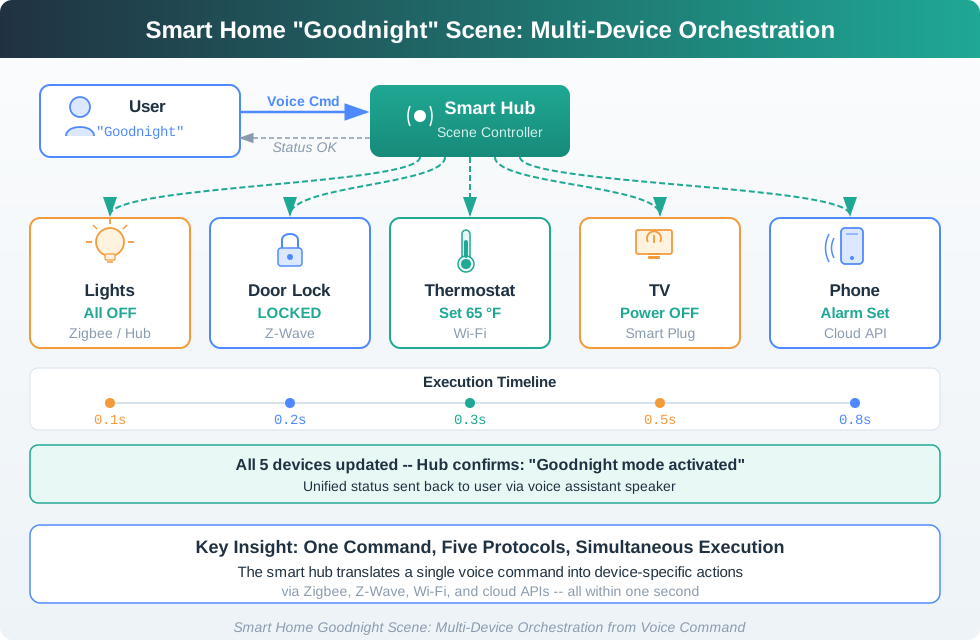
- The user sends one command to a hub, but lights, the door lock, thermostat, TV, and phone alarm use different links and actions.
- The execution timeline makes their order visible before the hub reports completion.
Major section
Local, Cloud, And Platform Paths
A command may start in a phone app, pass through a cloud service, reach a local hub, and then reach a device.
- Another command may stay local.
- The review should make hidden dependencies visible.
- A dashboard that says "online" while local control is broken or "offline" while local manual control still works is not giving enough evidence.
Major section
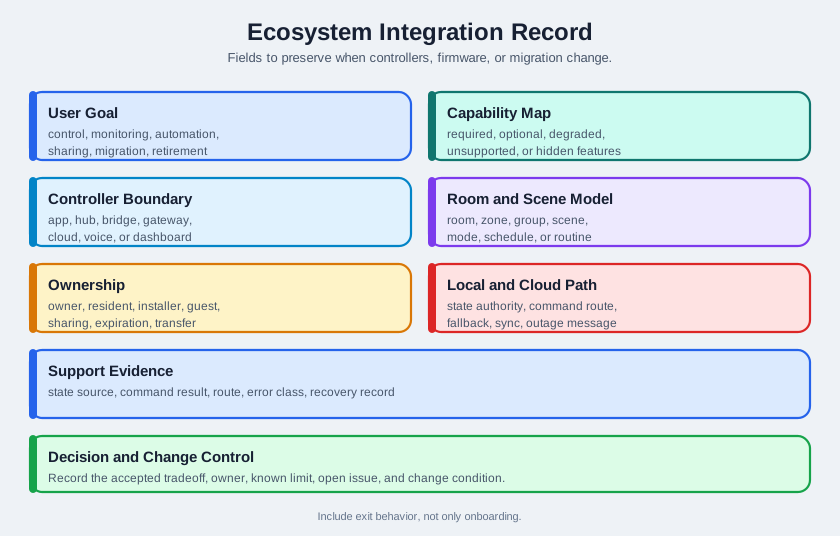
Ecosystem Integration Record
The light can expose on and off, brightness, color temperature, scenes, firmware update, power state, and health.
- A controller may support only some of those, so the record begins with the exact capability being promised.
- Ownership, path, and observed result need to be recorded with that route.
- This lets reviewers distinguish a missing capability from a delayed command or stale state in another controller.
- Ownership and permission: owner, resident, installer, operator, guest, support, service, sharing, expiration, and transfer.
Major section
Worked Review: Shared Building Ecosystem
A shared building has locks, lights, sensors, thermostats, cameras, and a facility dashboard.
- Residents, maintenance staff, property managers, and support staff use different interfaces.
- which capabilities each role can see and control.
- Change condition: Rerun the review when account roles, resident workflow, hub model, cloud controller, facility dashboard, device replacement process, or log retention changes.
Major section
Worked Review: Multi-Platform Home
device capabilities exposed in each controller and which are missing or degraded.
- whether a scene preview shows every affected device before activation.
- whether local control still works when a cloud path or app account is unavailable.
- Change condition: Rerun the review when a new controller is added, automation ownership changes, capabilities are remapped, firmware changes exposed clusters or services, or account sharing changes.
Major section
Common Findings
One controller shows a state that another controller cannot confirm.
- Rooms and scenes are duplicated or renamed differently across apps.
- Automations run in an unknown location, making outages and conflicts hard to explain.
- A device is removed from one app but remains active in another account or hub.
- Guest, installer, support, and owner roles are not separated.
Major section
Summary
Ecosystem integration is the review of how multiple connected-device boundaries become one understandable product experience.
- It covers capabilities, controllers, rooms, groups, scenes, automations, ownership, permissions, local and cloud paths, support evidence, migration, and decommissioning.
- The strongest ecosystem records avoid vague compatibility claims.
- They show which capabilities work where, who owns state and automations, what works locally, what needs the cloud, how users recover, how support diagnoses failures, and what change requires a fresh review.
Deck summary
Key takeaways
Most ecosystem failures are semantic, not radio failures.
- Two controllers may rename a device, move it between rooms, edit a scene, rotate a credential, or send competing actuator commands.
- Room, zone, scene, and automation semantics must preserve the user's intended meaning rather than merely transport protocol fields.
- Interoperability depends on mapping device capabilities into a shared model.
- Rooms and scenes are not cosmetic.
Retrieval practice
Recall check
UX Uma says: answer from memory, then check your reasoning.
Q1A device is advertised as ecosystem-compatible, but in one controller it exposes on/off only while the manufacturer app exposes brightness, energy use, firmware update, and health state. How should the compatibility claim be qualified across the controllers?
Show answer
Answer: B Ecosystem integration review verifies capability mapping, state authority, and user-facing limits across controllers.
Print reference
Answers
Answer key.
- B · Ecosystem integration review verifies capability mapping, state authority, and user-facing limits across controllers.