Security: Threats & Defense · Study deck
IoT Security Frameworks
Picture a connected lock whose review says only that it follows a familiar framework.
Shield Shelly is your guide for this deck.

After studying this chapter
Learning objectives
You will be able to:
- compare IoT security frameworks against architecture, design principles, and the threat-modelling process
- select a framework's controls that map to an actual reviewed risk, not a checklist
- build a framework-based review record with defense-in-depth cross-references
- Explain: A gateway means the boundary system that connects local devices to another network or service.
Major section
In 60 Seconds
A gateway means the boundary system that connects local devices to another network or service.
- Telemetry means records a system sends about readings, state, and health.
- This runway does not prove that the whole system is secure or compliant.
- The deeper sections compare framework lenses, architecture layers, local controls, evidence, scope, and review boundaries.
Major section
A Framework Is a Lens, Not a Certificate
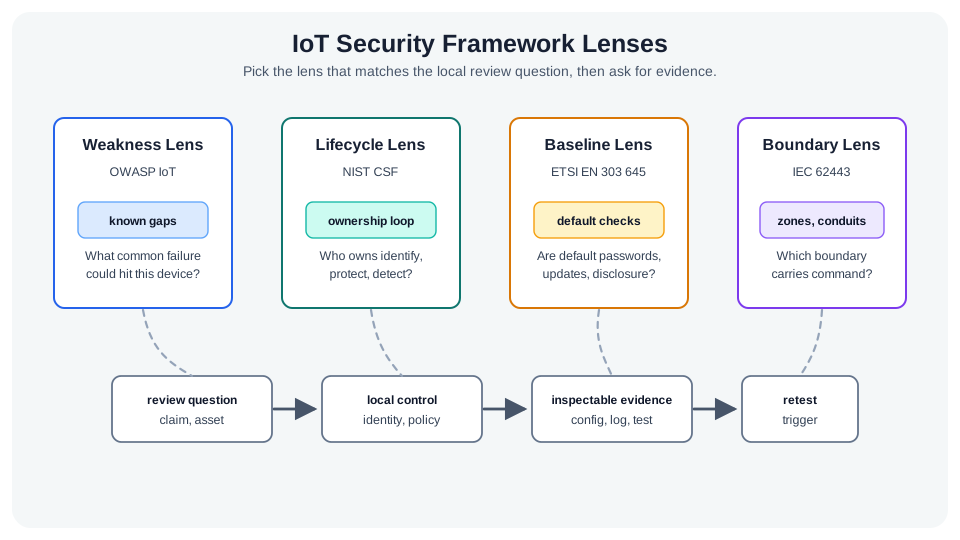
An IoT security framework is a structured set of questions and expectations that helps a reviewer look at a device, gateway, cloud service, or deployment in an organized way.
- Frameworks help you ask better questions and request the right records.
- Beginner ExamplesTaken together, these checks make the section reviewable.
Major section
A Framework Is a Lens, Not a Certificate (continued)
The most important thing to understand first is what a framework does not do: naming a framework does not make a system secure, and a framework name on its own is not evidence.
- The answer still has to come from the system itself — its configuration, logs, tests, and design notes.
- The discipline is to keep the framework as a lens over real assets and trust boundaries, never as a substitute for them.
- An IoT security framework is a structured set of questions and expectations that helps a reviewer look at a device, gateway, cloud service, or deployment in an organized way.
Major section
A Framework Is a Lens, Not a Certificate (continued)
A security framework is the lens: it sharpens what you look for, but the condition of the system is what you are actually measuring.
- Different lenses bring different details into focus, which is why the lens is chosen to fit the question.
- Evidence and retestA finding is defensible only with inspectable evidence and a recorded trigger that says when the review must be repeated.
- If you can describe a framework as a lens over real controls and evidence, you have the core idea.
Major section
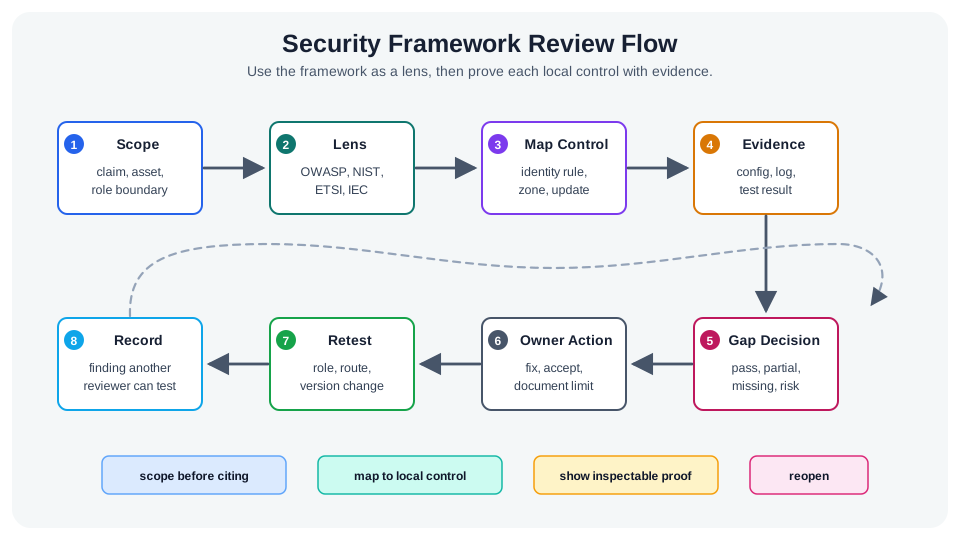
Choose a Lens and Run the Review
The point is not to memorize every framework but to match the lens to what you are actually trying to confirm.
- A lifecycle lens (the NIST Cybersecurity Framework) fits when the question is whether security work is organized and repeatable across functions such as identify, protect, detect, respond, and recover.
Major section
Choose a Lens and Run the Review (continued)
An industrial boundary lens (IEC 62443) fits operational-technology questions about zones, conduits, system roles, and separation.
- A management-system lens (ISO/IEC 27001) fits questions about ownership, risk treatment, control operation, and review cadence.
- Asset inventory, protective controls, monitoring, response, recovery.
- Owner records, monitoring rules, and a recovery or rollback test.
Major section
Choose a Lens and Run the Review (continued)
If the question is "Can a telemetry-only identity issue actuator commands?", an access-control and boundary lens matters far more than a broad program-maturity lens.
- The lens is a weakness lens focused on weak authorization and ecosystem interfaces.
- The mapped control states that a telemetry identity may publish telemetry but must not publish actuator commands.
- DecisionConfirmed if rules and tests show command rejection.
Major section
Choose a Lens and Run the Review (continued)
Evidence to inspectBroker or gateway authorization rules; recorded tests where a telemetry identity is denied a command; logs of denied command attempts; and deployment notes for topics, routes, and any gateway bypass paths.
- Partial if rules exist but no rejected-command test is recorded.
- Missing if command and telemetry identities share one role.
- Retest triggerReopen after role changes, topic or route changes, broker-rule changes, or gateway firmware or policy changes.
Major section
Evidence Quality, Layering, and the Review Record
The deeper layer is where a framework review becomes defensible.
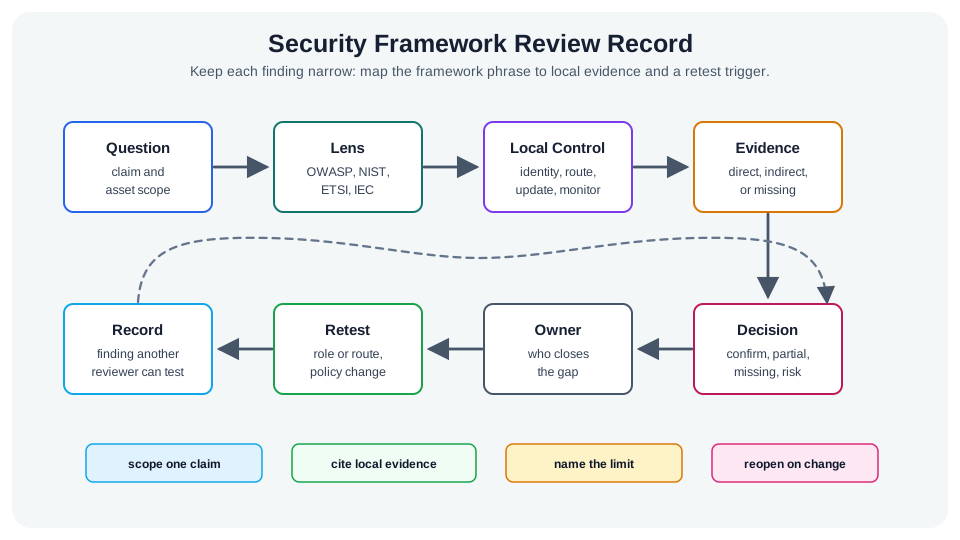
- A single framework statement often touches several IoT layers at once, and the work is to turn that statement into specific, inspectable evidence at each layer rather than a single broad claim.
- Identity or boot integrity is assumed, not shown.
Major section
Evidence Quality, Layering, and the Review Record (continued)
A defensible review decomposes the statement and asks for evidence at each relevant layer, so a confirmation at one layer is not mistaken for proof across all of them.
- Segmentation, allowed routes, and authorized paths.
- A boundary is drawn on a diagram but not enforced.
- Detection signals, alerts, and response records.
Major section
Evidence Quality, Layering, and the Review Record (continued)
Failures would be silent with no detection evidence.
- Direct evidence — a configuration, a log of a denied action, a passing test — is strongest.
- Indirect evidence supports a claim without proving it outright.
- The recurring mistake is treating a diagram or a vendor statement as if it were a denied-action log.
Major section
Evidence Quality, Layering, and the Review Record (continued)
It asks broadly whether the system is secure.
- When evidence is indirect or missing, the honest record says so and marks the assumption separately, so a later reviewer knows exactly what remains unconfirmed.
- The fields below are the minimum that make a finding narrow and reproducible.
- No owner, decision, or retest trigger is recorded.
Major section
Evidence Quality, Layering, and the Review Record (continued)
The claim and the asset or boundary are named.
- Frameworks Encourage Defense in DepthA second reason frameworks span layers is that good security does not rest on a single control.
- A real identity, route, update path, or monitor is named.
- Direct or indirect evidence is cited, with gaps marked.
Deck summary
Key takeaways
A gateway means the boundary system that connects local devices to another network or service.
- An IoT security framework is a structured set of questions and expectations that helps a reviewer look at a device, gateway, cloud service, or deployment in an organized way.
- The most important thing to understand first is what a framework does not do: naming a framework does not make a system secure, and a framework name on its own is not evidence.
- A security framework is the lens: it sharpens what you look for, but the condition of the system is what you are actually measuring.
Retrieval practice
Recall check 1 of 3
Shield Shelly says: answer from memory, then check your reasoning.
Q1What best describes the role of a security framework in an IoT review?
Show answer
Answer: D Frameworks shape the questions and structure the evidence while the security conclusion still depends on the system's own controls and records.
Retrieval practice
Recall check 2 of 3
Shield Shelly says: answer from memory, then check your reasoning.
Q2The review question is 'Can a telemetry-only identity issue actuator commands?' Which framework lens fits best, and why?
Show answer
Answer: C The lens should follow the question; this is an authorization-boundary question that maps directly to broker or gateway rules and a denied-command test.
Retrieval practice
Recall check 3 of 3
Shield Shelly says: answer from memory, then check your reasoning.
Q3A review confirms 'the device updates securely' by citing an architecture diagram and a vendor statement, with no signature-verification log or recovery test. Why is this finding weak?
Show answer
Answer: D Diagrams and vendor statements show intent, not enforcement.
Print reference
Answers
Answer key.
- D · Frameworks shape the questions and structure the evidence while the security conclusion still depends on the system's own controls and records.
- C · The lens should follow the question; this is an authorization-boundary question that maps directly to broker or gateway rules and a denied-command test.
- D · Diagrams and vendor statements show intent, not enforcement.